








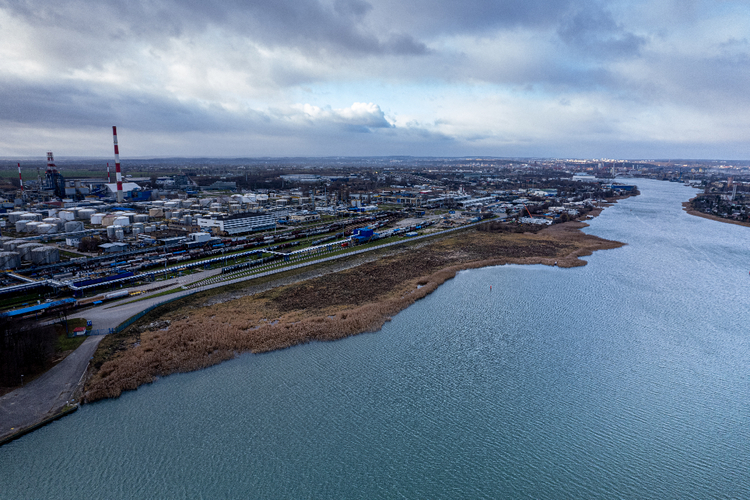
The ORLEN Group is investing over half a billion zlotys in the Gdańsk refinery to strengthen the security and reliability of product supplies. A terminal for handling marine vessels will be built at its quay, which will enable the transshipment of over a million tons of products, including base oils, marine fuels, and fuel bio-additives, starting in 2025. The investment will be carried out by a consortium of companies led by the Sopot-based NDI Group. Simultaneously, a modern HBO installation, known as the Hydrocracking Base Oil block, is being built in Gdańsk in connection with the terminal. The value of this project exceeds 1.4 billion zlotys.
Thanks to the HBO installation, which has been underway since 2021, the economics of crude oil processing will improve. Introducing state-of-the-art Group II base oils—a completely new category of products—to the Polish and foreign markets will significantly increase the company’s competitiveness. The installation is expected to produce over 400,000 tons of these oils annually, along with tens of thousands of tons of fuel semi-finished products.
– In line with our declarations, we are committed to the dynamic development of Gdańsk assets, leveraging their value to achieve the strategic goals of the entire ORLEN Group. We are allocating a total of 2 billion zlotys to investments that will increase the profitability of the refinery’s crude oil processing and strengthen the security of product supplies. By investing in our own infrastructure, we increase our independence from external partners, thereby generating significant savings in logistics. Importantly, we are utilizing the potential of local companies that will work on this project under our commission – says Daniel Obajtek, CEO of PKN ORLEN.
The target transshipment capacity of the marine terminal located on the Martwa Wisła river could reach up to 2 million tons of products per year in the coming years. The implementation of this investment will improve the profitability and security of supplies of biocomponents for fuel production (bio-gasoline and bio-diesel) and the transport of products (base oils and marine fuels) manufactured at the refinery. The terminal will also relieve the railway siding operating on the plant’s premises, as this is currently the route used for transporting products between the refinery and external transshipment points.
The project includes the construction of a transshipment quay for handling marine vessels up to 130 m long, with a draft of up to approx. 5.8 m and a width of up to 17.6 m. The planned works include the construction of the quay along with two transshipment stations for handling tankers (each with 4 loading arms) and the necessary infrastructure, i.e., buildings, pipelines, steel trestles, and underground and auxiliary infrastructure connecting the terminal to the refinery in Gdańsk. The project will be carried out by a consortium consisting of companies from the Sopot-based NDI Group (consortium leader), as well as Biproraf sp. z o.o., BPBM “PROJMORS” Sp. z o.o., and Dipl. Ing. SCHERZER GmbH. The general contractor will operate under a “turnkey” formula.
– We are facing another engineering challenge – a highly complex and technologically advanced project. We are carrying out the work at a critical point, which is the site of the Gdańsk refinery. This requires very precise work planning and execution while maintaining the highest safety standards. Our consortium consists of experienced and complementary entities for the project’s implementation, and as the leader, we will ensure that cooperation between all participants in the process runs smoothly and for the benefit of the project – says Małgorzata Winiarek-Gajewska, CEO of the NDI Group.
The terminal will enable the transshipment of components and biocomponents that are ingredients of biofuels (bio-diesel and bio-gasoline), such as: FAME, i.e., fatty acid methyl esters, obtained from vegetable oils and used as a diesel component; UCOME, i.e., second-generation biofuels produced from waste, such as used cooking oil; methyl tert-butyl ether (MTBE), an organic gasoline component that increases its octane number; as well as xylenes used in petrochemical processes and low-sulfur marine fuels (MGO and RMD).
The terminal will also play a key role in the dispatch of base oils from another, even larger project with which its schedule is closely linked – the Hydrocracking Base Oil (HBO) block being built in Gdańsk, the construction of which began at the end of 2021. Both investments are scheduled to be commissioned by mid-2025. The heart of the HBO project is the catalytic dewaxing and hydrorefining (DW/HDF) installation, which will consist of several sections: reactor, hydrogen compression and hydrogen gas circulation, light product separation, and liquid product distillation. The HBO installation at the Gdańsk refinery will enable the production of high-quality oils.
Both the HBO installation project and the marine transshipment terminal construction project were prepared by specialists from the LOTOS Group. Thanks to the excellent cooperation between the teams of both merging companies, they were seamlessly taken over and are currently being continued by PKN ORLEN. The budget for the marine terminal project is over 0.5 billion zlotys. Its final implementation – following the rise in prices of construction supplies and services after Russia’s invasion of Ukraine – will be possible thanks to the securing of the investment amount by a strong entity with great investment capabilities, which is PKN ORLEN.