











This year, not only will global GDP melt, but also the dynamics of trade in goods, which will shrink to a level of 1-2%. Consequently, sea, air, and road transport will slow down, as will contract logistics, freight forwarding services, and other markets. Rail will also slow down, especially long-distance intermodal transport.
After the outbreak of the war in Ukraine, it was to be expected that the accelerating global economy would slow down sharply. Since February 2022, it has had to face an energy, food, and inflation crisis, broken supply chains, and weakening production and demand. The grim picture of the slowdown intensified in the final months of last year, when the most important global institutions began publishing estimates regarding global GDP and trade dynamics.
According to the economic forecast of the Organisation for Economic Co-operation and Development (OECD) from November, global GDP growth in 2022 will reach 3.1%, in 2023 2.2%, and in 2024 2.7%.
In October, the International Monetary Fund (IMF) also published an updated calculation regarding global GDP growth. According to the IMF, the global economy will grow by 3.2% in 2022 and by 2.7% this year, with a 25% probability that the dynamics could even be below 2%. Trade in goods is also expected to slow down drastically, with its volume having grown by 10.8% in 2021. In 2022, it is expected to melt to 2.9%, and this year to just 2%.
In terms of value expressed in dollars, global trade in goods in 2023 will experience a recession of -0.4%. Volume growth of exports of goods in developed economies is expected to fall from 9.7% in 2021 to 2.4% in 2022 and further down to 1.7% in 2023. Developing economies and emerging markets will see slight increases from 1.4% in 2022 to 2.4% in 2023, but this is still a massive slowdown from 11% in 2021.
Growth indicators for global imports of goods look equally grim, which will dive from 10.8% in 2021 in developed economies to 1.5% in 2023, recording 5.3% in 2022. Imports of goods in developing economies and emerging markets are expected to increase by 1.4% in 2022 and by 2.9% this year. However, it is difficult to be optimistic when looking at the 2021 data and the 12.1% growth.
The OECD also has no good news about the state of global trade. Data published at the end of November shows that the value of trade in goods of G20 countries in Q3 2022 fell for the first time in two years. Exports shrank by 1.26%, while imports by 1.09%. European Union exports fell by 1.5%, while imports by 0.7%.
The sad picture of global trade in goods is completed by a recent forecast from the World Trade Organization (WTO). According to the WTO, global trade in goods will grow by 3.5% in 2022. This is a slightly better result than the April forecast (3%), but in 2023, growth will be only 1%, which is a significant correction compared to the earlier estimate of 3.4%. This year, exports from North America will grow by only 1.4%, from Asia by 1.1%, and from Europe by 0.8%. Forecasts for imports were estimated at 0.8% for North America, 2.2% for Asia, while Europe will reach a negative value of -0.7%.
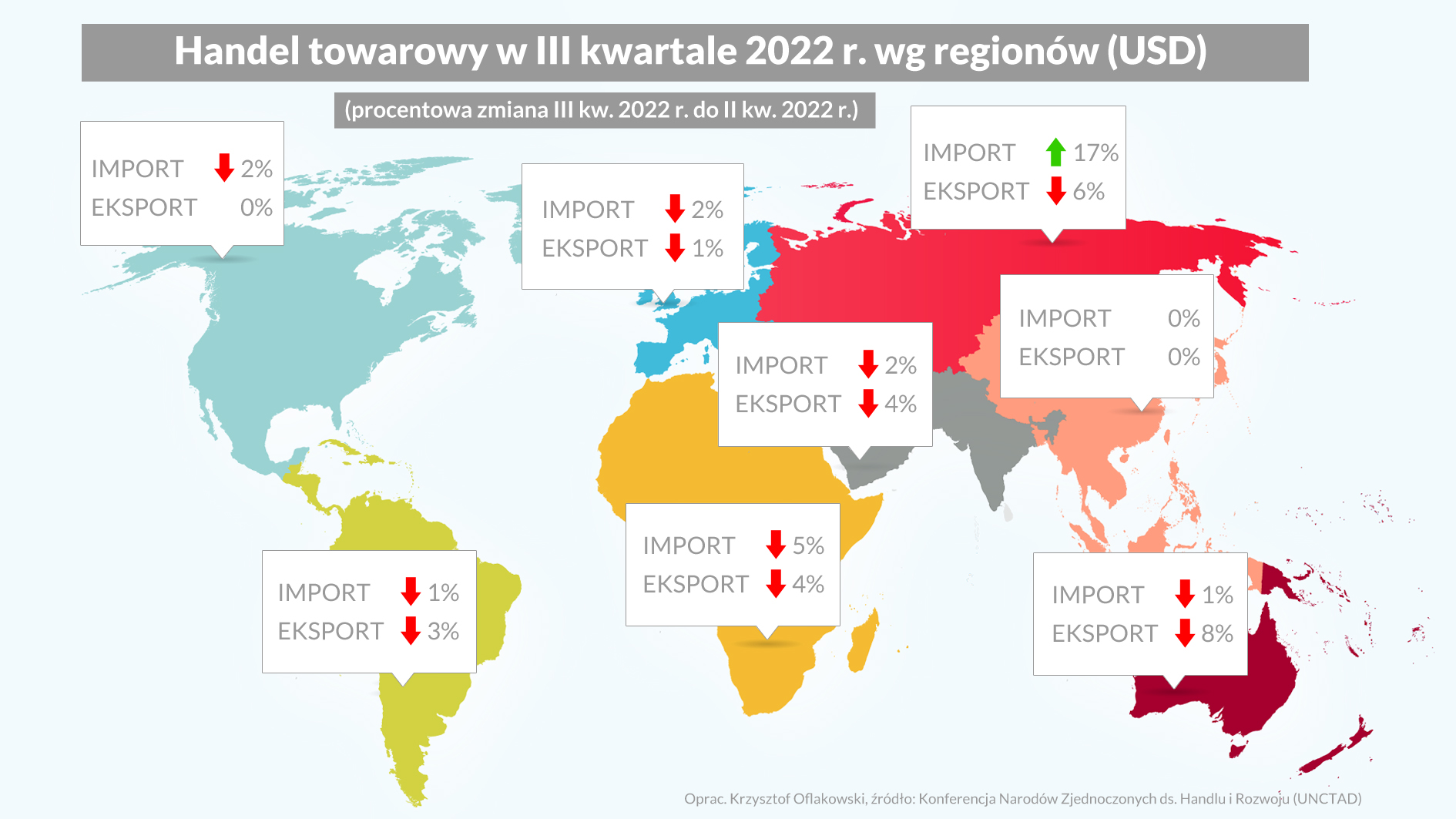
The United Nations Conference on Trade and Development (UNCTAD) also warns of a slowdown, and although global trade in goods for 2022 is expected to reach almost 25 trillion dollars, which is about a 10% jump year-on-year, this is mainly due to strong growth in the first half of the year. In Q3 2022, the value of global trade in goods decreased by about 1% compared to Q2 2022, and further declines are announced for the last months of the year. Data presented in December show that despite even double-digit quarterly year-on-year growth, positive trade trends quarter-on-quarter have decreased for most regions of the world. The exception is East Asia, which maintained its turnover level, as well as North America, where exports were maintained, and Russia, which increased imports.
Declines in trade will be felt by all types of transport
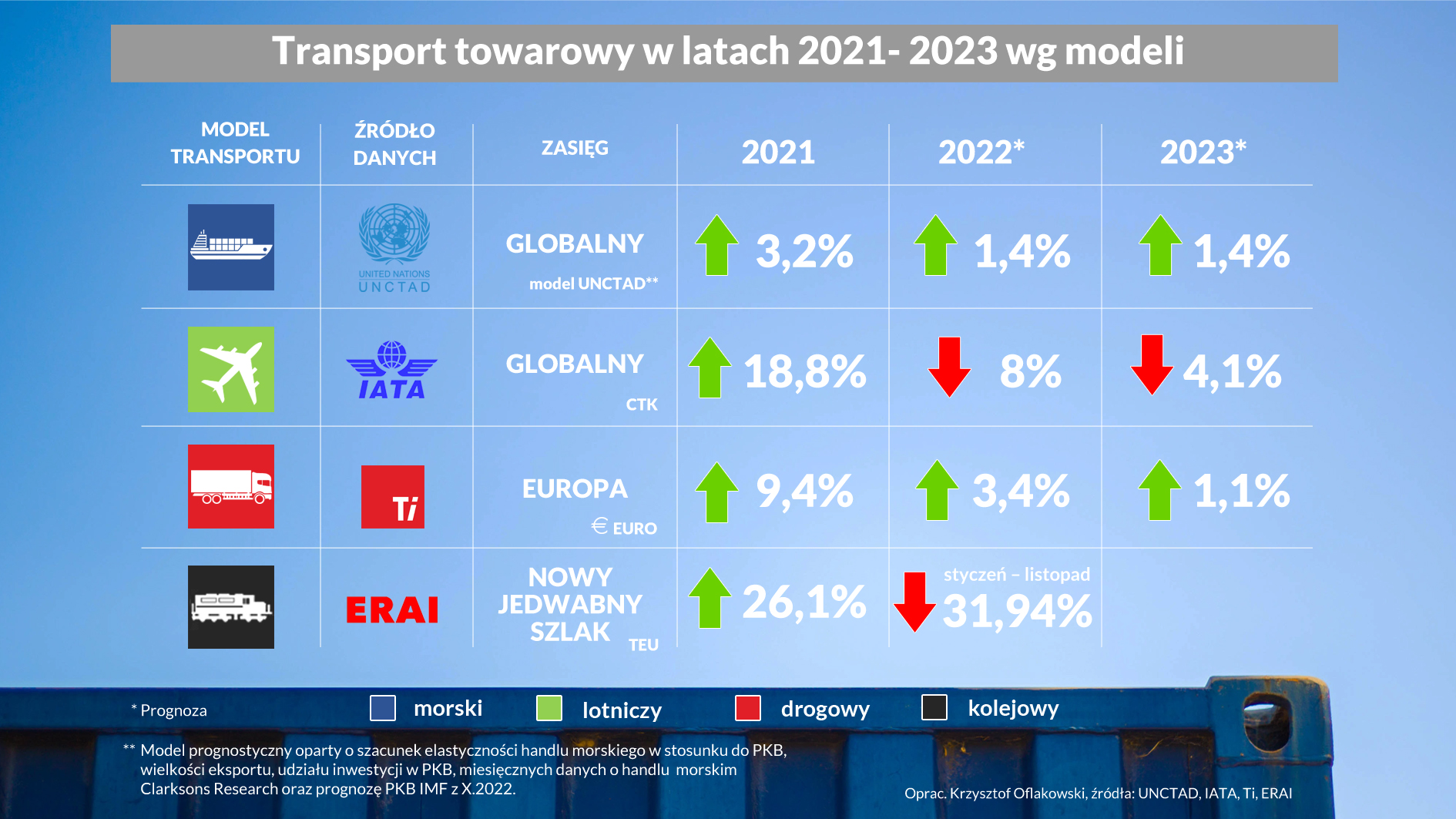
In its latest Review of Maritime Transport, UNCTAD estimates that the growth dynamics of international maritime trade will lose momentum and fall from 3.2% in 2021 to 1.4% in 2022, maintaining the same value this year. Between 2023 and 2027, maritime trade will grow at an average annual rate of 2.1%, which is well below the historical average of 3.3%. According to the organization, the prospects for maritime container transport look slightly better, which is expected to grow by 1.2% in 2022, which is an optimistic estimate in the face of the current economic situation. In 2023, container transport is expected to grow by 1.9%, and in subsequent years by 3%, 3.1%, 2.9%, and 3.8% in 2027, respectively.
Clarksons Research forecasts point to lower growth values in maritime transport. The entire maritime trade sector will grow by 0.9% in 2022 and by 2.2% in 2023. Container transport will end last year in the red (-0.1%), and this year it is expected to reach growth of 2.4%.
The slowdown in ocean freight, caused by reduced global demand, has been visible for a long time in falling transport prices. The Drewry composite index, reporting on spot rates on major shipping routes, was 77% lower in mid-December than in the same week in December 2021. This is the 42nd consecutive week of declines in rates for a 40-foot container (FEU).
IATA also predicts declines in air cargo
The International Air Transport Association (IATA) announced in mid-December that total airline revenues will reach 727 billion dollars in 2022, i.e., about 87% of those in 2019, with cargo transport accounting for about 28% of revenues. For 2023, IATA predicts an increase in total revenues to 779 billion dollars, which will represent about 93% of the 2019 result. Goods transport is expected to generate 149.9 billion dollars in revenue, but this will be a decrease of almost 25.6% from last year’s 201.4 billion. The share of cargo in total revenues will also fall to 19%. Air cargo traffic (CTK – cargo tonne-kilometers) will also decrease by 4.1% in 2023, and an 8% decline is also forecast for 2022. The tonnage of goods transported on board aircraft will also decrease from 60.3 million to 57.7 million in 2022. As in the case of maritime transport, general declines and weaker demand for air freight will result in lower rates.
Road transport – key for Polish companies
Reduced demand for goods and melting volumes in maritime transport will entail declines in land transport, especially road transport. This is particularly important for Polish companies, because vehicles registered in our country perform the most transport work of all European Union countries. According to Eurostat, in 2021 it was 379.8 billion tkm (tonne-kilometers). Behind us were Germany with 296.1 billion tkm and Spain with 270.2 billion tkm. The transport work performed in road transport across the entire Union amounted to 1.9 trillion tkm, so Poland accounted for nearly 20%.
Forecasts from the analytical center Transport Intelligence (Ti) predict that the slowdown in the European road transport sector, which was already noticeable in the second half of last year, will extend into this year. This will result in real market growth of only 1.1% and a value of about 389.3 billion euros. Domestic transport is expected to grow at a rate of 0.7%, which is much slower than international transport services, which will grow by 2.1%. The clearly better condition of international transport is expected to be due to the handling of e-commerce orders and the retail market. A comparison of forecasts for the past and current year clearly shows that the transport industry on the Old Continent will hit the brakes. Domestic transport will fall from a growth trend of 3.3% to the mentioned 0.7%, while the international market will weaken from 3.6% to 2.1%. Ti’s predictions for 2022 speak of a 3.4% growth of the entire sector. For comparison, in 2021, European road transport grew by 9.4%.
A number of interconnected factors are expected to be responsible for the declines to 1.1% in 2023, with the war in Ukraine, high inflation, the energy crisis, and the vision of a global recession at the forefront. This will lead to a weakening of Europeans’ purchasing power and, consequently, to a reduction in demand for transport services. These are the same factors that will cause declines in other transport models.
The final scale of the slowdown will be determined by the growth rate of European GDP, which is not the best news in the face of the expected recession in Germany (-0.6% according to the European Commission). Currently, even 16% of local entrepreneurs declare that they have had to reduce production or partially give it up due to high energy prices.
If the situation in road transport this year is to depend on the condition of the EU economy, it is worth emphasizing that it was already growing very slowly last year. According to Eurostat, in Q3 2022 it grew by only 0.4%. In turn, the European Commission in its autumn forecast assumed GDP growth in 2022 for the entire Union at 3.3%, and in the eurozone at 3.2%. The year 2023 is a large drop to 0.3% both in the eurozone and outside it. A rebound is expected in subsequent years, and in 2024 economic growth is expected to reach 1.6%.
– The weakening condition of the EU economy is never good news for Polish companies operating in the area of international trade, not only those from the logistics sector. Entrepreneurs should carefully monitor the development of events, especially since EU countries account for the majority of Polish trade in goods. Data from the Central Statistical Office (GUS) from mid-December show that in the period January – October, we sent almost 76% of Polish exports of goods to Community countries. As for imports, it was 51% of goods. Due to the proximity of this market, trade takes place largely using road transport, so the weakening economic situation in the Union may be worrying for Polish companies. However, the situation is not as dramatic as it might seem. Road transport, although it feels the slowdown, is still recording upward trends. In November, it achieved a 0.5% increase compared to November 2021. Also, in the period January-November, the growth of road transport in Poland was 0.9% higher than in the same period a year earlier. It can also be seen that the adaptation of the transport and warehousing sector in Poland to the situation beyond our eastern border is growing. In December, as many as 75% of companies believed that the impact of the war in Ukraine on their operations would be small or unfelt. A month earlier, 70% of companies thought so – says Marcin Bąk, President of the Management Board of Spedimex, a Polish logistics operator serving retail chains, shopping malls, e-commerce, as well as less-than-truckload (LTL) and full-truckload (FTL) transport in Poland and Europe.
– Thanks to the shopping peak in the last quarter, we had a good closing of the year, and according to our clients, not everyone expects drastic declines. Online sales are still maintained at a good level, and data published before the end of the year indicate that in November, the share of e-commerce in total retail sales of goods in Poland increased to 11.9%. So far, this is the best result in the past year and 0.8% higher than in January 2022, when this percentage was 11.1%. Taking into account that December is usually a good period for online trade, this result may be even better in the last month of 2022. Our experience shows that in the perspective of the coming year, it will still be possible to count on several sectors that will guarantee growth. In addition to e-commerce, this will also be the pharmaceutical segment and, which seems less obvious, the luxury goods market, which is achieving good results. Although there is uncertainty in many markets, both among operators and clients, ultimately the blackest scenario may turn out to be far from reality. Instead, one should think about solutions, even to structural problems in companies, which may slow down the dynamics of transport in the coming months and years or limit the development of the transport sector in Poland and on the Continent. We are talking in particular about the digitalization of the industry and the constant shortage of drivers. Alleviating this last issue in particular will bring a strategic advantage to Polish carriers in the long term and will allow them to strengthen their dominant position on the European market – adds Marcin Bąk.
Staffing problems will deepen the coming declines
The lack of drivers may lead to a reduction in available cargo space in the coming years, and the transport exchange Timocom draws attention to this problem. Its data show, among other things, that in 2022 the offered space in Europe stopped at the 2021 level, and in Germany, 24% less transport capacity was reported for the first 10 months of last year than a year earlier. The general trend in Europe is expected to maintain a downward course.
In the long term, the shortage of drivers will slow down the regeneration and development of the sector, and the staffing problem will deepen. In Poland, Spain, Romania, Denmark, Germany, and France, the demand for drivers in the period January – September 2022 increased by 44%. At least 6,000 new vacancies were opened each quarter, and a scenario in which the demand for drivers will grow at a rate of 10% per year for the next 5 years is highly probable.
According to the International Road Transport Union (IRU), as many as 425,000 vacancies for truck drivers in Europe (10% of all positions) remained unfilled in 2021. By the end of 2022, this is expected to be 14% of positions. The issue of shortages is further complicated by the fact that 30% of current drivers will retire by 2026, and the gap between them and the generation entering the labor market is expected to triple, resulting in an increase in the vacancy rate to as much as 60% by 2026. In a pessimistic scenario, by that time, Europe could be short of as many as 2 million professional drivers.
The entire TSL industry will hit the brakes
It may be comforting for European logisticians that a clear slowdown is expected not only on the Old Continent but also on a global scale, within the entire TSL market – regardless of the type of transport and business model.
For example, the global contract logistics sector in 2023 will slow down to 3.1% year-on-year, reaching a value of over 253.7 billion euros. Markets in North America and Europe will develop below average, growing next year by 2% and 0.6%, respectively. Maintaining a positive growth trend in the global market will be due to the Asia-Pacific region, which will grow by 5.7%, thus approaching 105.6 billion euros. Markets in Europe and North America will grow to just under 74.1 billion and 59.2 billion euros. In the medium term, contract logistics is expected to develop at an average annual rate of 3.7% in 2021-2026 and reach a value of over 286 billion euros at the end of the forecast.
Another example of a slowdown will be the global freight forwarding services market, which is expected to grow nominally by 27.6% in 2022, but in real terms, it will be a decrease of 2.4% compared to the previous year. Air transport will shrink in real terms by 2.7%, while maritime by 2.2%. Real growth of the entire market in 2023 is estimated at 0.7% to a value of over 265 billion euros. Air transport will grow by 0.8%, while maritime by 0.7%. The driving force will again be the Asia-Pacific area, where the market will grow by 1.3% (1.3% each for maritime and air transport). The European market will grow by 0.5% (air 0.6%, maritime 0.5%), and in North America by 0.1% (air 0.1%, maritime 0%).
The share of major players in the global market in 2023 will look as follows: Asia-Pacific 34.4% (91.3 billion euros), Europe 32.2% (85.3 billion euros), North America 22.3% (59.1 billion euros).
Rail will also shift to a slower gear
Due to limited demand and production, as well as a decrease in trade flows at sea, in the air, and on the roads, the slowdown will also reach the tracks, especially on long-distance international routes and in intermodal transport. This is already clearly visible on the rail New Silk Road.
Data from the ERAI (Eurasian Rail Alliance Index) index, powered by JSC UTLC ERA, a company handling about 80% of transport on the China-Europe-China route, show that container transport on this route fell by 31.94% in the period January – November compared to the same period a year earlier. During the eleven months of last year, 386,374 TEU (twenty-foot equivalent unit) were transported. Transport in tonnage terms also fell by 27.8% and at the end of November amounted to just under 2.33 million tons. Most commodity groups recorded declines, including machinery, electrical equipment, and parts (-32.25%), vehicles other than rail (-48.11%), furniture (-39.02%), toys (-50.84%), and clothing and accessories (-44.98%).
Domestic transport may look slightly better in the coming years, which is well shown by the example of the PKP Cargo Group. Despite declines in intermodal transport both in terms of mass (-7.6% to 6.8 million t) and transport work performed (-13% to 2.96 billion tkm), the Group’s total revenues after three quarters of last year were 21% higher than in the same period a year earlier. Declines in intermodal transport caused by lower intensity of transport on the New Silk Road and limited capacity of routes from seaports, where priority was given to coal transport, were compensated by the transport of liquid and solid fuels as well as metals, ores, aggregates, and building materials.