











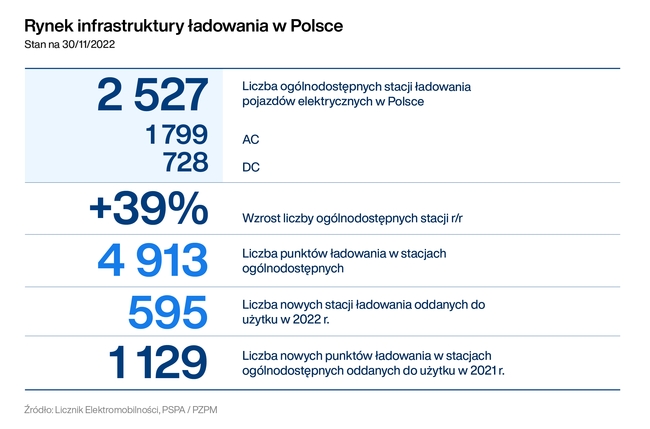
Over 600 new charging stations were installed in Poland in 2022. This is a better result than in previous years, but still insufficient to meet the ambitious targets set by the EU AFIR regulation. Within just the next three years, the total power of the Polish charging network should increase at least 5-fold. Without the introduction of urgent legal changes, this will not be possible.
From January to November 2022, 595 new publicly accessible charging stations were installed – this is the largest increase in charging infrastructure in the history of Polish electromobility. The Polish network of publicly accessible charging points is currently about 30% larger than at the end of 2021 and almost twice as large as at the end of 2020. Similar to the vehicle segment, Polish electromobility in the infrastructure sector is also concentrated primarily in the largest Polish cities. In the TOP 15 urban centers in terms of charging network development (i.e., Warsaw, Gdańsk, Katowice, Kraków, Szczecin, Poznań, Olsztyn, Wrocław, Toruń, Sosnowiec, Łódź, Częstochowa, Gdynia, Włocławek, and Płock), 44% (1,117) of all publicly accessible EV charging stations in Poland are located.
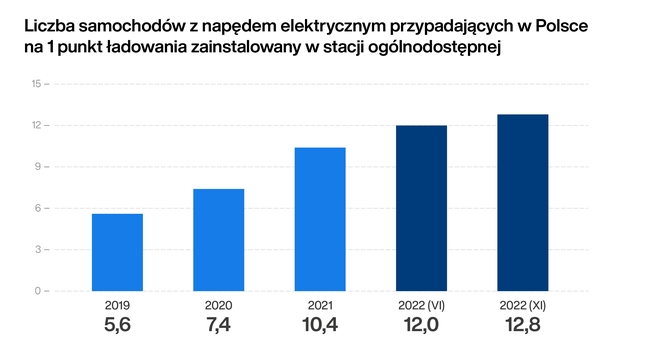
Unfortunately, this infrastructure is still developing too slowly in Poland. Despite new investments, increasing demand for charging services driven by the growth of the electric vehicle fleet, the growing involvement of large international operators in the Polish market, and the introduction of a subsidy system from NFOŚiGW funds, there is no decisive acceleration in the pace of DC charging station expansion in Poland. Based on the latest edition of the PSPA report “Polish EV Outlook 2022,” at the end of 2019, the number of electric vehicles per one charging point was 5.6. In 2020, this ratio increased to 7.4, in 2021 to 10.4, and in mid-2022 to 12. In November, it was already 12.8. This creates a risk that in the coming months, queues may start to form in front of chargers, especially in locations with particularly high traffic. In the long term, this could lead to a decrease in demand in the electromobility market.
– Currently, there are more than twice as many electric vehicles per charging point in Poland than there were three years ago. There is no indication that this trend will reverse anytime soon. Taking into account data from the International Energy Agency (IEA), Poland currently has a similar number of charging points (4,913) as the UK in 2013, Germany in 2015, Spain in 2017, or Sweden in 2019. However, in the latter country, at the end of 2021, there were already almost 14,000 points – almost 3 times more than we have now, even though it is a country with a passenger car fleet over 5 times smaller. Accelerating infrastructure expansion in Poland requires decisive action from public administration. The industry is unable to overcome numerous systemic barriers on its own. Legal changes are necessary – says Jan Wiśniewski, Director of the PSPA Research and Analysis Center.
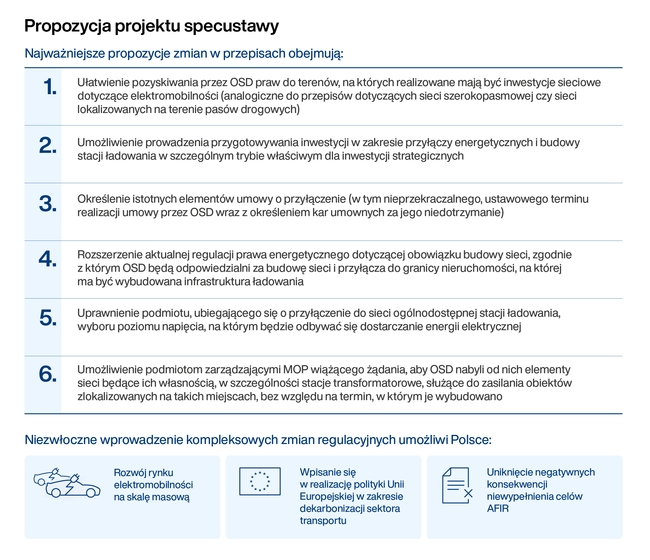
Addressing the challenges of the charging infrastructure sector, PSPA, together with key industry partners (including major operators), developed a draft special act in 2022 containing proposals for regulatory solutions to remove the biggest barriers delaying the expansion of the publicly accessible charging station network in Poland. The assumptions of the draft include a significant reduction in the time required to build connections for publicly accessible charging stations to the DSO network, which should not exceed 12 months, regardless of the voltage level, as well as the implementation of mechanisms to facilitate and stimulate DSOs to invest in the expansion of distribution networks to prepare them for connecting mass-scale charging infrastructure in the future. This applies particularly to areas where the distribution network is poorly developed. Furthermore, the industry wants precisely defined standards for the construction of connections by DSOs (e.g., regarding the location of the connection point or the possibility of choosing the voltage level, regardless of the charging station power) to facilitate the expansion of charging infrastructure and to organize the ownership structure of energy infrastructure located at Travel Service Areas (MOPs).
 Commissioned by the Ministry of Climate and Environment, the PSPA Association has also developed a Project for the optimal distribution of charging infrastructure along the TEN-T core network roads. 188 priority locations for the installation of charging stations, both for light and heavy-duty vehicles, have been identified. Recommendations in this regard take into account the requirements of the draft Regulation of the European Parliament and of the Council on the deployment of alternative fuels infrastructure and repealing Directive 2014/94/EU (AFIR), as well as the state of distribution networks in Poland.
The expansion of publicly accessible charging stations in Poland can also be accelerated by public subsidies. On March 31, 2022, the calls for proposals under the “Support for electric vehicle charging infrastructure and hydrogen refueling infrastructure” program launched by NFOŚiGW were concluded. The program provided grants for private charging stations with a power of at least 22 kW (up to 25% of eligible costs), publicly accessible stations with power from 50 kW to less than 150 kW (up to 30% or up to 45% of eligible costs in the case of smaller municipalities), publicly accessible stations with power from 150 kW (up to 50% of eligible costs), as well as hydrogen refueling stations (up to 50% of eligible costs). The subsidies enjoyed significant popularity among potential beneficiaries. The budget for the call covering ultra-fast stations (with a power of at least 150 kW) was fully reserved in just two weeks. Infrastructure sector stakeholders can still count on subsidies – in January 2023, further calls under the NFOŚiGW program will start.
– We are very pleased that infrastructure funding will be resumed – this is an important impulse for its expansion at the current, early stage of the electromobility market development. Very importantly, in 2023, a budget almost twice as high has been reserved for grants for the fastest stations than for subsidies covering other categories of chargers. However, subsidies will play a subsidiary role to the necessary legal changes. There is less and less time to introduce them. Based on the targets set by the draft AFIR, the total power of charging stations installed in Poland should increase almost 5-fold within three years. And if the much more ambitious proposal of the European Parliament is accepted, the growth will have to be 13-fold. Without the necessary optimization of the law, Poland has no chance of meeting these goals – concludes Maciej Mazur, Managing Director of PSPA.