








PKP Energetyka is implementing an innovative project to prevent traction icing using an automatic weather station. Key components of the installation, which will help reduce winter network failures and train delays, will be supplied by ABB.
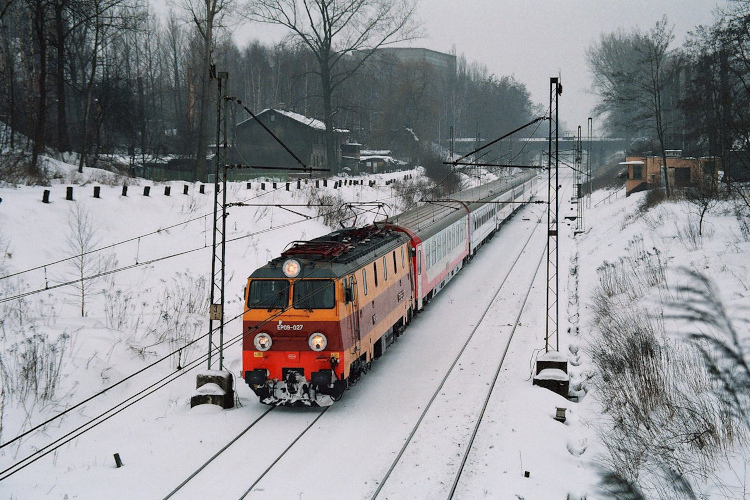
The climate we have means that in winter, not only trains can fail, but also railway infrastructure. Frost is often the main culprit behind traction network failures – specifically rime and ice, which cause a loss of contact between the pantograph installed on the train and the traction. In such a situation, the train stops drawing electricity and comes to a halt.
This happens especially on winter mornings, when the first trains head out onto the tracks after a few hours of schedule downtime. In such situations, the traction is de-iced mechanically using maintenance trains equipped with special devices. It is hard work for many people in adverse conditions.
– We want traction de-icing to be carried out remotely and automatically, supported by a system that will predict the potential for rime and ice accumulation. The prototype solution is based on controlling the current magnitude to raise the temperature on the traction wires without unnecessary energy losses – says Marta Wyżykowska, Senior R&D Specialist at PKP Energetyka.
Importantly, the current intended to prevent icing will be “closed” in a so-called de-icing loop. Simply put, a small amount of electrical energy will be sent to the wires at risk of icing – based on precisely measured meteorological parameters – which will heat the contact wire to a temperature that prevents rime from settling. This is a “preventive maintenance” solution – addressing problems before they occur.
The prototype is being built in the Opole Voivodeship, at the PT Kostów traction substation. The heart of the installation will be an ABB Enviline controlled converter.
– Its primary function is, of course, to convert alternating current from the power grid into 3kV direct current used by the traction network, but in this case, the converter also has an additional task, which is to properly “adjust” this current to the current state of the traction wire. The de-icing process must be constantly monitored in terms of current and voltage parameters, especially since it will take place at a time when there is no energy receiver in the loop, such as a train – says Maciej Kordas from ABB Electrification business in Poland.
The unusual device – using thyristor technology for a 3kV DC network – will be manufactured at the ABB factory in Bielsko-Biała. Additionally, the converter will be equipped with a control system based on an AC800 controller. This is an open platform providing high computing power, which is important from the point of view of integration with other local systems.
The converter unit is intended to work with an automatic weather station. As Marta Wyżykowska from PKP Energetyka emphasizes, this is an important predictive element. Reacting with sufficient advance notice will increase the effectiveness of the solution and minimize the risk of train traffic stoppages.
Such an extensive anti-icing system using an automatic weather station and a 3kV DC controlled converter is an innovation even on a European scale. A somewhat similar solution was once chosen by, among others, the Italians, but the Polish version of anti-icing will be characterized by greater effectiveness and energy efficiency.
The PKP Energetyka project is co-financed by the National Centre for Research and Development and the European Regional Development Fund.