











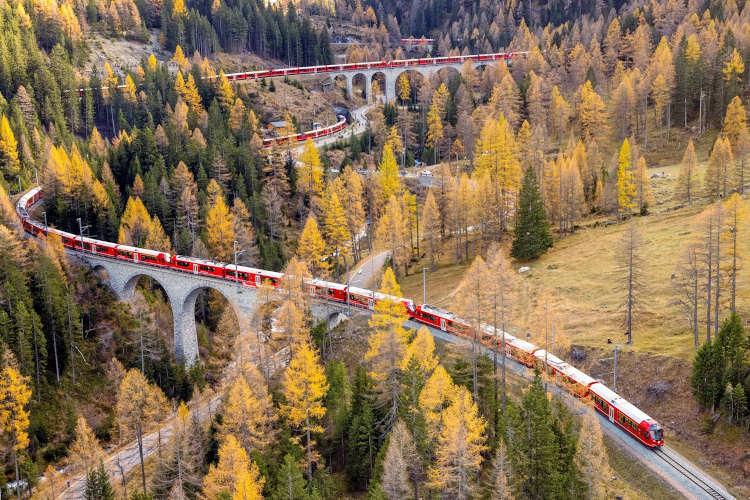
The Swiss Rhaetian Railway (RhB) has operated the world’s longest passenger train along an Alpine route, setting a new railway record.
In Poland, passenger trains running on popular routes, such as from Katowice to Gdynia or from Warsaw to Łódź, can have up to 12 carriages. There are cases, like the IC Chopin from Warsaw to Vienna at one time, which counted 16 carriages on a certain section of its route (i.e., a total of 430 meters in length!), but such consists are a rarity. Now, let us imagine a train 1.9 km long, which has exactly 100 carriages and a total of 4,550 seats inside…
It was precisely such a consist that traveled a 24-kilometer – and quite spectacular – route in the Swiss Alps, overcoming an elevation gain of 790 meters in 45 minutes. This is not so simple when we are talking about a route resembling a serpentine and a vehicle weighing almost 3,000 tons. It required seven engines on board to achieve this. Ultimately, they managed to reach the destination, set a new record, and show a new face of sustainable transport.
The Rhaetian Railway has existed since the 19th century and has a very long tradition of innovation aimed at increasing efficiency and reducing negative environmental impact. Suffice it to say that the ABB Bordline converters installed on the train are energy-efficient enough to allow RhB to save approximately 900 MWh per year. That is enough energy to power 200 Swiss households.
The Swiss achievement was also intended to show that while routes may not change that often (especially those inscribed on the UNESCO World Heritage list…), thanks to changing technology, the limits of the capabilities of rail vehicles and railways as such are constantly being pushed. And that means it is worth investing in rail.
The Swiss railway network totals 5,500 km and is fully electrified. It is, in fact, the only country in Europe that does not have to use diesel locomotives. It is also a continental leader when it comes to energy-efficient solutions for rail transport. For comparison, according to 2019 data, out of a total of 200,161 kilometers of tracks in all European countries, only 56 percent are electrified. In Poland, the share of electrified lines in all operated lines is 63 percent – more than three percent higher than in Germany, with the length of lines in Poland being 19,000 km, and in Germany over 30,000 km.
A statistical electric train emits 20-35 percent less carbon dioxide than a train powered by diesel engines. Fortunately, the electrification of European railways is progressing. A good example is Lithuania, where less than 10 percent of lines are “plugged into the grid.” Recently, ABB announced that it would carry out an electrification project for a 730-kilometer section between Vilnius and the port of Klaipėda. Thanks to this section alone, the percentage of lines powered by electricity in Lithuania will increase to 39 percent. We are talking about a route that will be used by 3/4 of all freight trains and 2/3 of all passenger trains in that country. And the modernization of the route is also an opportunity to use trackside energy storage systems, which can use energy from braking and send it back to the grid. This train showed that it is worth electrifying lines, modernizing rolling stock, and continuing to invest in a tradition that is over 100 years old.