











Returning to offices after the pandemic proved difficult – both for employers and employees. Companies tried to encourage, and sometimes even force, teams to return to the office – often unsuccessfully, because the possibility of remote work was a benefit for many people that they did not want to give up. At the same time, the lack of meetings in the office did not foster relationships, communication, or creativity. To increase work comfort, Rohlig Suus Logistics decided to create a workplace to which employees would want to return, even when they had the alternative of remote work. The company conducted the largest opinion survey in its history at that time, and then, based on the conclusions from the survey, implemented a completely new office standard as part of the Office of the Future project.
For the logistics industry, the pandemic period proved to be a unique challenge. The need to ensure supply chain continuity despite closed borders, quarantine measures sometimes imposed on entire areas, and very dynamic rate changes were compounded by remote work that was challenging not only technologically. Once it became clear that the way of working had changed forever, Rohlig Suus Logistics, together with Kinnarps, began work on redefining employee needs and adapting their offices to a hybrid model. As part of the preparations for the changes, dozens of webinars, surveys, and individual interviews were conducted, and based on their results, the layout and organization of the office were completely changed. This strategic project was carried out with the personal involvement of the company’s management board. To date, revolutionary changes in layout, equipment, and, above all, the way of working in the office have already covered the headquarters in Warsaw, port offices in Gdynia and Szczecin, the branch in Łódź, as well as the branches in Bydgoszcz and Poznań opened after relocation.
The post-pandemic challenge of remote and hybrid work
The new office project was intended to support a corporate culture focused on dialogue, quick decision-making, creativity, and collaboration – in line with one of the company’s values, “one step ahead.” The inspiration was the new standard of office spaces in the IT, consulting, and financial industries, but the key was identifying employee needs and what effective and comfortable office work means to them. As part of the preparations for developing a new work culture, webinars were organized with all users of the space that was to be affected by the changes, and anonymous surveys and individual interviews were conducted, including with key managers and the board. Over 100 people took an active part in them, pointing out the advantages of working from home and from the office, expectations regarding the future of work, and needs that the new work model should satisfy. The work styles of employees, types of tasks and the level of focus necessary for their implementation, the pros and cons of the current space, types of internal meetings and those with external guests, needs regarding technological tools, and office habits were analyzed. As the survey participants pointed out, the existing, typical office space supported a traditional work style, hierarchy, and created barriers between people – which was absolutely contrary to how they perceived the corporate culture themselves. At the same time, many employees complained about communication difficulties, the lack of opportunities to build relationships, and the inability to spend time freely with colleagues, which were the result of working exclusively remotely. The new work model and changed layout were intended to support project work, flexibility, and digitalization of the workplace, personalization of space, and improvement of work comfort. 70% of employees clearly opted for hybrid work and returning to the office for at least 2-3 days a week.
– Although remote work has many advantages, it often caused the blurring of boundaries between private and professional life, frustration related to difficult communication, and on a company scale – more difficult implementation of projects requiring a non-standard approach and close cooperation of various teams. Interpersonal relationships also suffered, and these have always been a very high value in our company. At the same time, the forced return to offices that several large companies tried to implement caused employee resistance. Our approach was completely different – we wanted to create a comfortable space where everyone would find a place for themselves, corresponding to their work model at a given moment. We wanted to attract people to it so that after a difficult period of working only from home, they could combine the best of remote and stationary work in a hybrid formula. That is why in-depth employee opinion surveys and involving them in co-creating this new space were so important – comments Jacek Głowacz, HR Director at Rohlig Suus Logistics.
Space for comfort and health
The new space is associated with a cozy, home-like, and modern interior – warm, friendly colors dominate, the entire office is filled with air-purifying plants and unusual decor elements – original furniture, paintings, sculptures, or… Lego bricks. Thanks to many light points and zone switches, employees can independently adjust the brightness of the rooms to their needs. For stress relief, employees can use foosball, a pool table, or chess.
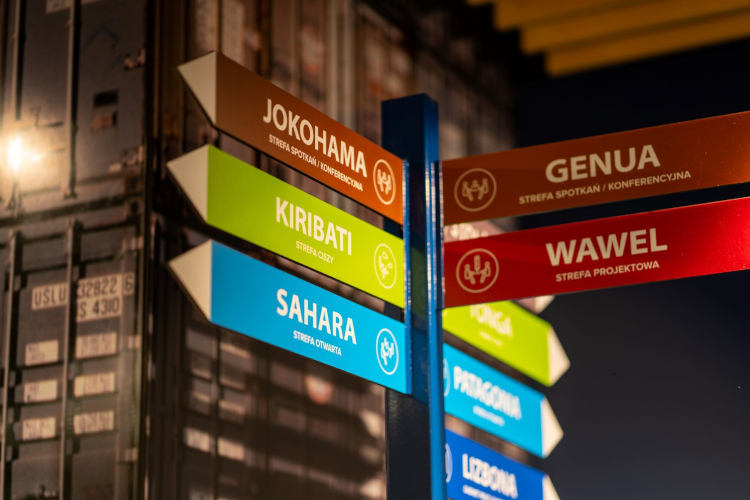
Employees pointed to the need to adapt the office to different work styles and tasks – meetings, brainstorming, independent focused work, or smaller offices for work and meetings in small groups. Therefore, the new office includes project rooms, informal meeting rooms, large conference rooms with a movable wall system, acoustic booths for online meetings and phone calls, independent work offices, and shared workspaces. Individual zones and rooms are named after geographical regions and the most beautiful places in the world, and their signage and visual information system were developed with design specialists. Some desks have height adjustment, and various seating furniture is also available to employees, promoting correct posture and spinal health.
– Before the changes, employees often pointed out that our space did not correspond to the corporate culture. Therefore, while working on the project, we looked for solutions that would support cooperation, communication, and creativity, but also make working in the office more pleasant. One of the main goals of our business strategy is to be the number 1 employer in the industry, so we decided to treat the change project as an investment in achieving this goal. We assumed from the start that the changes would – in stages, of course – take place throughout the organization. They will cover the entire company, including, of course, regional branches. The standard of regional offices will not differ from the Warsaw headquarters. In many of them, we have already implemented the changes. We believe that the needs of employees can and should determine the directions of the company’s development – comments Agnieszka Małecka, Administration Director.
Because employees complained in surveys about the weakening of relationships during remote work, common spaces play a key role in the new office – properly soundproofed relaxation areas, places for informal conversations, or kitchens arranged in a cafe style and places for meetings over coffee, tea, health-promoting herbal infusions, or pressed juices.
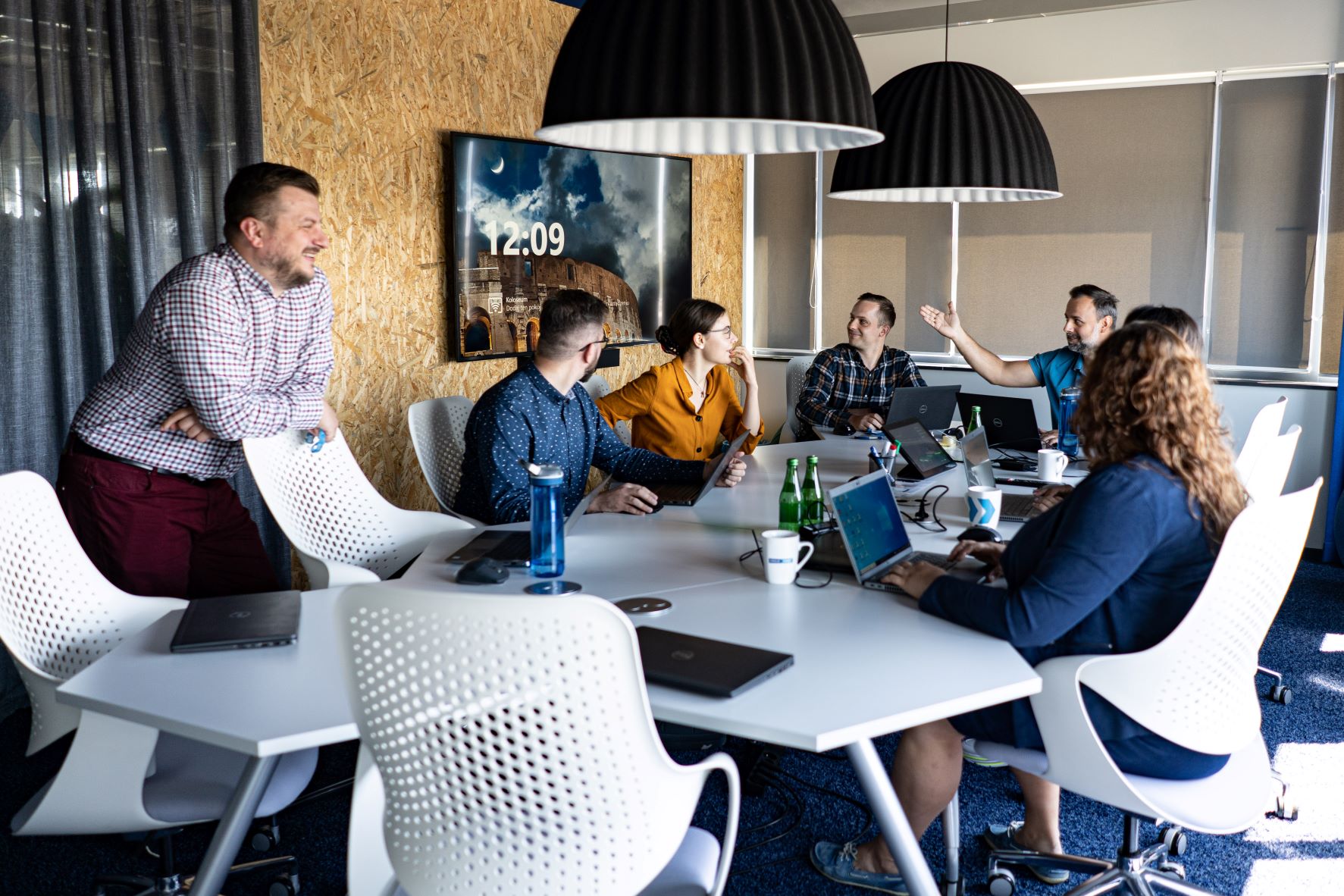
One of the most important challenges indicated by employees was improving acoustics. The buzz and noise in the open space is one of the factors that hinders concentration and increases fatigue. Therefore, in addition to installing acoustic booths, curtains and acoustic lamps were also taken care of, improving work comfort.
Digital first
The change in the layout and equipment of the office was also associated with a large technological investment. The company has fully switched to systems and equipment enabling remote work. All workstations have been designed to support mobility and work flexibility. Desks have docking stations and a varying number of monitors and chargers, depending on needs. As part of hot-desking, you can book any desk – using an application available on laptops and phones or by scanning a QR code. The internal application also allows you to book parking spaces or conference rooms and offices. Conference rooms have been adapted for online meetings, equipped with a standardized system with two 55/65-inch TVs, high-class Poly AV equipment, tablets for the MTR (Microsoft Teams Rooms) system, and interactive monitors for conducting online workshops.
In the next steps, Rohlig Suus Logistics will renovate office spaces in subsequent company branches and rooms for drivers, for whom new standards have also been defined, consistent with the finishing standard of the new offices.
Source: Rohlig Suus Logistics