








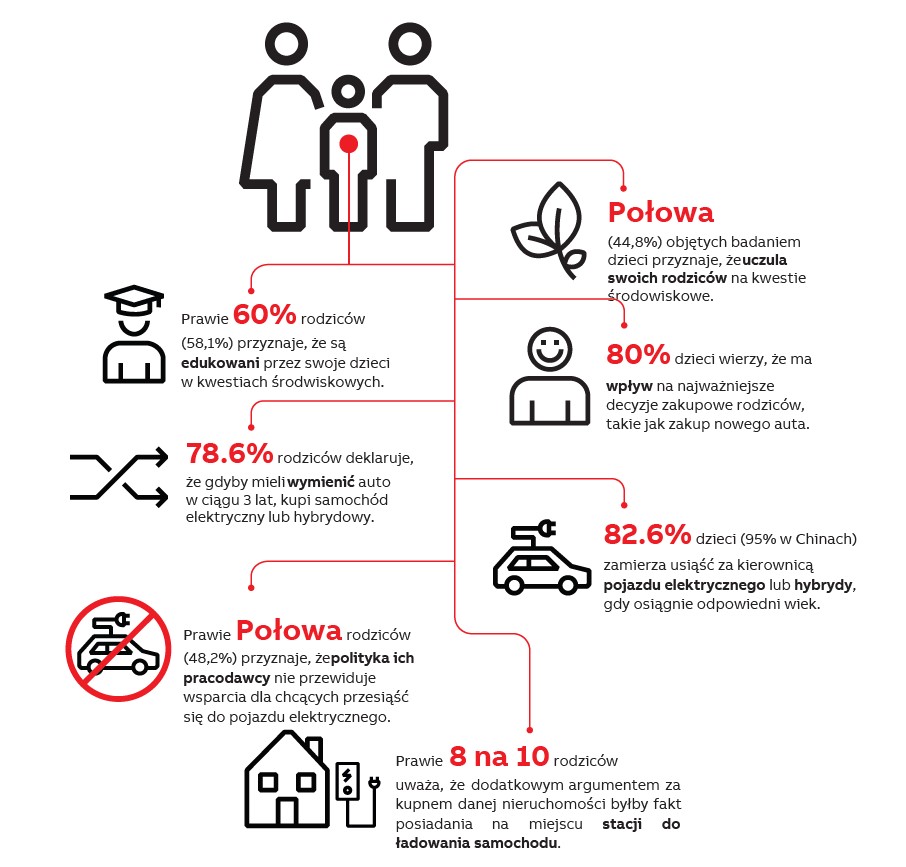
82 percent of children (95 percent in China) intend to get behind the wheel of an electric or hybrid vehicle as soon as they reach the appropriate age. Children are therefore at the helm of the e-mobility revolution, even though they cannot drive a car themselves yet.
According to a global study conducted by the ABB E-Mobility business, children are not only a source of knowledge for their parents regarding environmental protection, but they also participate in key purchasing decisions, such as buying a car. The study was conducted on a group of 2,500 parents and 2,500 children (aged 8-16) in countries that are the largest markets in the e-mobility industry: Canada, China, France, Germany, the Netherlands, Norway, Sweden, Switzerland, the UK, and the United States. The findings are optimistic and demonstrate a high level of awareness and the role that the youngest generation has – and will have – in reducing the negative impact of entire communities on the environment.
In the study, nearly 8 out of 10 parents (79 percent) and 3 out of 4 children (73 percent) are aware of the challenges related to environmental protection in the world. Parents and children are also in agreement in most cases regarding the causes and effects of climate change. At the same time, for both groups, environmental protection is an important factor integrating generations.
Almost half of the children have urged their parents to take better care of the environment. On the other hand, 58 percent of parents admitted that their children educate them in the area of ecology. 80 percent of children believe they have an influence on their parents’ most important purchasing decisions. It is therefore not surprising that almost the same percentage of parents declare that if they were to replace their car within the next 3 years, they would buy an electric (EV) or hybrid (PHEV) vehicle.
In the United States, the influence of children on the consumer behavior of adults is even greater – one-third of parents who are already owners of an electric vehicle admit that they switched from a combustion engine car as a result of pressure from their children.
– Our study shows that the youngest generation is very aware of environmental issues as such and the advantages of e-mobility in this context. I think that in this respect, Poles do not differ from the nations covered by the study. This is important because those who are currently teenagers will be making the decision themselves in a few years as to what their first car should be – says Krzysztof Marat, E-mobility Market Development Director at ABB in Poland.
Economic and ecological factors are the most important arguments for EV owners for over 60 percent of all respondents. In China, the percentage of parents who believe that owning an EV was a good decision for financial and environmental reasons is significantly higher (as much as 93 percent). It is worth noting that in the study, the Chinese – both adults and children – show greater awareness in many categories than other nations.
The study also reveals what additional benefits e-mobility brings, but also what still constitutes a challenge. Thus, nearly 8 out of 10 parents believe that an additional argument for buying a given property would be the fact that there is a car charging station on-site. At the same time, almost half of the parents admit that their employer’s policy does not provide support for those wanting to switch to an electric vehicle. According to the International Energy Agency (IEA), by 2030, e-cars will account for 30 percent of all cars sold globally, and the role of easily accessible charging infrastructure in workplaces and residential areas will become critical.
– Young people are focused on a zero-emission future. Analyzing the results of studies that basically confirm this is very encouraging – especially now, when many people still do not feel support for actions that reduce the negative impact on the environment – added Frank Muehlon, President of ABB E-Mobility’s global business.
ABB is publishing the study results on World EV Day. As part of its sustainability strategy, the company has declared that it will have a fleet of 10,000 electric vehicles by the end of this decade. Last year alone, the number of chargers installed at ABB locations increased by almost 100 percent – from 545 to 1,082 units (ABB operates in 146 locations in 27 countries). Additionally, in 2021, fully electric or hybrid (PHEV) vehicles accounted for 44 percent of all cars ordered for ABB’s own fleet.