








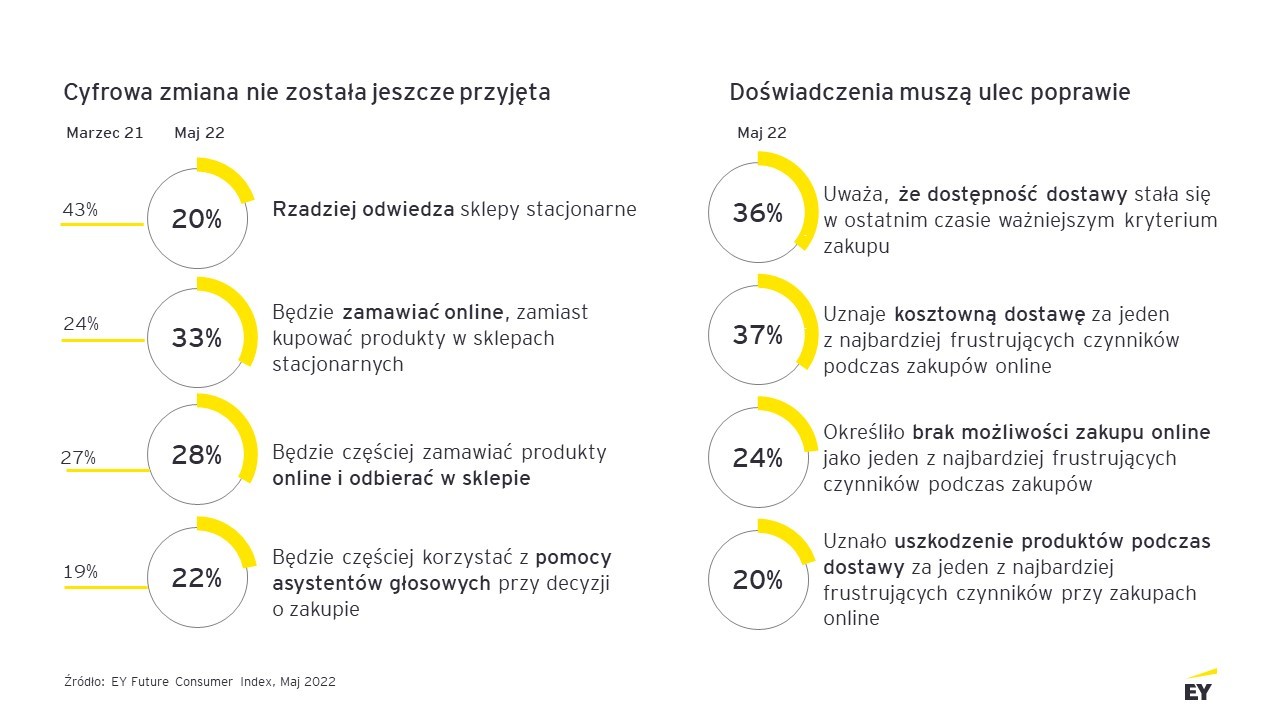
The results of the fifth Polish edition of the EY Future Consumer Index study indicate that as pandemic restrictions were lifted, Poles were more willing to return to brick-and-mortar stores. While in March 2021, 43% of respondents declared they visited them less frequently, by May 2022 this percentage had dropped to 20%. At the same time, the group of consumers choosing the e-commerce channel is growing. In May 2022, 33% of Poles declared they would order products online instead of buying them in physical stores. This is 9 percentage points higher (an increase from 24%) than in March 2021. Simultaneously, as many as 37% of respondents consider high delivery costs to be one of the most frustrating factors when shopping online, and 36% state they do not trust sellers operating exclusively in the digital world. However, price will remain the deciding factor, as 61% of respondents claim that rising costs mean they can no longer afford everything and must look for savings.
The pandemic contributed to the rapid development of the e-commerce segment and changes in consumer attitudes, but as the results of the EY Future Consumer Index study show, in many cases, this was an action resulting “from the need of the moment.” In May 2022, only 20% of respondents admitted to visiting physical stores less frequently, while in March 2021, this percentage was 43%. The difference resulting from the lifting of pandemic restrictions is therefore as much as 23 percentage points. However, a growing group of consumers is showing a permanent change in their shopping habits. In May 2022, 33% of Poles declared they would order online instead of buying products in physical stores. In March 2021, it was 24% – a difference of 9 percentage points. It is worth noting that they are increasingly using the support of voice assistants in this decision-making process – in May 2022, 22% of respondents indicated this (an increase of 3 percentage points compared to March 2021).
– The lifting of pandemic-related restrictions worked in two ways. For some consumers, it meant a quick return to old habits and shopping in physical stores. Others, however, continued their online shopping habits or returned to this model after visiting a shopping mall. Meanwhile, for several months, the key factor influencing the development of e-commerce has been inflation. Therefore, to maintain the growth momentum of the e-commerce market, investments in innovations that influence lower order fulfillment costs will be of the greatest importance, as well as the consolidation of this sector, as a result of which, thanks to economies of scale, sellers will be able to offer consumers attractive prices – says Michał Płotnicki, EY Poland Partner, E-commerce Sector Leader.
The results of the EY Future Consumer Index study indicate that it is the costly delivery of ordered products (37%), the lack of ability to choose a given product online (24%), and damage to an item during delivery (20%) that are considered some of the most frustrating factors during shopping. At the same time, 36% of Poles believe that delivery availability has recently become one of the more important purchasing criteria. Low quality of service in these areas may increase the likelihood of consumers leaving a given provider or increase the desire to return to the physical shopping model. Especially when rising inflation has an increasing impact on consumer decisions. Already 61% of Poles claim that the increasingly higher costs of goods and services mean they cannot afford everything and must save.
Entertainment online. Finance offline
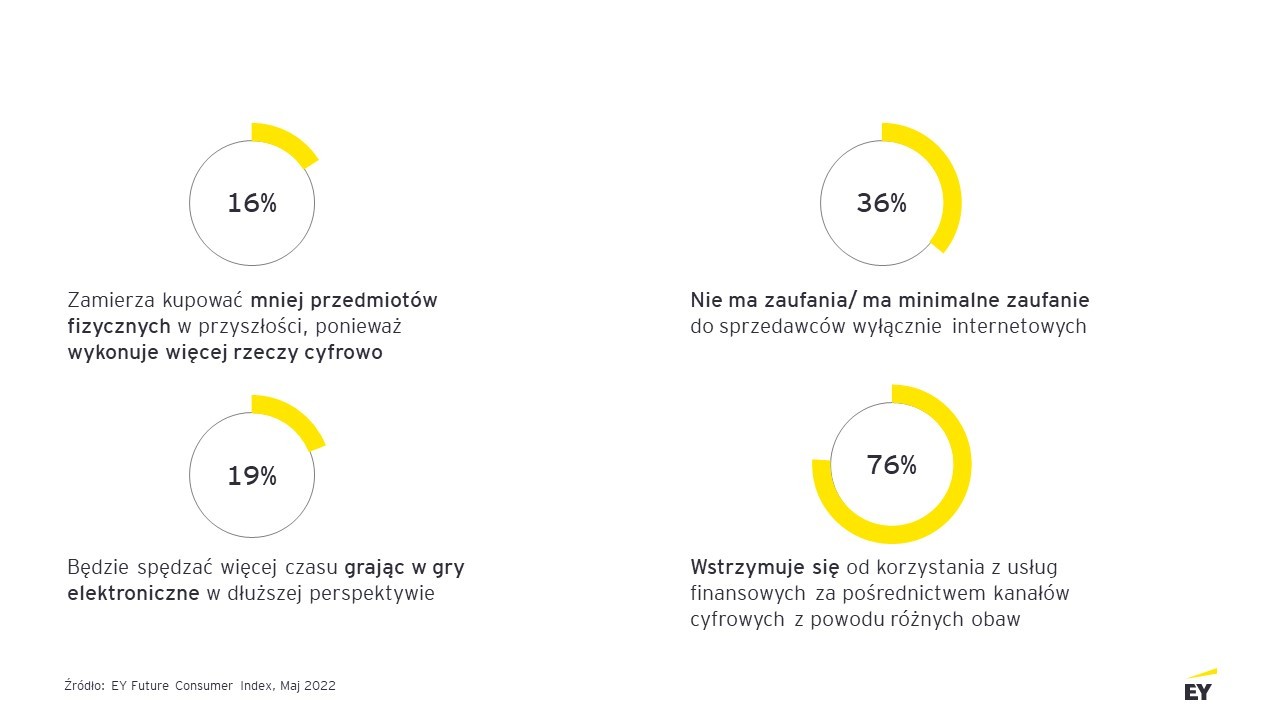
Consumers in Poland are increasingly willing – albeit still with a high level of caution – to enter the world of virtual reality. Outside of the shopping area, for most, it is currently a zone of entertainment. Further development of this area of life should be expected – already 19% of Poles plan to spend more time playing electronic games in the long term. Interestingly, as many as 16% of respondents intend to buy fewer physical items in the future because they spend more time in the digital space. It should be expected that with the development of platforms such as the Metaverse, this percentage will grow.
The increasingly wider displacement of the real world by the digital one, however, encounters a blockade in the area of trust. Currently, 36% of consumers do not have it (or have it to a minimal degree) for online-only sellers. At the same time, as many as 76% of Poles refrain from using financial services via digital channels, and 36% do not perform any transactions this way, fearing a leak of their data. Direct contact with a physical person is also still preferred – 47% of respondents would not use a bot’s services when making decisions regarding savings and investments.
– The pandemic made Poles discover digital services on a massive scale. This applies to the area of shopping or seeking entertainment. Undoubtedly, further growth should be expected in these segments, especially in a situation where consumers are massively looking for savings, and the internet gives them wide opportunities to compare prices from different sources. However, at this stage, the trust of Poles in the digital world often ends as well. In areas related to finance, we remain traditionalists, and the process of transitioning to the digital world is much slower than in the case of shopping or entertainment. The perception of potential threats may have an impact on this state of affairs. Failed purchases carry much smaller consequences than a potential leak of sensitive personal and financial data – summarizes Grzegorz Przytuła, Partner at EY-Parthenon, expert in the Retail and Consumer Products Sector.
About the study
The fifth Polish edition of the EY Future Consumer Index study, prepared by EY Poland, was conducted between May 17-27, 2022, on a group of 1,000 people aged 18-65. The study covered the entire country and all social groups. Respondents answered questions regarding current shopping behaviors, moods, and predicted attitudes in the near future.