








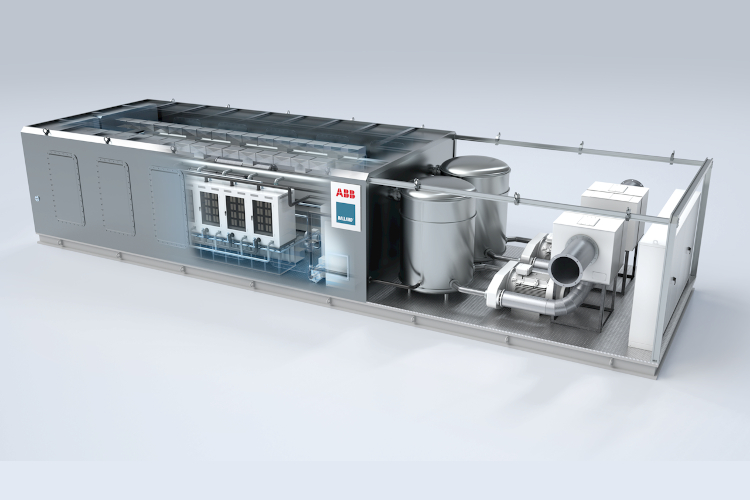
ABB and Ballard have received Approval in Principle (AiP) from the classification society DNV for a high-power fuel cell concept. The concept has been under development by both companies since 2018.
The AiP is an important milestone in the development of this new technology—it provides an independent assessment of the concept, confirming that the design is feasible and that there are no significant obstacles to its implementation. With this approval, the solution can be finalized within the next few years and subsequently deployed on many types of marine vessels.
– Hydrogen plays a significant role in the energy transition process, which is why it is crucial to develop safe technologies of this type that the industry can trust. Based on robust and independent standards, the AiP approval can help build that trust – said Tuva Flagstad-Andersen, Regional Manager, North Europe at DNV Maritime.
The high-power fuel cell module is a flexible solution for marine vessels that require several 3 MW systems for efficient operation.
– Such a fuel cell system is supplied together with hydrogen tanks, tailored to the specifics of the ship and the expected number of continuous operating hours. The complete solution also includes an automation system and electrical components, such as converters, switchgear, or propulsion power supply. The whole system can be integrated with energy storage – explains Jarosław Szumny from ABB’s Industrial Automation business in Poland. – Most ships that we can call “hydrogen-powered” must have a battery system. It acts as a kind of support for power regulation or the hydrogen energy generation process itself. There are many types of ships, and therefore many different applications for such hydrogen solutions.
A cruise ship sailing in coastal areas can operate entirely on fuel cell power or switch to it in environmental restriction zones. Another example is a ferry with a regular operating schedule. Such a vessel, having the capability for frequent hydrogen bunkering (refueling), could operate solely on fuel cells. In turn, on ocean-going vessels, energy from fuel cells could meet the needs of auxiliary equipment.
– Vessels built for short-sea shipping in the Baltic will have to meet European emission standards. Shipowners are already switching to alternative propulsion, such as LNG and hydrogen. The trend is also noticeable in Polish shipyards, for example, in the production of floating service support vessels – says Jarosław Szumny. – The profitability of hydrogen production will increase as the technology matures. The second factor is emission charges, which shipowners will want to avoid. On the other hand, a limitation remains the lack of adequate infrastructure for “refueling” larger hydrogen ships. Ports must have the capacity to store hydrogen supplies and possess appropriate equipment for bunkering such vessels.
Fuel cells convert chemical energy from hydrogen into electrical energy through an electrochemical reaction. If renewable energy sources are used to produce hydrogen, the entire energy chain can be “clean”.
Fuel cell systems of several megawatts each can be combined to increase the overall power of the hydrogen system. The successful development of the high-power fuel cell system concept is the result of a collaboration initiated in June 2018 between ABB and Ballard, a world-leading provider of proton exchange membrane (PEM) fuel cell solutions.
– This is a successful combination of ABB’s experience in marine solutions with Ballard’s expertise in megawatt-scale fuel cell systems for land-based applications. Thanks to this, we can take a step forward in hydrogen solutions for large ships — said Jesper Themsen, President and CEO of Ballard Power Systems Europe A/S.
Maritime transport is responsible for nearly 3 percent of global greenhouse gas (GHG) emissions. Pressure to transition to more environmentally friendly energy sources has led to the setting of emission targets by the IMO – the International Maritime Organization (a United Nations agency responsible for the safety and security of shipping). The IMO aims for greenhouse gas emissions from ships to be at least 50 percent lower by 2050 compared to 2008 levels.
Hydrogen fuel cells are one of the most promising technologies for reducing greenhouse gas emissions. Currently, smaller ships sailing on short routes are powered by such cells, and the technology is already nearly ready for deployment on larger vessels.
– We are constantly striving to decarbonize transport and are convinced that the electrification of vessels, including fuel cell technology, will play a key role in the maritime industry achieving its environmental goals – says Juha Koskela, Division President, ABB Marine & Ports.
The demand for hydrogen has more than tripled since 1975. To popularize its use, appropriate scalability of solutions and a reduction in production costs are essential. ABB works with customers and partners to further develop and integrate technology that will make hydrogen an accessible, affordable element of the global low-emission energy mix. In Italy, the company is collaborating with Swiss-based Axpo to develop green hydrogen facilities. In France, ABB is providing the Freelance distributed control system and the ABB Ability™ Manufacturing Operations Management digital platform to the first production plant of Lhyfe — a company that produces and supplies 100 percent green hydrogen. ABB is also working with Hydrogen Optimized on large-scale green hydrogen production systems connected to the power grid.