








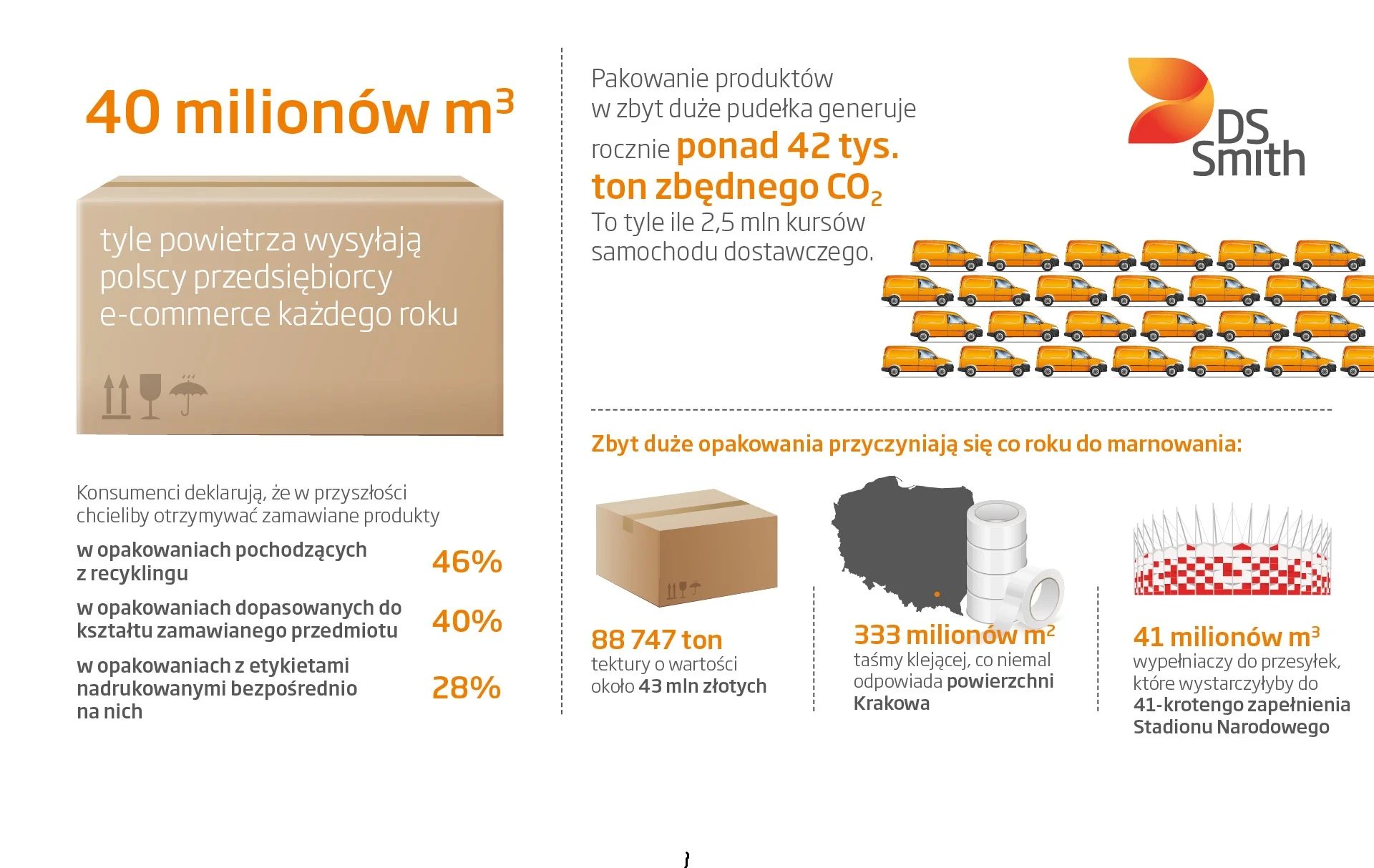
In addition to the products ordered, Polish consumers receive over 40 million m3 of air due to oversized packaging, according to the latest research commissioned by DS Smith. It is as if Poles paid to ship the air contained in 13,500 Olympic-sized swimming pools. Packing shipments in poorly fitted boxes also generates over 42,000 tons of unnecessary CO2 annually. How can we get rid of excess air in e-commerce shipments and say goodbye to air-commerce once and for all?
Research commissioned by DS Smith, a leading provider of environmentally friendly packaging, has shown that tons of raw materials and money are wasted as a result of shipping air in e-commerce parcels, and consequently, the growing trend of air-commerce. According to data from the Polish Economic Institute, two years ago the average resident of our country generated 342 kg of municipal waste. It is estimated that in eight years, in 2030, the average waste production will rise to as much as 370 kg, although annual packaging consumption is already as high as 160 kg per capita. According to 2020 data, less than 30 percent of all waste is recycled.
The conducted research showed that every year, due to overly spacious packaging, the following is wasted in Poland:
- 88,747 tons of cardboard worth 43 million zlotys, which could have been used for other purposes,
- 333 million m2 of adhesive tape used for packing shipments (which almost corresponds to the area of Krakow),
- 41 million m3 of shipment fillers, which would be enough to fill the National Stadium 41 times.
Oversized packaging also means nearly 2.5 million additional delivery vehicle trips, resulting in the emission of as much as 42,000 tons of unnecessary carbon dioxide into the atmosphere.
According to the study, the use of oversized packaging, in addition to having a significant impact on the natural environment, also has a negative effect on how brands are perceived by consumers. Every third Polish e-commerce customer (29 percent) who received a shipment with too much empty space around the packed product feels negative emotions towards the brand whose product they purchased. Another 18 percent of respondents declare that they would not decide to make a repeat purchase from such a seller.
What irritates Poles the most about packaging when they receive an ordered shipment? As many as half of them (48 percent) have difficulty opening the package, and 43 percent believe that the seller used too much plastic adhesive tape for packing. For 40 percent of us, the packed shipment is too large in relation to the product being sent.
– Today’s consumer expects a reduction in the materials used for packaging. Wasting raw materials and the unnecessary costs associated with it is one thing, but the environmental cost resulting from unnecessary CO2 emissions is equally painful. – says Paweł Mazanka, Head of Innovation and Product Development at DS Smith Poland – Now is the best time to get rid of air from e-commerce shipments and curb the infamous air-commerce trend.
Almost half of the respondents (46 percent) would like to receive their shipments in recycled packaging, and four out of ten people care about matching the shipment to the shape of the item being ordered.
Even seemingly small actions, such as minimizing the raw materials used, can bring significant savings. – Thanks to thoughtful and responsible packaging design, we can reduce the negative impact on the environment, as well as optimize costs throughout the supply chain. Changing packaging by just 1mm can make a significant difference. – emphasizes the DS Smith expert.
– Already at the design stage, we can decide on the quantity and quality of raw materials so that they meet the requirements of the product and the sales channel to the highest degree. In one of the projects implemented, minor changes in the packaging design allowed for as much as 30 percent cost savings, while simultaneously reducing CO2 emissions by 10 percent. – says Paweł Mazanka, Head of Innovation and Product Development at DS Smith Poland – This is exactly how we develop and implement projects with our clients that are in line with circular economy principles, and I hope that such an approach will become the norm for the entire industry and we will soon forget about “air-commerce”.
In cooperation with the Ellen MacArthur Foundation, DS Smith has developed Circular Design Principles. Currently, the company is working on about two thousand projects that meet all the standards for “circular” products.
Source: DS Smith