








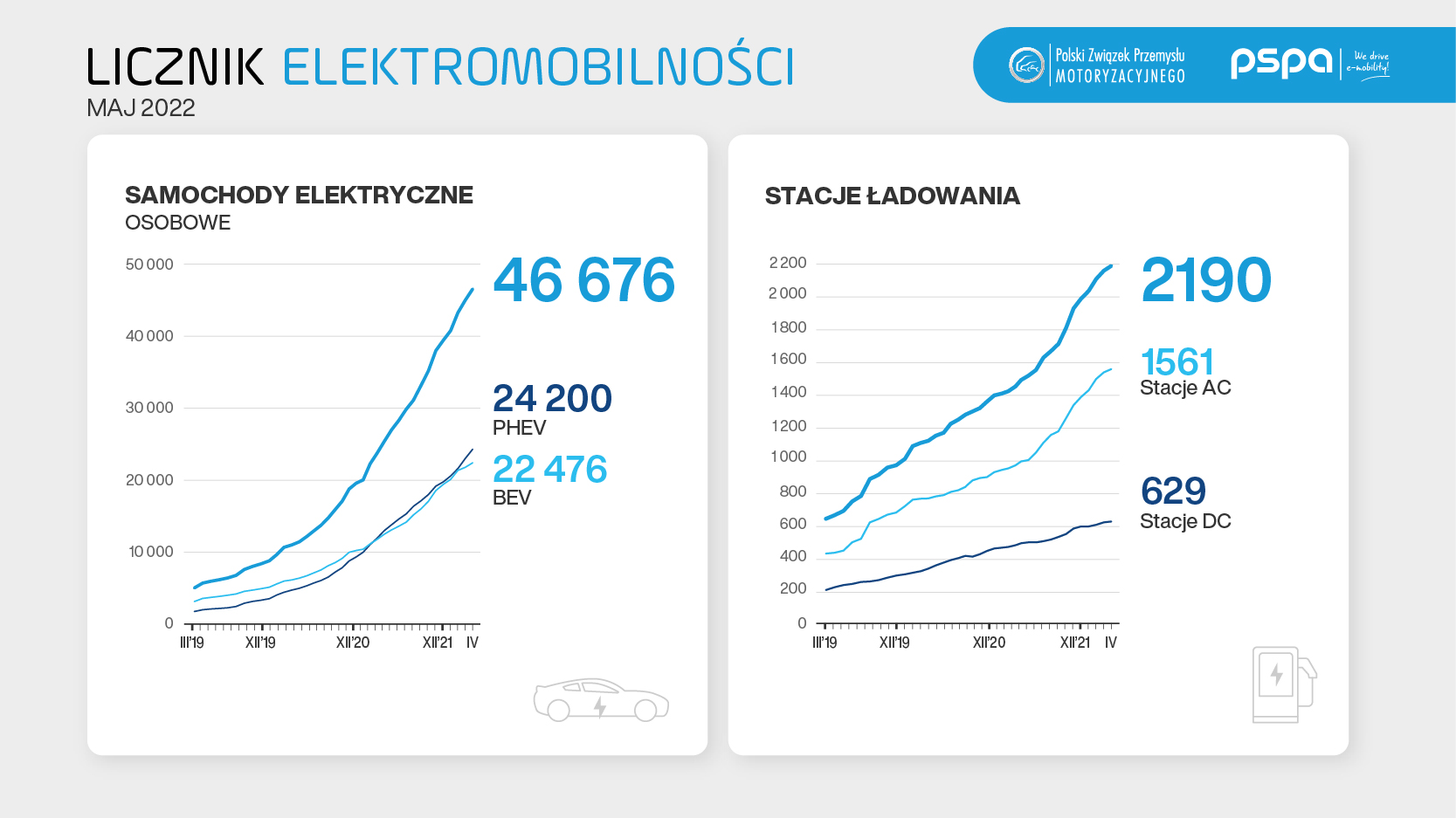
In Poland, according to data from the end of May 2022, a total of 48,675 electric passenger and commercial vehicles were registered. During the first five months of 2022, their number increased by 9,892 units, which is 45% more than in the same period of 2021, according to the Electromobility Meter launched by PZPM and PSPA.
At the end of May 2022, there were 46,676 electric passenger cars on Polish roads. Fully electric vehicles (BEVs) accounted for 48% (22,476 units) of this part of the vehicle fleet, and the remainder (52%) consisted of plug-in hybrids (PHEVs) – 24,200 units. The fleet of electric delivery and heavy-duty vehicles numbered 1,999 units. The fleet of electric mopeds and motorcycles also continues to grow, consisting of 13,822 units at the end of May, as well as the number of hybrid passenger and delivery vehicles, which increased to 393,246 units. At the end of last month, the fleet of electric buses in Poland grew to 753 units.
Parallel to the fleet of electric vehicles, charging infrastructure is also developing. At the end of May 2022, there were 2,190 publicly accessible electric vehicle charging stations (4,253 points) operating in Poland. 29% of them were fast DC charging stations, and 71% were slow AC chargers with a power of less than or equal to 22 kW. In May, 24 new publicly accessible charging stations (36 points) were launched.
– The ban on the registration of new internal combustion engine cars voted through by the European Parliament is another factor that will accelerate the inevitable transformation of the transport sector in Poland. Currently, however, our country is not ready for it in terms of infrastructure. Over the last two years, the number of passenger EVs per one charging station has more than doubled: from 10 to 21. Expanding the charging network to a level enabling the electrification of the vehicle fleet on a mass scale is a long-term project, which is why public administration should implement the necessary changes now. First and foremost, it is necessary to shorten connection procedures and develop the necessary distribution networks – says Maciej Mazur, Managing Director of PSPA.
– The number of registrations of zero- and low-emission vehicles is growing, but the pace of transition to low-emission mobility must accelerate, as this is expected by the European Commission and the European Parliament. This is also included in the National Recovery Plan, where, in addition to provisions regarding a rapid transition to, among others, zero-emission drives, there are provisions for the introduction of a registration fee for internal combustion cars in the coming years and a new tax system from 2026. This will be a very important and difficult discussion, because so far, several attempts to introduce the so-called ecological tax in Poland have failed. And it must be emphasized that a well-constructed and socially acceptable new tax system will certainly support the replacement of the fleet with low-emission vehicles, which will contribute to reducing harmful emissions and will be very beneficial for the environment – says Jakub Faryś, President of PZPM.