








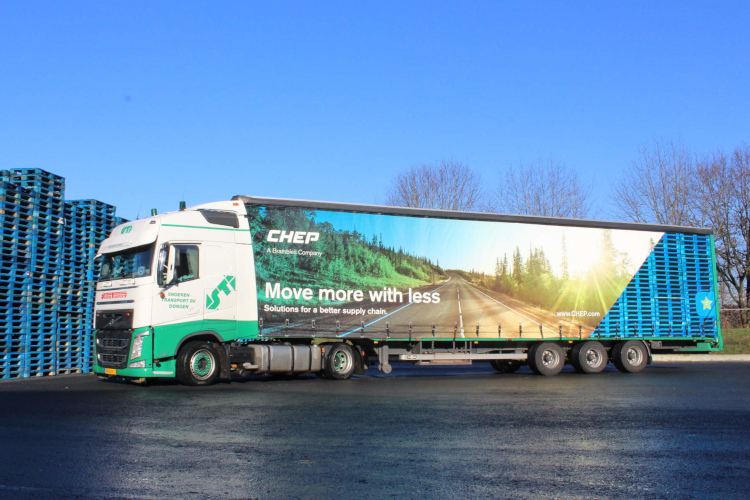
As part of its adopted sustainability program, the global logistics company operating under the CHEP brand is accelerating its decarbonization strategy, working intensively on pioneering, regenerative supply chains
Brambles has committed to achieving net-zero greenhouse gas emissions by 2040. The assumptions adopted based on the 1.5°C global warming report were the foundation of the 5-year sustainability program published in 2020. By committing to the provisions of the Paris Agreement, Brambles had previously set an ambitious goal of achieving net-zero greenhouse gas emissions no later than 2050. The new net-zero roadmap has accelerated this deadline by 10 years.
– Global warming is one of the greatest challenges of our time, and we need more decisive action today. Brambles can boast unique achievements in reducing greenhouse gas emissions – this success stems from adopting a circular business model and implementing numerous innovations. The next stages of the roadmap will be crucial for the goal we initiated many years ago. Developing science-based targets and shortening the deadline for net-zero greenhouse gas emissions by ten years means accelerating our mission to create a regenerative supply chain. By realizing our ambitions regarding net-zero emissions, among others, we will continue to be a global leader in sustainability, developing the supply chains that the world will need in the future – emphasizes Juan José Freijo, Brambles Chief Sustainability Officer.
Brambles’ new ambitious commitments translate into concrete actions based on a detailed decarbonization roadmap. The document defines two main stages:
1. Mid-term emission reduction targets for 2030, recently approved by the Science Based Target Initiative (SBTi), which include the following indicators:
- a 42% reduction in absolute Scope 1 and 2 greenhouse gas emissions compared to 2020 levels. Scope 1 and 2 are emissions generated from fuel consumption and purchased electricity from the grid for own operational needs;
- a 17% reduction in absolute Scope 3 greenhouse gas emissions compared to 2020 levels. This category includes emissions from the value chain related to: purchased capital goods, upstream and downstream transportation and distribution, waste generated in operations and at third-party service centers – this accounts for over 90% of Scope 3 emissions; and
2. A long-term “net-zero greenhouse gas emissions” goal by 2040, which has been adopted to complement the mid-term science-based targets. This goal will cover 100% of the company’s Scope 1, 2, and 3 emissions[3].
A concrete decarbonization action plan
To achieve the set goal, Brambles has established a dedicated decarbonization function integrated with the supply chain unit. Working with internal and external process participants across cross-functional projects, the team has developed a roadmap with goals that will enable the realization of a global strategic vision across five continents and 60 countries.
– The plan to achieve net-zero emissions by 2040 was developed jointly with all regions and based on approved sustainability priorities. It will set a long-term strategic direction for our company and help maintain our leadership position in sustainability. We have identified parts of the organization where optimization will significantly improve decarbonization efficiency, as well as key factors that will allow us to achieve the adopted goals. In particular, this concerns supportive policies and guidelines, as well as zero-emission infrastructure and transport technologies. All of this – combined with an internal action plan that incorporates carbon emissions into the decision-making process – will accelerate the transition to a net-zero business model. – explains Marisa Sánchez Urrea, Brambles Global Supply Chain Decarbonisation Director.
To achieve the net-zero goal, Brambles will focus on three main areas of development: operations (carried out in-house or by subcontractors), logistics, and direct procurement. Key factors for these areas include:
- Maximizing the recovery and reuse of Brambles pallets and containers to strengthen the company’s circular model;
- Renewable electricity to power Brambles’ facilities and subcontractor facilities;
- Optimization of logistics and facility operations (including reducing empty runs and maximizing truck loading);
- Enabling the use of alternative fuels and zero-emission transport technologies (electric, hydrogen);
- A supplier engagement program, supporting supply chain participants in calculating carbon emissions and setting related targets;
- Reducing waste and implementing solutions that will enable the elimination of landfills as a disposal option; and
- Exploring carbon offsetting opportunities[4] (natural and technological).
More information on Brambles’ decarbonization strategy can be found at https://brambles.com/net-zero-roadmap.