









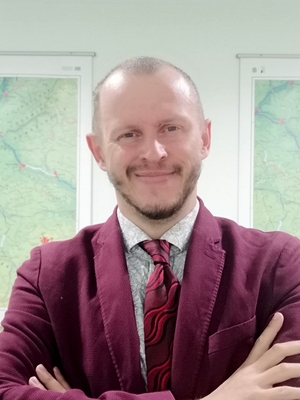
An interview with Dr. Piotr Trzepacz, Deputy Director of the Institute of Geography and Spatial Management at the Jagiellonian University.
Janusz Mincewicz: The Institute of Geography and Spatial Management at the Jagiellonian University, which you co-direct, has decided to create a 2-year supplementary master’s degree program in e-spatial management. Is this a trend or a necessity?
Dr. Piotr Trzepacz: It is primarily a conviction resulting from observation, analysis of the educational offer related to spatial management at foreign universities, and the effect of cooperation with entities where our graduates find employment or with which we cooperate directly. Our study program was created partly based on the results of interviews we conducted with potential employers of our graduates. We know how to listen to the market. No less, we value the tips provided to us by our graduates. I often ask them myself what was the greatest difficulty for them when they started their professional adventure, when, after leaving the university walls, they faced their first tasks in the workplace. In this way, we verify our assumptions about what and how we should teach our students.
 J. M.: How often are changes introduced to study programs such as e-spatial management?
P. T.: Higher education has long ceased to be a rigid structure, unchanging in the long term. Its program is subject to constant modifications – within the limits allowed by the current education system. In our Institute, the introduction of new courses and the closing of some of those that made up the existing program takes place every year. However, this does not mean that we have a revolution in the program every year. On one hand, we want and need to respond to current demand. On the other hand, a university education should provide a certain broad set of skills allowing for universal application. Soft skills, as well as openness to learning as a process that never ends, will be useful to every one of our graduates, regardless of the career path they choose.
J. M.: Have there been any candidates willing to study this major?
P. T.: The first cycle of studies in the field of e-spatial management began in the 2015/2016 academic year. Since then, the program has been launched every year. We consider this a great success. In Krakow alone, several universities offer studies related either to spatial management itself or to geoinformatics. Most often, the first year starts with a group of a dozen or so people. These are master’s studies, which are chosen by graduates of various bachelor’s degree programs. They are often graduates of technical or economic universities. This means that in a group of a dozen or so people, everyone brings a slightly different approach to space and its management. Thanks to this, students also learn from each other, and we learn from them. We have the right to believe that the adopted assumptions and actions were correct. In a very short time, our program was ranked third in the ranking of spatial management study programs published in the Perspektywy magazine.
J. M.: Are students from abroad also interested in the program?
P. T.: E-spatial management studies are conducted in Polish. This does not mean that candidates from other countries do not apply for a place. However, they must demonstrate a satisfactory level of proficiency in the Polish language at the recruitment stage. For all the programs we conduct, we have noted an increase in interest from students from Ukraine and Belarus. I can therefore say that the origin of the students corresponds to the dominant directions in migration processes. The Faculty of Geography and Geology of the Jagiellonian University, of which our Institute is a part, offers a fully English-language program called Earth Sciences in a Changing World. E-spatial management students also benefit from dedicated courses in English. In this way, they also develop language skills related to issues of geoinformatics, remote sensing, land use, or transport.
J. M.: Where will graduates of this program find work?
P. T.: I think what pleases us most is that it is difficult to point to any one dominant type of institution or enterprise. We do not limit ourselves to one clearly defined profile, because that was never our goal. Our graduates work in various geoinformatics companies, institutions responsible for spatial planning, in companies where skills in preparing location studies are necessary, or those related to the acquisition, visualization, and analysis of spatial data. Some graduates have entered a scientific career path after these studies and are working on their doctorates. Our studies provide a package of skills and knowledge that is useful in many places. Companies, institutions, local government, organizations related to environmental protection is a list that does not exhaust the possibilities of our graduates.
J. M.: The Institute boasts that the e-spatial management study program is a new quality on the Polish market, developed based on many years of didactic and scientific experience of the Institute and the best international standards. Where do you draw your patterns from?
P. T.: As I signaled earlier – we must be constantly aware of changing needs, and at the same time not be afraid to remember the strong, universal foundations. That is why we do not adopt a specific pattern. I can say that e-spatial management is our innovative approach. We bet on a fusion of spatial management and geoinformatics, and the “e” in the name of our program is, on one hand, work on spatial data in a digital environment, but also a reference to e-learning. I can say that it was these studies and the preparation of some didactic materials in the form of e-learning that prepared us for remote work during the pandemic.
J. M.: The Institute writes on its website that graduates of the e-spatial management program can analyze natural and socio-economic data necessary for making spatial decisions and use geoinformatics tools for space management. What does this mean in practice?
P. T.: I will give an example. If an employer tells our graduate that they are thinking about finding a new location for their business, our graduate will find this location and will be able to identify all the challenges resulting from it. Knowing ESRI geoinformatics software well, they will be able to easily carry out tasks using practically any other software related to geographic information systems. And finally – the employer will be just as satisfied with their independence as with their ability to work in a group.
J. M.: Is e-spatial management an irreversible future?
P. T.: Seeing how everyday life has become for all of us, for example, mobile applications that collect spatial data about us, which are then to be used in decision-making processes, I can say that it is not so much an irreversible future as a response to a very current need and possibilities. And these are possibilities that are constantly expanding.
J. M.: On the Institute’s website, you quote Sylvain Tesson: “A free man masters time. A man who has power over space is simply powerful.”
P. T.: I would add to that that a person aware of the value of the space they decide on is even more so. In e-management, we teach not only tools, a critical look at data, or a high awareness of the formal and legal aspects of space management. We also do not forget about values. Our students know that the physical dimension and the dimension of the economic value of space are not everything. We are geographers teaching spatial management. For us, everything is part of a larger whole functioning in a system of very complex connections. Building this awareness and respect for space as a good of special importance in young people is something we realize to some extent through every course that fills our study program.
J. M.: Is the popularity of a study program like e-spatial management linked to the popularity of e-commerce?
P. T.: Absolutely. Just as we have moved many commercial operations to the digital environment, we are moving decision-making about space to it as well. The best proof of this is the particular popularity of geoportals. In the digital environment, we collect information about the needs of residents and consult planning projects. We use subsequent mobile applications that record our behavior in space. By sharing a route run or cycled with friends on social media, we provide them with spatial information in a digital environment.
J. M.: Do you have any concerns that developing e-commerce will harm retail, even marginalize it, and that large shopping centers will begin to collapse and be replaced by online stores?
P. T.: Not long ago, we were revitalizing post-industrial areas by creating shopping centers in rebuilt facilities, and soon we will have to revitalize shopping centers themselves. It is worth noting that alongside the crisis of large-format retail and the growing popularity of online retail, we see a number of other changes in consumer behavior. We want to buy vegetables, fruit, or eggs at local markets again. We are increasingly getting bread at a local bakery that is not part of a chain. That is why I would ask a different question – should all large shopping centers have been built?
J. M.: It turned out that during the pandemic, not only e-commerce flourished, but also cybercrime: theft of sensitive personal data, hacker attacks, or disruptions in business operations. Is this a major threat to e-commerce and business conducted online?
P. T.: Pirates are still rampant off the coast of Somalia, and the pandemic showed how quickly the supply chain can be broken on a global scale. Not long ago, it was unthinkable that planes would suddenly stop flying over our heads, as was the case during the pandemic. At the beginning of October, Facebook literally “died” for 6 hours. All this means that we must remain as aware of traditional threats as we are resilient to being surprised by new ones. We teach our students that the solutions they will create and implement should make cities and villages resilient. We will not always be able to protect them from a cataclysm, but we can build in them the ease of returning to the path of further growth after it. The same approach should be taken to trade or business activity. And how to do it? Read reports, forecasts, scientific publications. Cooperate with universities.