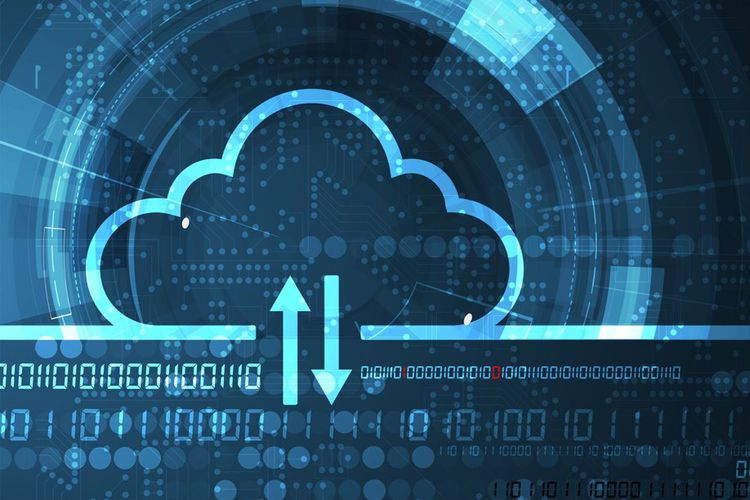
We are at an event of interest, we take a photo, and it lands in the cloud. Another case: we have data in a factory and we want to use it to predict failures. We connect to an existing tool that will analyze our data in the cloud and start feeding us back with the information we are interested in. One more example from the factory: we regularly perform advanced image analysis for quality control purposes, but we are starting to run out of computing power. We increase the power by renting it in the cloud.
Below are a few words about three types of cloud usage, especially in industrial conditions, both among large and smaller companies.
Cloud as a space
The most common use of the cloud is as a space for storing, sharing, and transmitting data. Probably because we do this every day, not only in our professional lives… The first big step is moving to working on documents online. A simple test is to ask yourself the following question: What would happen if I lost my computer or the contents of my desktop? Working online gives you the ability to access files, events, and emails from anywhere and on any device, for example, from a web browser. Using these capabilities, you can easily work on spreadsheets that are up-to-date for everyone in the same way. Many a company “stands” on Excel. Files can be linked to create simple tools, e.g., for monitoring production progress in combination with order deadlines handled by sales staff. Larger companies also use these amenities, working on platforms (e.g., Sharepoint, G Suite) that can be configured to a large extent to suit their own needs and create automation rules – e.g., if one person adds a row in file A, the creation date of that row appears in file B, and an email notification is sent to specific people.
Cloud as a tool
As entrepreneurs and managers, we often ask ourselves which skills we want to develop in-house and which to leave to external providers. It is similar with cloud applications. We can decide to use ready-made solutions to which we can quickly connect our systems, information sources, or even use and post data directly in the cloud using so-called APIs. An example could be a notebook with contacts and a CRM customer relationship management system with browser access, where we additionally have the ability to track activity, report, and collect history. More technical examples concern tools for monitoring the condition of the machine park, where we can connect sensors in parallel without interfering with the machines, or systems that use our controllers and information collected on company servers, or more advanced systems using algorithms that predict failures. Benefits include the ease of expanding the number of users, managing access and permissions, and a simple way of extending functions. There is practically no implementation phase, other than getting to know and limited customization of the system to our needs. The latter can actually also be a barrier when we have highly individual needs. Another barrier, e.g., when using cloud-based production planning tools, may be the preparation of processes in our company. These systems require the introduction of, among other things, routings and clear material structures. SMEs tend to have limited data in this regard, and the process is based on a combination of tracking inventory levels and production orders in various systems or spreadsheets.
Cloud as power
Regardless of whether we use the cloud as a space or as tools, we can always use the cloud to increase our computing power or data storage size. Buying server space tailored to our current needs or purchasing computing power is easily available today. This relieves companies of the need to develop and maintain their own IT infrastructure. Image analysis is particularly demanding. In this case, there are additional problems with the availability of graphics cards – caused years ago by the popularity of cryptocurrency miners, and currently by the shortage of semiconductors. In addition to the example related to image analysis for quality control, there are also systems that analyze human movement on the shop floor. (Not just in the form of analyzing their presence in specific zones). Commercial applications of motion-capture methods are already being created in factories, used, among others, in Hollywood or the computer game industry, and consisting of reflecting human movement and anatomy in a digital way. The essence of the innovation is the use of these mechanisms based on recordings, e.g., from industrial cameras, which eliminates the need to use suits or sensors placed on a person.
Is a cloudy future awaiting us?
A very interesting topic of cloud manufacturing is also appearing on the horizon, in the spirit of Industry 4.0. This is achieving such a level of production digitalization that as a manufacturer, we offer our production capacities and receive payment for time, machine wear, raw materials, or tools. Everything is configured online using price lists available to customers, and in addition, clients independently upload orders to the schedule, technical data about products, and have the ability to track the progress of work on an ongoing basis. Apart from the obvious barrier of having a high level of digitalization of the machine park, a management system, and customer access, the infrastructure is not yet ready for this – due to insufficient bandwidth. An intermediate solution is local collection of detailed data and sending them in bulk packages further on. However fascinating this topic is technologically and in terms of the business model, it will not be common anytime soon – unlike the already used and rapidly developing areas: space, tools, and increasing power in the cloud.
The article comes from the magazine LOGISTYKA 6/2021.
The e-edition of the magazine is available in our offer!
Stay up to date, subscribe to the LOGISTYKA magazine!