








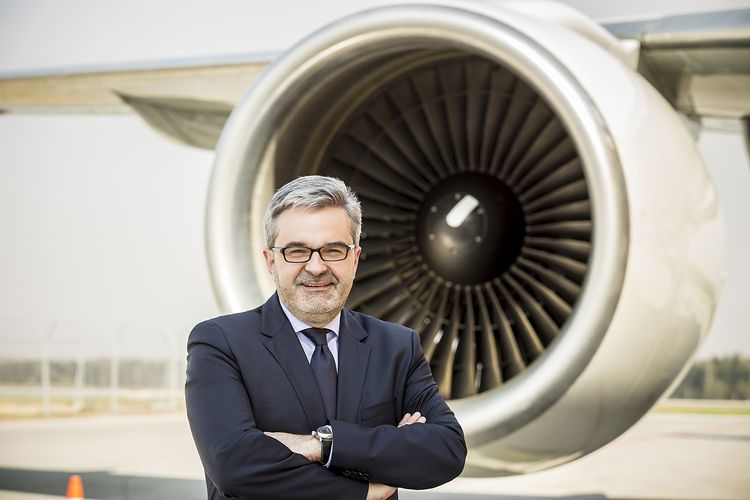
Janusz Mincewicz interviews Artur Tomasik, President of the Pyrzowice Airport.
Janusz Mincewicz: Is the Polish aviation industry starting to return to pre-pandemic times?
Artur Tomasik: Summer has arrived, and with it, a significant easing of pandemic restrictions in most European countries. People have started going on vacation, which has clearly translated into a stimulation of passenger traffic after its winter and early spring hibernation caused by successive waves of the coronavirus pandemic. In recent months, passenger traffic has indeed increased significantly; while we handled 40,000 travelers in Pyrzowice in April of this year, there were over 85,000 in May, about 225,000 in June, and over 400,000 in July. These data seem very optimistic, but I am a realist – the aviation industry is still stuck in the greatest crisis in its history, which began in March 2020. As long as the coronavirus pandemic does not end, the crisis in aviation will continue.
J.M.: Why?
A.T.: Aviation, as a very cost-intensive area of business activity, needs stability and predictability, and the coronavirus pandemic has introduced unprecedented uncertainty and a number of new risks that we all have to face. However, it is worth emphasizing that, for example, PLL LOT has significantly strengthened its position at Katowice Airport during the pandemic. Since the first quarter of this year, they have based their wide-body Boeing 787 Dreamliner with us, which they use to operate direct flights from Pyrzowice airport to Mexico and the Dominican Republic on behalf of travel agencies, and in the upcoming autumn-winter season, they will also fly to the Maldives, Cuba, and Thailand. In addition, during the summer season, the airline also bases three Boeing 737s, which it uses to operate medium-haul flights for agencies and as part of the “Flight for Vacation” project.
J.M: Are you satisfied with the results of the first half of the year?
A.T.: In the passenger transport segment, the first half of 2021 was difficult for all Polish airports, including Katowice Airport. Undoubtedly, the period from January to June was marked by the third wave of the coronavirus pandemic, which was the strongest in Poland so far. During this period, 421,000 travelers used the Pyrzowice network of connections, which is 238,000 fewer than in the first half of 2020 and as many as 1.6 million fewer compared to the record-breaking first half of 2019. The situation of Pyrzowice compared to other regional airports in the passenger transport segment is better in that we have had very good cooperation with travel agencies and the airlines flying on their behalf for many years. Thanks to this, we are the national leader in charters, and it is precisely in this segment that the best average flight occupancy rates are recorded during the pandemic, which means that we currently handle the most travelers of all domestic regional airports. In the pandemic year 2020, we strengthened the position of Katowice Airport in the cargo segment, in which we have been the undisputed leader for years; during this time, almost 20.4 thousand tons of air freight were transported to and from Pyrzowice.
J.M.: What are the forecasts for this year in the cargo segment?
A.T.: The current year looks even better. In January, Lufthansa Cargo opened a nationwide air freight integration point at Katowice Airport. In addition, Amazon launched three additional regular cargo routes. DHL Express is also developing excellently. By the end of the year, we expect to handle well over 30,000 tons of cargo, which is over 50% more compared to 2020.
J.M.: How has the expanded Terminal B improved the airport’s capacity?
A.T.: The terminal area has increased from 12,000 to 17,000 square meters. Its heart is the most modern checked baggage transport, inspection, and sorting system in Poland. We use two tomographs for security checks, thanks to which we have a 3D image of the scanned suitcases. Up to 1,900 pieces of checked baggage can pass through the system in an hour. Thanks to this investment, the annual capacity of the entire Katowice Airport terminal infrastructure has increased from 6 to 8 million passengers. The coronavirus pandemic did not stop us from continuing to expand the aircraft maintenance base, which consists of two tasks. The first is the construction of an apron with an area of 6.5 hectares, with stands for nine medium-haul aircraft, e.g., Airbus A321s. The investment will be completed in the fourth quarter of this year. The second task is the construction of a third hangar for aircraft maintenance. This project started in the second quarter of this year and will last twelve months. The tenant of the new hangar will be the airline Wizz Air. We are also working intensively on the concept of expanding the cargo zone. This transport segment is developing dynamically. In the coming years, we want to provide thousands more square meters of space for cargo operators operating in Pyrzowice.
J.M.: Are you not afraid that the announced fourth wave of the pandemic will negatively affect aviation?
A.T.: I have no doubt that we will have to face a fourth wave of the coronavirus. After good summer months, we are counting on a large drop in passenger traffic in the upcoming autumn-winter period. We have a long way to go to get out of the crisis. Fortunately, Katowice Airport, thanks to many years of consistently implemented infrastructure expansion, is not just passenger transport, but also dynamically developing cargo and a thriving aircraft maintenance base. Thanks to this, in this very difficult time, it is easier for us to maintain financial liquidity and the ability to implement key, development-oriented investments. Katowice Airport has its strengths.