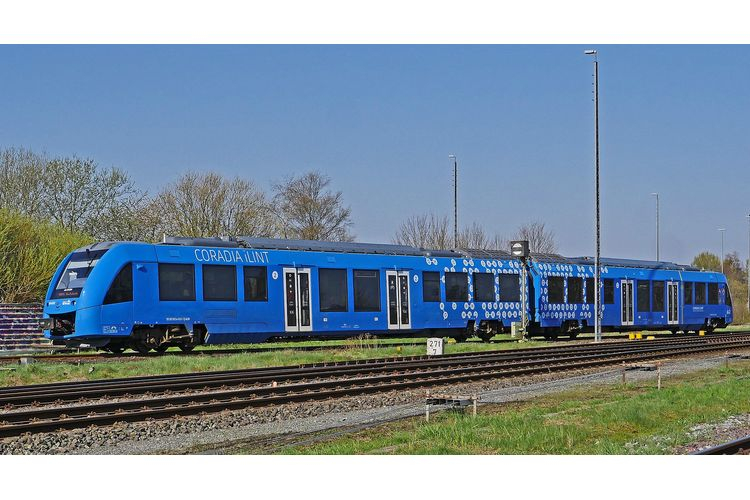
Produced in Alstom’s factories in Germany and Poland, the Coradia iLint is the world’s first hydrogen-powered passenger train. It is a quiet, zero-emission vehicle that emits only water and water vapor. Germany, Austria, as well as France and Italy have already decided to purchase hydrogen trains. Such vehicles could replace traditionally powered trains in Poland as well, where 74% of rail transport is still based on coal and a large portion of routes remains unelectrified.
The use of hydrogen in rail is an opportunity for a significant reduction in CO2 emissions, but also a chance in the global race for hydrogen technologies. The vehicle has just debuted on Polish tracks during operational tests on a track near Wrocław.
– The Coradia iLint is the first train to use hydrogen fuel cells to generate electricity. It is designed for unelectrified lines, which account for almost half of the routes in Europe and one-third in Poland. The train does not require special preparation of these lines for travel, as it does not require the construction of an electrification network – explains Sławomir Nalewajka, Managing Director of Alstom in Poland, Ukraine, and the Baltic States.
The world’s first hydrogen passenger train was designed and built at Alstom’s facilities in Salzgitter, Germany, and the unequipped carriages for the iLint vehicle are produced in Poland – at the Alstom Konstal plant in Chorzów. The vehicle is equipped with fuel cells that convert hydrogen into electricity and is packed with technologies such as an intelligent power management system and available energy, or clean energy conversion technology that allows for flexible energy storage in batteries. The Coradia iLint reaches a maximum speed of up to 140 km/h, is fully zero-emission, accommodates approx. 300 passengers, and has a range of up to 1,000 km on a single refueling.
– The Coradia iLint train has performance comparable to a classic diesel-powered vehicle. However, it is completely zero-emission, emitting only water and water vapor. It is also quiet and does not require the electrification of railway lines, which are expensive to build and maintain. A refueling station is obviously needed, but this train can freely run on virtually any track – says Artur Fryczkowski, Sales and Business Development Director of Alstom in Poland, Ukraine, and the Baltic States.
According to data cited by Alstom, replacing one diesel regional train with a hydrogen train will provide the same effect as removing 400 passenger cars from the roads for a year.
– Let’s imagine that replacing 30 diesel trains with iLint hydrogen trains would mean a reduction of 22,000 tons of CO2 per year, which equals the annual CO2 emissions of 12,000 cars – says Sławomir Nalewajka.
Poland has high hopes for the use of hydrogen in rail. It is estimated that approx. 74% of rail transport in our country is still based on the use of hard coal and lignite. Poland is the fifth-largest producer of hydrogen in the world. It produces approx. 14% of the hydrogen generated in Europe, which is used mainly in industrial processes. However, this is mainly so-called grey hydrogen, which is not ecological because it is produced from fossil fuels such as oil or gas. On a global scale, only about 5% is so-called green hydrogen, i.e., low-emission, produced from renewable energy sources.
– Poland is already a large producer of hydrogen today – albeit grey, which is worse from the point of view of the European Commission, but we have the potential to further develop this technology. We can do this independently or in cooperation with foreign partners, among other things, so that unelectrified railway lines – and we have quite a few of them – can function more ecologically. Such technology would also allow for more flexible transport, and this is the direction we want to follow to attract passengers to rail – says Andrzej Bittel, Deputy Minister of Infrastructure and Government Plenipotentiary for Counteracting Transport Exclusion.
Currently, the use of hydrogen in transport or energy is still marginal, but demand is constantly growing. According to the plans of the European Commission, which published a new hydrogen strategy in July last year, it is to serve as a clean, widely available fuel and energy source in the future.
– The European Union’s strategy is sustainable and intelligent transport with zero exhaust emissions. Decisions taken in recent years concern the liquidation of short-haul air connections up to 500 km and replacing them, among other things, with zero-emission hydrogen rail – emphasizes Sławomir Nalewajka.
– We will support the green transformation on the railway, we will facilitate the introduction of hydrogen trains to Polish tracks – says Andrzej Bittel. – We have a pool of funds for this in the National Recovery Plan, and I think they will also be found in the next Infrastructure and Environment Operational Program.
Alstom is also focusing on the development of sustainable and intelligent solutions in transport. The concern was the first in the world to design and implement a hydrogen-powered train into mass production. From 2022, they will enter regular operation in Germany. The Lower Saxony railway has ordered 41 Coradia iLint trainsets. France and Italy have also placed orders.
Source: Newseria