









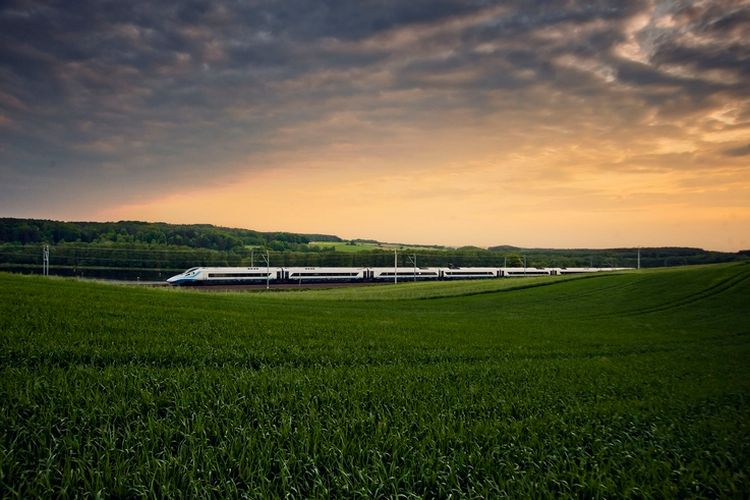
From June 2, 2021, people checking connections on the www.intercity.pl website can find out what carbon footprint their train journey will leave and how much more environmentally friendly it is compared to other modes of transport.
PKP Intercity wants to raise awareness among passengers about the environmental impact of various modes of transport. Rail travel is characterized by more than 3 times lower carbon dioxide emissions than road transport and more than 8 times lower than air transport, making it the most ecological form of public transport. To this end, as of June 1, PKP Intercity has introduced information in the e-IC system for passengers regarding the carbon footprint their train journey will leave and how much more ecological it is compared to traveling by car or flying. For this year’s summer holidays, there are plans to implement a printout on tickets containing information about the carbon footprint.
– We want to become the first Polish passenger carrier whose operations will be climate neutral. Moreover, rail, as the most ecological form of public transport, has the ambition to become the first-choice mode of transport for as many of the country’s residents as possible in the coming years. By choosing PKP Intercity trains instead of road transport, in 2020 alone, Poles contributed to a reduction of 460,000 tons of carbon dioxide emissions into the atmosphere. PKP Intercity’s plans assume reaching over 74 million passengers by 2030. This will reduce the negative impact on the environment by attracting people who have previously used individual transport – explains Tomasz Gontarz, member of the board of PKP Intercity.
The extent to which the choice of transport mode translates into CO2 emissions can be seen in specific examples. In the case of a PKP Intercity trip from Szczecin to Gdańsk, 11 kg of carbon dioxide is emitted per passenger, compared to 37 kg for a car trip and 70 kg for a flight. A trip between Poznań and Kraków results in 13 kg of CO2 emissions when choosing a train, 46 kg for a car, and 81 kg for a plane. In turn, when traveling from Warsaw to Wrocław, one must account for emissions at the level of 11 kg for a train, 41 kg for road transport, and as much as 98 kg by air*. It should also be remembered that in the case of the most emission-intensive air travel, one often has to account for travel to and from a suburban airport – which means additional travel time and further kilograms of emissions.
Passengers perceive rail as an ecological mode of transport
The ecological awareness of travelers is systematically growing. As many as 86% of PKP Intercity train passengers perceive rail as the most ecological mode of public transport – this is according to an online survey regarding, among other things, travelers’ attitudes towards ecology, conducted at the turn of March and April 2021 among PKP Intercity passengers. In September of last year, 76% of travelers thought so. According to declarations, for 51% of people traveling on the carrier’s trains, issues related to ecology influence their choice of transport mode. This is an increase of 7 percentage points compared to September 2020, when 44% of passengers made such a declaration.
Together for the environment
Although rail is already distinguished by low emissions compared to other modes of transport, PKP Intercity does not cease in its efforts to be even more “eco” – the carrier is working on ecological offsetting. Passengers, whose ecological awareness is constantly growing, will be able to take direct part in achieving climate neutrality by PKP Intercity by opting for a voluntary additional fee. This will be entirely allocated to ecological purposes. The company plans to carry out plantings in provinces chosen by travelers together with the State Forests, which the parties confirmed by signing a letter of intent.
Green investments in modern rolling stock
The key to the further development of rail in a pro-environmental spirit is intensive investment in rolling stock. Since December 2017, PKP Intercity has been consistently implementing the largest investment program in the company’s history, “PKP Intercity – Railway of Great Investments,” the goal of which is the modernization and purchase of new rolling stock and further increasing travel comfort. The carrier entered 2021 with contracted agreements with a total value of over PLN 5 billion gross.
Wishing to effectively implement the plans for the development of the railway sector across Europe outlined by the European Commission by 2050, the Company announced at the beginning of 2021 the continuation of its rolling stock strategy until 2030, within which it will invest PLN 19 billion in modern rolling stock. The plans set the following goals: reducing greenhouse gas emissions in transport by 90% by 2050, scheduled journeys under 500 km to be carbon neutral by 2030, and rail as the main and least emission-intensive mode of public transport. As a result of the investments, the carrier’s fleet will be powered by, among others, new electric vehicles with significantly lower CO2 emissions.
*The carbon footprint is given for one passenger. It is calculated based on data from the CER (Community of European Railways and Infrastructure) as follows: commercial distance is multiplied by the average emission level of: train 28 g CO2/pkm, car 102 g CO2/pkm, plane 244 g CO2/pkm.
Source: PKP Intercity