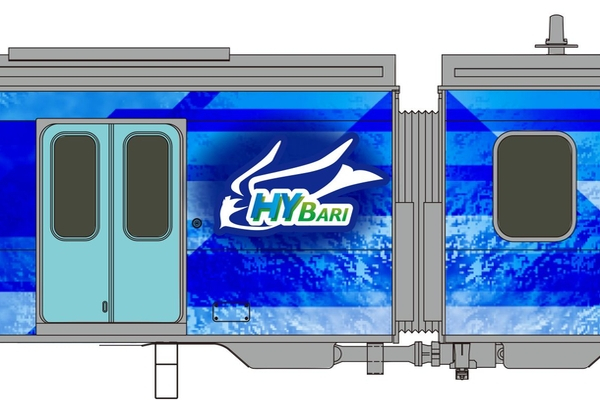
Three Japanese companies: Toyota, East Japan Railway Company (JR East), and Hitachi have joined forces to create a prototype of a hydrogen-electric hybrid train. The train will be powered by batteries and fuel cells and will contribute to the development of eco-friendly rail transport.
The name HYBARI is an abbreviation for HYdrogen-HYBrid Advanced Rail vehicle for Innovation. The prototype of the new hybrid train is expected to have two cars. Individual components of the propulsion system will be mounted in their undercarriages. The primary energy source for the train will be hydrogen stored in Toyota’s high-pressure tanks. The hydrogen will be fed into a fuel cell stack. There, through a reaction with oxygen taken from the air, electricity and water vapor will be produced. The electrical energy will power the motors and be stored in batteries, which will also store energy recovered during braking. The electric motors will therefore be powered from two sources – fuel cells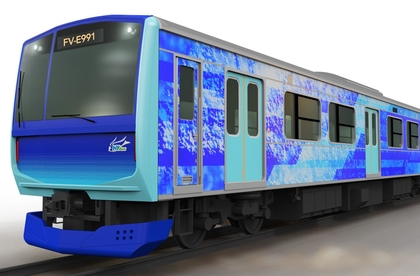 and batteries.
The assumed maximum speed of the HYBARI prototype is 100 km/h. The train will be able to cover 140 km on a single refueling. The drive system will include 4 motors with a power of 95 kW, two inverters, and four Toyota fuel cell stacks with a solid polymer electrolyte, each with a power of 60 kW. The set will be complemented by two lithium-ion batteries with a capacity of 120 kWh and four modules of five hydrogen tanks holding 51 liters of gas at a pressure of 700 atmospheres (70 MPa).
Tests of the train will begin in March 2022 on short local lines in the vicinity of Yokohama and Kawasaki.
Ultimately, HYBARI trains will be able to replace diesel trains on routes without overhead lines. The Hitachi railway hybrid drive, developed jointly with JR East, will be expanded with fuel cell technology, which is used, among others, in the Toyota Mirai passenger sedan and the Toyota SORA city bus. The cells will be adapted to operate in completely different conditions in a locomotive drive. The hydrogen-electric drive will have to provide very high power, sufficient to move the train.
Japan sees hydrogen not only as an exceptionally clean and ecological fuel but also as an opportunity to ensure the country’s energy security and independence from external fossil fuel suppliers.
Source: Toyota
Read also about innovations in transport:
– Innovative means of transport – Hyperloop as an answer to contemporary communication problems
– A large-scale hydrogen truck is being built
– Alstom hydrogen train soon on the tracks
– Daimler accelerates and presents a concept truck with hydrogen fuel cell drive
We write more about the transport of the future and the use of hydrogen in the magazine Logistyka 4/2020.
The e-edition of the magazine is available in our offer!