









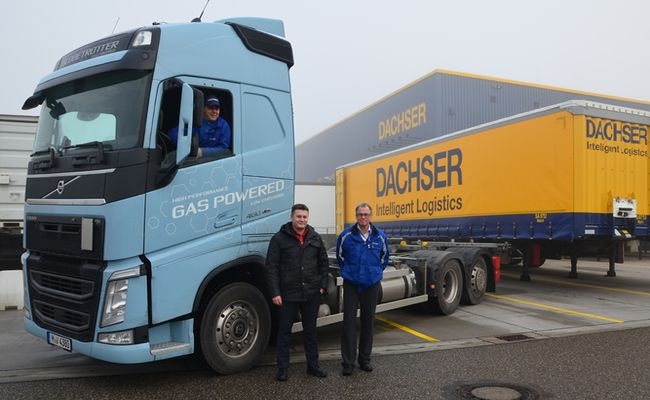
Dachser is conducting real-world tests of trucks powered by natural gas. Results obtained in Karlsruhe, Germany, show that LNG (liquefied natural gas) can be an alternative to diesel, even for long-haul routes. However, this is conditional upon the expansion of refueling infrastructure for this fuel.
“Yes” to clean air, “no” to diesels
Restrictions on the movement of older diesel vehicles meeting Euro 1-5 standards are in force in a growing number of European metropolises. In Germany alone, dozens of cities have introduced or plan to introduce diesel bans in the coming months. There are also voices calling for restrictions on trucks traveling on motorways. Wishing to prepare in advance for potential limitations, Dachser is increasing the number of low- and zero-emission vehicles in its fleet. The operator already uses such vehicles in urban distribution in some European agglomerations, but is simultaneously testing eco-friendly solutions for long-distance applications. LNG may prove to be a promising alternative to diesel.
Dachser built a mobile liquefied natural gas refueling station in Karlsruhe to enable testing of a truck powered by this fuel. The vehicle covered a total of over 5,000 kilometers as part of this experiment. The results of the project proved promising for the operator.
– The drivers were impressed. They did not notice any real difference in handling the truck compared to a diesel-powered vehicle – says Thomas Leyerle, responsible for fleet and technical equipment at the Dachser logistics center in Karlsruhe. – The assumed range of 1,000 kilometers on a single tank is very realistic, as shown by trips to Rheine and Switzerland.
Pros and cons of gas
The use of liquefied natural gas as a fuel brings many advantages. Above all, it allows for a significant reduction in the level of pollutants emitted into the atmosphere: CO2 by 20%, nitrogen oxides by 70%, and soot particles by as much as 95% compared to diesel. The noise level generated by such an engine is also significantly lower. Furthermore, LNG-powered vehicles are exempt from road tolls in Germany in 2019 and 2020, and a “green discount” of 12,000 euros is granted upon their purchase. All this makes them an attractive alternative to diesel trucks. However, there is still a serious problem that significantly limits the scale of LNG vehicle usage – insufficient refueling infrastructure. According to data from NGVA Europe (The Natural & bio Gas Vehicle Association), the European association promoting the use of natural gas as a fuel, there were only 210 LNG refueling stations operating across Europe as of May this year*. For this reason, the widespread use of gas trucks for long-haul transport is currently practically impossible. In the coming years, however, EU countries, as well as private operators, are planning a significant expansion of the liquefied natural gas station network.
– Dachser is currently testing various types of powertrains. LNG is a very promising alternative to the diesel engine – as proven by tests conducted under real operating conditions for the truck – comments Christian Schütz, Head of Technical Department at Dachser. – However, considering the limited refueling options, we must conduct detailed analyses and calculations to determine if and on which routes it would be possible to implement LNG vehicles at this moment.
*Source: https://www.ngva.eu/stations-map/