











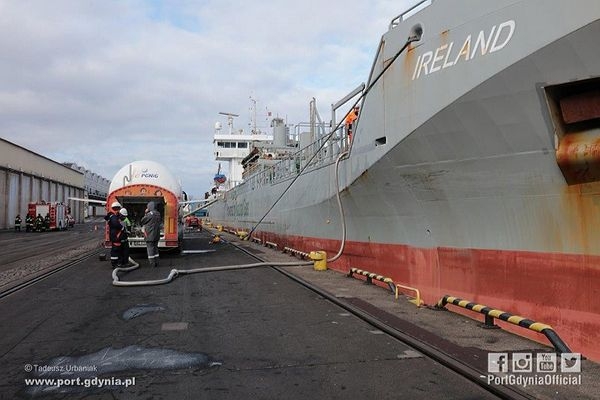
Commercial bunkering operations with eco-friendly LNG fuel have been carried out in the Tri-City ports. Over the past week, vessels powered by the “fuel of the future” have called at Gdynia and Gdańsk. These are the first operations of this kind in Poland.
LNG bunkering in Poland has become a reality. In total, across both Tri-City ports, 72 tons of LNG fuel (42,800 Nm3) were transferred from four tanker trucks to the tanks of the vessels “Fure Valo” and “Ireland”. The ability 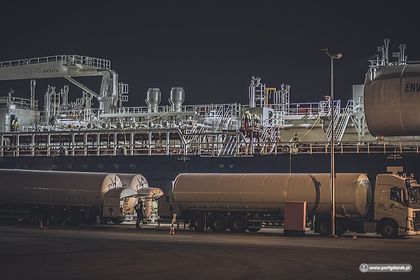 to bunker ships with one of the cleanest fuels available on the market positions the ports of Gdynia and Gdańsk as the next “green ports” in the TEN-T core network. In accordance with the directive on the deployment of alternative fuels infrastructure, Polish seaports are required to provide this type of service by the end of 2025 at the latest.
– Our experts took part in dozens of meetings, workshops, and conferences, during which they shared their knowledge regarding LNG. Their professionalism, commitment, and substantive contribution have helped create the regulations and procedures that others can now use – comments Adam Meller, President of the Port of Gdynia Authority.
– Polish ports are having their moment now. We are carrying out massive investment programs and securing new contracts. We are doing all this, firstly, to meet current market needs and, secondly, to prepare for what the future brings. One of the elements of this future is precisely vessels powered by liquefied natural gas – explains Łukasz Greinke, President of the Port of Gdańsk Authority.
Both ports have been preparing for LNG vessel fueling for a long time. They conducted rescue and emergency exercises,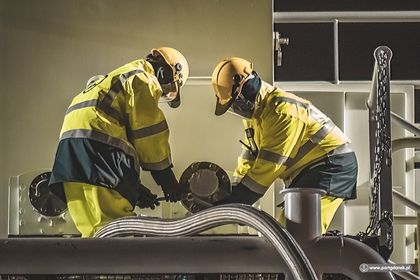 developed procedures and regulations, thanks to which the bunkering operations were carried out this month. By implementing the LNG bunkering service, the Tri-City ports are responding to the needs of a market that is rapidly changing the technologies used in maritime transport due to emission standard restrictions. As an eco-friendly fuel, LNG emits fewer harmful pollutants into the atmosphere during combustion than, for example, coal. Another advantage of LNG is the possibility of liquefying natural gas into LNG, which reduces its volume by approximately 600 times, leading to lower storage and transport costs for the gas.
Ships powered by liquefied natural gas (LNG) are increasingly leaving shipyards, which poses a significant challenge for ports in terms of servicing these vessels. Currently, the Tri-City ports provide LNG bunkering for ships via the truck-to-ship method. In the future, an alternative will also emerge in the form of a mobile bunkering point using ship-to-ship technology.