








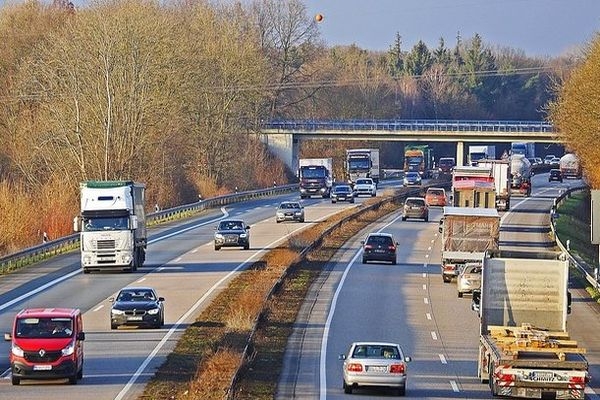
In 2018, over 30,000 transport companies in Poland carried 18% more goods than in the previous year, and their service sales grew by nearly 13%. The data looks impressive. However, the heavy transport industry will now have a steeper hill to climb than in previous years. Why? While the position of leader in international road transport is not currently threatened, domestic carriers must prepare for challenges—both those already known and entirely new ones, which generate uncertainty and anxiety. What is the condition of Polish enterprises providing goods transport services to and from European Union countries?
According to the latest Economic Risk Ranking for companies for 2019, the transport sector as a whole employs 1,078,000 people[1]. Meanwhile, the Statistics Poland (GUS) report shows that this is one of two industries that recorded the largest increase in employment compared to 2017. The number of purchased vehicles with a GVW of over 3.5 tons, which reached nearly 30,000 in 2018, increased by 8% compared to 2017[2]. In 2018, Polish enterprises employing more than 9 people transported 603.9 million tons of goods, which is as much as 10% more than the year before[3], and in total, Poles transported 289,920 thousand tons of cargo by road transport.[4] All the above indicators allow road transport to be assessed as a dynamically developing and stable pillar of the Polish economy. Is it really?
Economists and financial market experts show that it is otherwise. In reports on company bankruptcies in 2018, one can see an increase in such insolvent enterprises precisely in the TSL sector. The debt of 27.8 thousand Polish carriers totals over 925 million PLN, while in 2017 the debt amount was 664 million PLN.[5]
– Road carriers are particularly exposed to uncertainty and fluctuations both in Poland and among our export partners. The situation is not favorable, as lower economic growth in the eurozone, the planned secession of Great Britain, as well as proposed changes to the rules of operation in international road transport make the transport of goods by heavy trucks a major challenge for business owners – argues Łukasz Włoch, chief expert at the National Center for Driver Settlement (OCRK). – Internal risks, such as a decline in the profitability of domestic enterprises, to which smaller businesses are particularly exposed, and rising wages, and consequently labor costs, will also have a significant impact on the condition of Polish transporters. Add to this the specifics of freight settlements, where the contractor often receives payment for the service performed after several dozen days, as well as complicated and constantly changing EU regulations and high penalties for offenses – there are many factors threatening the financial liquidity of transport companies.
Hard to come by
Reports on forecasts and threats emphasize that Polish entrepreneurs have a problem with hiring qualified drivers – it is estimated that we are short of about 30,000 employees.[6] To improve the situation, regulations are being changed, for example, from this year:
• deaf people can apply for category C and C1 driving licenses,
• numerous facilitations are being introduced for employees from the East,
• students of the driver-mechanic and road transport technician professions in secondary schools can obtain category C and C+E qualifications.
However, there is still an insufficient number of drivers, which significantly hinders the development of enterprises but also generates costs for maintaining and acquiring employees. The Economic Risk Report also mentions this: “An important source of risk in this context are changes regarding the minimum wage in many Western European countries.”
– For many carriers, especially small ones, the costs of maintaining an employee may prove difficult to accept, especially since minimum wage rates have been constantly rising for 19 years. Furthermore, employers must face constant tightening of regulations regarding working time and wage accounting. Moreover, the penalties imposed on drivers and entrepreneurs in many cases are inadequate to the offense – comments Łukasz Włoch from OCRK.
A bottleneck not just on the road
An increasingly publicized problem is payment bottlenecks, which transport company owners have to face. The latest research on their debt shows that in 2018, the number of cases accepted for debt collection was 25% higher than the year before.[7]
– Difficulties in obtaining payment for a service performed are common in the TSL industry. It is worth noting the consequences, which can be ruinous for a carrier. Often, the financial bottleneck in question causes an extension of the time for transporting goods, which exposes the carrier to penalties imposed for failure to meet contract terms on time. Such amounts can reach as much as several hundred thousand PLN – adds the expert.
It won’t get better
Data from the Chief Inspectorate of Road Transport shows that there are 34,000 transport companies operating in Poland, and the majority of them are small enterprises with an average of 6 vehicles.
– Due to the fact that the sector is highly fragmented, it is difficult for smaller players to compete with large enterprises. Small companies are much more sensitive to rising costs associated with maintaining employees and any fluctuations in the Polish and foreign markets – comments Łukasz Włoch.
Main challenges for transporters in 2019:
• Deficit of qualified professional drivers; staffing shortages;
• Increase in minimum wage rates, i.e., raising the costs of maintaining an employee;
• Tightening of regulations and sanctions for non-compliance;
• Mobility Package – especially issues related to posted workers;
• Brexit – uncertain agreement scenario between the EU and Great Britain;
• Increase in fuel prices and road tolls;
• Meeting exhaust emission standards;
• Implementation and proper use of smart tachographs.
[2] Polish Automotive Industry Association
[3] Information on the socio-economic situation of the country in 2018
[4] Statistical Bulletin 12/2018 GUS
[5] Polish Transport Hindered by EU Regulations and Record Debts – National KRD Report, July 2018
[6] TransJobs.eu Report – Earnings of professional drivers in Poland; https://www.transjobs.eu/Raport-TransJobs.eu-Zarobki-kierowcow-zawodowych-2018.pdf
[7] https://pl.transinkasso.eu/aktualnosci/zadluzenie-firm-transportowych-w-2018/ (accessed: 21.02.2019)