








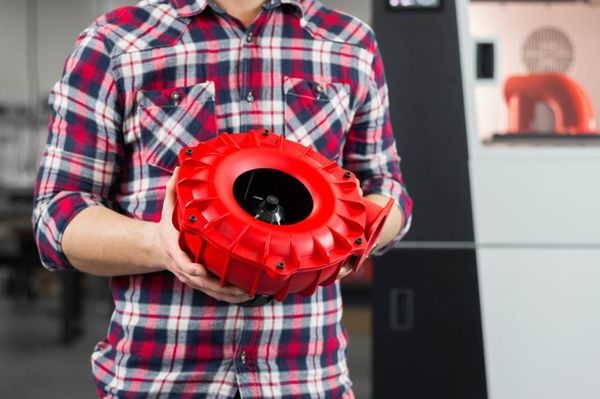
Companies like Electrolux, Panasonic, and Whirlpool have introduced this technology into their production processes to work more efficiently and prepare new models of their devices faster. 3D printing, as it is called, helps with prototyping, but it is also increasingly being used to manufacture parts that are installed in the finished product. Is this the answer to the home appliance industry’s woes?
According to a GfK report, in the first six months of 2018, the global major home appliance market recorded a growth of 3.5 percent, and the small appliance market grew by 7 percent. Forecasts predict that the upward trend will continue over the coming months. Despite its good condition, the home appliance industry is struggling with problems. Rising raw material prices, a lack of qualified staff, the need to improve production processes, and the introduction of innovations – all of this affects the condition of companies and forces them to look for new solutions. One of them may be 3D printing technology.
Savings and innovation
It seems that the constant increase in the price of home appliances is inevitable. This is influenced by, among other things, recycling costs burdening manufacturers, increasingly higher labor costs, or the drive to provide users with increasingly modern equipment, often with “smart” functions. That is why it is so important to look for savings that will allow for the optimization of company budgets.
In this case, it is worth looking at the entire production process and examining whether any of its stages generate avoidable costs. One must take into account not only the costs of raw materials and their processing, but also service, machinery, production lines, and finally, storage costs. Introducing innovations to factories, including 3D printing technology, allows for achieving significant savings, often not in just one, but in several departments of the company. Additive technology will positively influence the work of research and development, service, and maintenance departments. How is this possible?
Prototypes and spare parts from a printer
It is worth realizing that in the home appliance industry, 3D printing can be applied in four main areas: prototyping, production, mold making, and the supply of spare parts.
Today, 3D printing is used primarily in the first area, as it enables easy and fast creation of prototypes. This translates into significant savings in time and costs associated with product development and the time to market. Additive technology provides designers with greater freedom to experiment, even with designs featuring complex geometry. It also allows for obtaining prototypes that closely resemble the final product: companies can therefore propose a greater number of new ideas to potential customers and then decide to start production of those that generate more interest. Thanks to lower costs in the product development phase, engineers can test more designs simultaneously. Moreover, it is possible to control various aspects related to design processing in practically real-time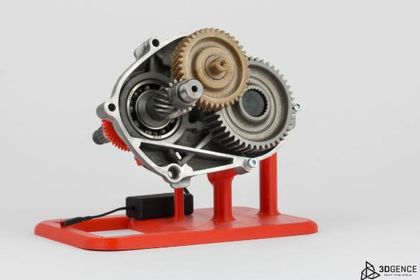 and quickly identify possible areas for improvement.
– The range of materials that can be printed using 3D technology is still expanding, thus providing more and more possibilities for production departments. Currently, we can already find PP (polypropylene) material on the market dedicated to the home appliance industry. Crucially, 3D printing allows for the creation of very geometrically complex shapes. This is a great opportunity for designers and manufacturers in the home appliance industry – says Mateusz Sidorowicz from 3DGence, a company that manufactures 3D printers.
Prototyping is not everything. Elements created using additive techniques can also successfully become part of tools, machines, or production lines, and even finished end products. Finally, 3D printing will also prove useful in the production of spare parts. Printing them on-site means reducing storage costs and accelerating the entire production and service process.
The example comes from the biggest players
And how does all this work in practice? Engineers from the Haier Group, a leading manufacturer of household appliances in China, recently printed a fully functional window air conditioner using 3D printing technology. They also created a miniature washing machine, which they present at trade fairs. Its drum, cover, and frame were printed.
Whirlpool Corp., on the other hand, has developed a new production process in which it uses molds from a 3D printer. They are used for the production of refrigerator doors. GE Appliances 3D prints metal and plastic parts for device prototypes. Engineers also use this technology to build tools that improve traditional production processes, such as plastic injection molding and thermoforming. Electrolux uses 3D-printed spare parts in its daily work, Panasonic has applied 3D printing in the television production process, and Hoover 3D prints accessories for vacuum cleaners. The pizza oven produced by FirstBuild, a subsidiary of GE Appliances, has 11 different printed parts. Home appliance manufacturers will certainly not stop there.
Although the home appliance industry is developing without major obstacles, it must deal with rising prices that translate into the final price of devices and the need to implement innovations that will allow it to stay ahead of the competition and attract customers. 3D printing provides real savings, allows for working more efficiently, and enables the much faster manufacturing, testing, and market introduction of new models. The biggest players are already benefiting from its advantages. It is worth following their example.