











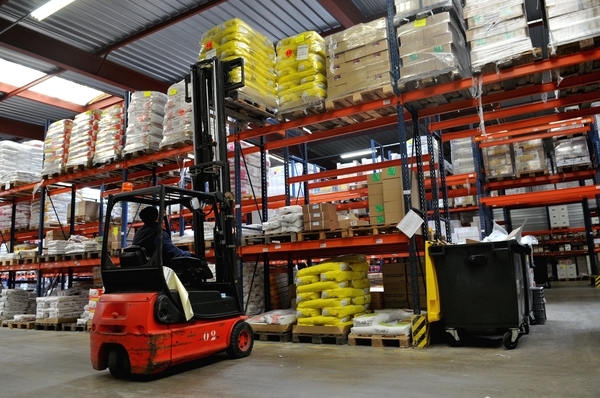
A warehouse is a link in the logistics system where goods are temporarily stored and directed to subsequent links in the supply chain. Warehouses can simultaneously serve as delivery and collection points, as well as hubs for the concentration or distribution of goods flows within the logistics system. Processes related to the accumulation of material goods stocks, their storage under proper conditions, and their transfer to recipients take place in the warehouse. The necessity for warehousing arises, among other things, from the fact that the production time of individual goods does not coincide with their consumption time. These differences are mitigated by appropriate stock accumulation in specific warehouses.
Consequently, warehousing refers to activities related to the large-scale storage of goods in a systematic and orderly manner, making them conveniently available when needed. In other words, storage means possessing or keeping goods in huge quantities from the moment of their purchase or production until their actual use or sale.
In supply chains, warehousing is an important element of operations in the distribution of goods, raw materials, and their production. It constitutes an integral part of the supply chain network, where activities, roles, and goals must be synchronized with the goals of the supply chain. Storage is costly in terms of human resources, facilities, and necessary equipment, and it directly affects the overall supply chain performance. Inadequate design and management of the storage system can lead to failure to achieve the required level of customer service, as well as the generation of excessively high costs.
Characteristics of warehousing and automation
Warehousing
The latest trends and pressure related to continuous changes, also within the supply chain and logistics, have caused an increase in customer service levels, inventory optimization, compression time, and cost minimization – inevitably changing the structure of the supply chain and the location and operation of warehouses within supply chains. A modern warehouse can no longer function effectively without the use of automation processes, because the benefits resulting from the application of new technologies allow for achieving a decisive competitive advantage for a given enterprise over others that have not implemented modern techniques to improve work and warehouse efficiency.
Initially, warehouses were created in a completely non-mechanized form. All work in such warehouses was performed manually, with the total use of human labor. There is no doubt that this type of warehouse is characterized by low throughput and work efficiency due to the long duration of individual activities without the help of mechanical devices. Another aspect of non-mechanized warehouses is the required large number of employees, which adversely affects the costs incurred by the warehouse manager.
The essence of improving warehouse work is that it is undertaken in places that require significant effort, high labor intensity, or where dangerous processes occur. In the initial phases, automation consisted, for example, of introducing a palletized form of storage and transshipment, or implementing mobile cranes with a very long boom. In subsequent stages, further development of palletization, containerization, and packaging took place. Various types of pallets, conveyors for moving pallets, special pallet racks, forklifts, stacker trucks, containers of various sizes, hoists, and overhead cranes were created. In mechanized warehouses, work can be carried out on the basis of “man to material” or “material to man”. Storage in warehouses according to the first principle involves the use of forklift trucks and warehouse stacker cranes and the retrieval of materials from rack slots. This method can be used in warehouses equipped with row frame racks.
The article contains 20,130 characters.
Source: Logistyka Magazine