











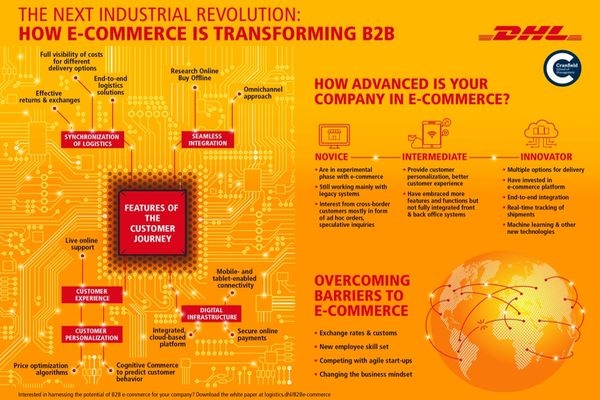
DHL Express, in collaboration with the Cranfield School of Management, has published a white paper. It contains the results of research on current trends and the significant potential existing in the field of e-commerce for business-to-business (B2B) service providers. The white paper serves as a practical guide to the specific features and digital strategies used by companies that are developing cross-border trade offerings. It presents a framework enabling companies to better understand and benchmark their own level of e-commerce development.
– In recent years, we have seen faster growth in business-to-consumer (B2C) e-commerce than in other sectors of the economy, with international premium shipments growing from 10% to over 20% of DHL Express’s turnover – said Ken Allen, CEO of DHL Express. – As the analysis shows, there is potential for dynamic growth in cross-border B2B trade, and the DHL Express network will enable this growth for companies around the world.
– E-commerce is radically changing the way B2B companies operate and is opening up new market opportunities around the world, while motivating many established companies to keep pace with agile new firms – said John Pearson, CEO of DHL Express Europe. – The most successful e-commerce companies today offer an enhanced customer experience, comparable to what we all know from our private online shopping. To compete in this changing market environment, B2B companies must also transform their supply chains, becoming more transparent, optimized, responsive, and flexible. Based on years of cooperation with the B2B sector and the success achieved in handling cross-border B2C transactions, DHL Express is well-positioned to help industrial companies enter the e-commerce market more actively.
According to Forrester Research, the volume of cross-border B2B transactions is expected to reach USD 1.2 trillion over the next five years. To capitalize on this potential, companies must provide a more flexible, scalable, and mobile customer experience, similar to that of retail (B2C) online shopping. However, B2B transactions are fundamentally different from B2C transactions, which requires a different approach. It is crucial for B2B companies wishing to provide such a customer experience to adapt certain website features and functionalities, such as product catalogs and direct customer support, or better integration of sales systems with accounting and administrative systems and comprehensive logistics processes.
– During our research, we identified three archetypes of companies operating in the e-commerce space, from “beginner” through “intermediate” to a true “innovator” – said Prof. Michael Bourlakis, Chair in Logistics and Supply Chain Management at Cranfield University. – Beginners, for example, have just started dipping their toes in the water when it comes to e-commerce and have basic functionalities on their websites. Innovators, on the other hand, have sophisticated offerings and use advanced technologies, such as machine learning and virtual reality, to better predict customer requirements and offer them personalized experiences. Within this framework, companies can see how they compare to other firms developing e-commerce offerings and gain knowledge on how to improve their own e-commerce operations.
For companies thinking about making their networks more flexible and capitalizing on overseas demand that sometimes emerges unexpectedly through the introduction of e-commerce offerings, international express logistics providers can provide global networks that enable direct access to foreign markets on a door-to-door basis and premium service handling. This allows the B2B sector to engage with new customer segments efficiently, without the need for extensive warehouse and distribution networks in markets with low transaction volumes. They also provide indirect benefits to e-commerce companies by strengthening brand credibility and trust, streamlining logistics processes, and minimizing financial risk by reducing the time it takes to transport goods and ensuring full visibility of orders.
Based on a combination of secondary research and survey results, the white paper identifies five categories of features that are essential for B2B e-commerce platforms: digital infrastructure, customer experience, customer personalization, seamless integration, and logistics synchronization. For companies looking to develop their capabilities in these five categories, the white paper also offers practical recommendations, such as using business analytics tools to gain better data and improve customer insights, as well as drawing inspiration from the supply chains of major retailers when developing omnichannel sales networks (i.e., combining physical stores with online or mobile channels).
New white paper “The Next Industrial Revolution: How e-commerce is transforming B2B”