












The construction industry is a field of economic activity where a relatively high number of accidents leading to death or injury are recorded. Regardless of the fact that these numbers are decreasing year by year, the key issue is compliance with Occupational Health and Safety (OHS) rules.
Before work begins, the investor is obliged to prepare a construction design, appoint management, and develop a health and safety plan, known by the acronym BIOZ. The primary goal of the latter is to reduce risks during construction work. The site manager is directly responsible for the safety of people on the construction site. They may appoint coordinators to monitor compliance with OHS and BIOZ regulations, but this does not relieve them of responsibility for the health and lives of their subordinates. Employees, in turn, should follow the instructions of their superiors and perform work in accordance with OHS regulations. It is also their duty to participate in OHS training and use personal protective equipment. In the event of any danger, it is necessary to inform the person managing the construction site and temporarily stop working.
Construction work under special supervision
Before starting work, the manager, together with the employees, should properly organize the construction site. The area where work will be carried out must be fenced off to prevent unauthorized persons from entering the site and to eliminate uncontrolled vehicle entry. For this purpose, appropriate barriers and gates are used to restrict the work area. A condition for starting construction work is the provision of water and electricity, as well as the organization of social rooms and a hygiene and sanitary zone for employees. The site manager must also ensure that appropriate internal roads are designated and mark out dangerous zones, i.e., those that pose a direct threat to the health and life of people staying near the construction site. If there is a risk of falling objects around the building, this area should be at least 1/10 of the object’s height, with the minimum dimension of the zone exceeding 6 meters. Portable barriers, scissor grilles, and warning tapes in signaling colors are usually used to separate the dangerous area. In turn, passages and walkways in the building should be covered with tight and durable protective roofs, located at a height of at least 2.4 meters and inclined at the lowest point at an angle of 45 degrees.
Proper signage and personal protective equipment as a condition for employee safety
Construction law and OHS regulations also require proper signage for every construction site. In addition to the information board, the investor is obliged to use appropriate safety signs, warning employees of various hazards or ordering them to behave in a certain way in a given zone. All those working on the construction site, as well as visitors and those supervising the work, are in turn obliged to strictly follow the messages contained therein. In accordance with the decision of the Minister of Labor and Social Policy, employees performing specific tasks are also obliged to use personal protective equipment, provided free of charge by the employer and intended to protect against injuries and bodily harm. They are matched taking into account the nature of the work and the associated risks. They must have appropriate certificates proving their suitability for work in specific conditions. The employee should use them until they are worn out, which may mean that a given protection will serve them for an indefinite period of time. When personal protective equipment is damaged, the employer is obliged to provide new items. It is worth remembering that a construction worker cannot perform their task without appropriate equipment and protective clothing. Importantly, the supervisor should also inform subordinates about the rules for using personal protective equipment.
Individual and collective protection in work at heights
By far the highest percentage of accidents on construction sites is related to work at heights. To minimize the number of risks, individual and collective protection measures are used. The first group includes primarily harnesses, lanyards, ropes, and shock-absorbing and self-locking devices. In the category of collective protection, railings protecting the employee from falling are essential. It is also worth paying attention to the safety of equipment enabling activities at heights. In external work, mobile scaffolding and work platforms are most often used. Modern products are equipped with a triple fastening mechanism, thanks to which they can be efficiently installed on the construction site. A compact, foldable design enables trouble-free transport and storage. Mobile scaffolding should be installed, operated, and dismantled in accordance with the manufacturer’s instructions by persons authorized for this type of work. If there is a risk of objects falling from a height, it is necessary to use covers in the form of protective nets. Particular caution should also be exercised when using leaning ladders. It is worth remembering that they should extend at least 0.75 meters above the edge against which they are leaned. It is forbidden to perform plastering and painting work on them. You also need to pay attention to the load capacity of the ladder, taking into account the weight of the employee and the weight of the building materials. On the market, besides classic ladders, safe platform models are available and mobile scaffolding. If there is a need to frequently transport a ladder, foldable variants with height adjustment are a good solution. An alternative to a ladder is a wide work platform, which guarantees greater work comfort, especially for activities requiring long-term engagement. Industrial stairs enabling efficient movement of employees are also helpful in creating access routes to places at heights. A condition for safety remains the permanent control of the condition of the equipment, carried out systematically both by qualified specialists and by the employees themselves.
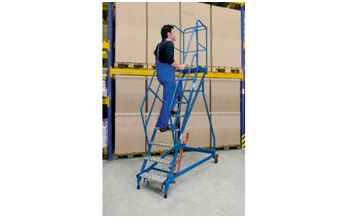
Platform ladder (source: kaiserkraft.pl)
It should also be noted that on 01.01.2018, an amendment to the EN131 standard, which concerns leaning ladders over 3 m, comes into force. Changes in requirements affect the use of leaning ladders longer than 3 meters, which will require widening the base, e.g., by using cross-traverses or a tapered construction.