










Due to the increasing mobility of Europeans, frequent travel, and changes in place of residence, the provision of medical services in a cross-border context has taken on a crucial new dimension, including the ability for patients to issue and fill prescriptions abroad. Issues related to this are legally regulated and allow for the issuance of paper-based prescriptions. Among healthcare industry representatives at the European Union level, there is a growing drive to develop a solution for the electronification of this procedure.
The electronic prescription is still associated as a symbol of innovation and modern solutions in the healthcare sector in Poland. Consequently, there is no shortage of concerns and doubts regarding the belief in the lack of readiness to implement such a solution in Poland, as well as the effectiveness and efficiency of its operation. Experts argue that these concerns are not fully justified, as pharmacies are equipped with computer hardware and appropriate pharmacy software. All medical offices, clinics, and other facilities not only must have computers but also a secure and stable internet connection. Proper equipment, as well as training for doctors, should take place so that all parties are adequately prepared for the implementation of electronic prescription requirements.
Among the various technical factors on which the effective and efficient functioning of the electronic prescription depends, the register of medicinal products also plays a key role. Based on this register, the person authorized to issue a prescription will create a list of medicinal products for the patient. In Poland, a reference register was created as part of the so-called P2 project, i.e., the “Platform for providing online services and resources of digital medical registers to entrepreneurs,” implemented by the Centre for Health Information Systems (CSIOZ). This register includes medicinal products authorized for marketing in the territory of the Republic of Poland and medicinal products entered into the Community Register of Medicinal Products.
It can therefore be stated that sooner or later, conditions will exist in Poland for the effective and efficient issuance and fulfillment of prescriptions in electronic form. However, will such a prescription – issued in Poland – be able to be filled in another European Union country under favorable legal conditions? This question, among others, has become the subject of discussion in many EU countries. Despite uniform legal regulations for member states, each country is characterized by its own, very often specific, approach to national regulations. This, in turn, affects the way medicinal products prescribed to patients as part of specific pharmacotherapy are described and identified. Such an approach entails specific consequences in the form of the lack of a uniform EU dictionary of medicinal products that would enable the effective fulfillment of an electronic prescription issued in a country other than the one where it was issued.
The reason for the difficulties in fulfilling an electronic prescription in a cross-border context is – in addition to the lack of a uniform dictionary of medicinal products – also the different way of prescribing drugs. There is a possibility of prescribing drugs using their international, chemical, or trade names. However, it should be remembered that trade names may differ depending on the country. Furthermore, within the EU, there are different procedures for registering medicinal products, different ways of authorizing products for marketing, and consequently: different methods of coding product data. The lack of a uniform approach to the identification of medicinal products is also a consequence of the use of national drug identifiers and attributes, which are understood only in the country where they are used. An additional difficulty is also the diverse approaches regarding the use of substitutes and the type of availability of medicinal products (OTC drugs vs. prescription drugs).
In view of the above, standardization trends are increasingly observed at the EU level, aimed at unifying the way data on medicinal products is collected and exchanged. Actions and initiatives undertaken at the European Union level clearly reflect the necessity for harmonization and standardization of specific solutions and methods of conducting selected processes, as signaled by healthcare representatives. This necessity is a result of the greater mobility of EU citizens and the pursuit of the highest possible level of patient service in the context of providing medical services in a cross-border context. The goal of such actions is to ensure the safety of pharmacotherapy, and consequently, patient safety.
Developing a concept for a mechanism conducive to the fulfillment of a cross-border electronic prescription was the idea that guided the project initiated in 2014 called OpenMedicine. The project involved 8 partners from the EU, with the support of a very large group of external experts. These include representatives of institutions such as the World Health Organization (WHO), the European Medicines Agency (EMA), and the American Food and Drug Administration (FDA). As a result of the work, a concept for a common data model, as well as a common nomenclature, was developed.
The starting point for the developed concept was a set of five international ISO standards regarding a harmonized approach for the identification and description of medicinal products, the so-called ISO IDMP (Identification of Medicinal Products). These standards, EN ISO 11238, EN ISO 11239, EN ISO 11240, EN ISO 11615, and EN ISO 11616, form the basis for the unique identification of medicinal products, giving authorities responsible for the supervision of these products a tool used in the process of development, registration, and management of the medicinal product life cycle, as well as monitoring adverse reactions and risk management. An integral part of these standards are specifications for data exchange. It is worth emphasizing that these standards refer to and are based on specific standards and solutions in the relevant areas, e.g., units of measurement (SI), the medical data exchange standard (HL7), or global identification standards (GS1).
In accordance with Commission Implementing Regulation (EU) No 520/2012 of 19 June 2012 on the performance of pharmacovigilance activities provided for in Regulation (EC) No 726/2004 of the European Parliament and of the Council and Directive 2001/83/EC of the European Parliament and of the Council, a legal requirement was formulated for the pharmaceutical industry to use terminology consistent with ISO standards. These standards were chosen not only because they standardize the approach to unique and harmonized identification of medicinal products for various purposes and unify the principles of describing and exchanging drug data. They will form the foundation of the medicinal product database created by the European Medicines Agency for monitoring drug safety and reporting their adverse reactions.
From a practical point of view, specific and agreed-upon identifiers will be assigned to each medicinal product, enabling the unambiguous identification of such a drug at various levels, i.e.:
– pharmaceutical product identifier: active substance, form, dose (pharmaceutical product identifier, abbreviated as PhPID),
– medicinal product identifier: marketing authorization holder, active substance, trade name, form, dose (medicinal product identifier, abbreviated as MPID),
– medicinal product identifier in a specific packaging form: marketing authorization holder, active substance, trade name, form, dose, number of units in the package (packaging identifier, abbreviated as PCID).
Thanks to such a unified approach, it will be possible to fulfill an electronic prescription cross-border according to the following scheme:
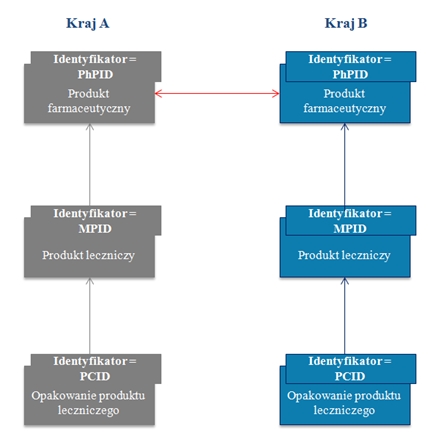
A common level of identification at the EU level will be the so-called PhPID. It should be remembered that the proposed concept will be possible to implement once all member states implement the ISO IDMP concept into national drug dictionaries. Furthermore, these databases will need to communicate with the European database being created by the EMA. It is expected that the start of implementation will not occur before 2018. From that date, not only the convenience of traveling patients but also their safety should increase.