











In Polish workplaces inspected by the National Labour Inspectorate, the most frequently identified irregularities are related to shortcomings in occupational health and safety training and compliance with safe work practices by employees.
In the context of striving to improve the level of occupational safety in Poland (including reducing the accident rate), labour inspectors pay special attention to occupational risk assessment and its quality – an improperly conducted risk assessment is seen as one of the causes of occupational accidents and a circumstance conducive to the development of occupational diseases. The number of accidents at work in warehouses is worrying – in 2012, there were over 6,000 accidents in Polish warehouses (this is 7.0% of all occupational accidents). It is therefore worth asking the questions: was the occupational risk assessment complete? Were all hazards identified in the assessment process? Was the knowledge of the assessment team sufficient to notice and properly interpret the changing work environment of a warehouse worker? Among the typical neglects regarding occupational risk assessment, the lack of a comprehensive approach to the problem of hazard identification is of particular importance – incomplete identification of hazards primarily concerns psychosocial hazards. This is all the more worrying because exposure to psychosocial factors can be related to all types of work activities.
The warehouse as a workplace
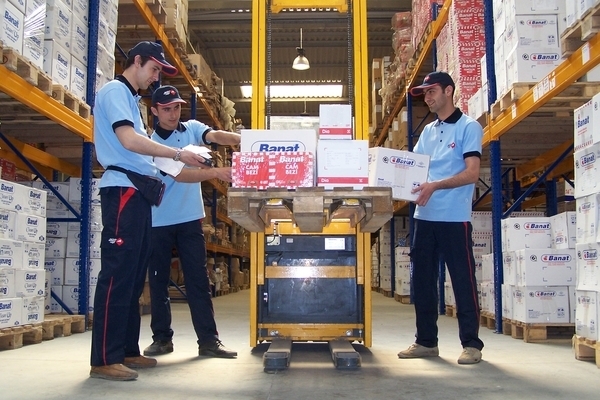
The term warehouse should be understood as a functional and organizational unit intended for storing material goods (stocks) in a separate space of a warehouse building according to an established technology, equipped with appropriate technical means, managed and operated by a team of people. The basic tasks carried out by a warehouse are the storage of goods for the required, limited time and all necessary handling activities related to moving goods and changing the form of load units. Regarding warehouse personnel, warehouse work includes activities related to unloading and loading goods, operating internal transport equipment, e.g., pallet trucks and forklifts, lifting equipment (rope and chain electric hoists, overhead cranes), as well as manual handling and lifting of loads. Ladders and platforms are also used in these works. A warehouse employee most often must have qualifications to operate various types of forklifts and to replace gas cylinders in the case of gas-powered trucks, as well as to operate battery charging stations at electric truck charging stations. Certain hazards are associated with performing the profession of a warehouse worker.
The article contains 39,260 characters.
Source: Logistyka Magazine
Sadlowska-Wrzesinska_Gabrylewicz_Drozyner_PROJAKOSCIOWE_ASPEKTY_OCENY_RYZYKA.pdf