











Access to market knowledge, cost optimization, and improved efficiency of logistics operations. These are just three of the benefits provided by the presence of a logistics process integrator in a company. 4PL is not a new concept, yet many companies still do not understand the differences between this model and 3PL services. Together with Rafał Krajewski, General Manager of GEFCO Poland, and Georges Gomes from GEFCO 4PL, we explain where the benefits of outsourcing logistics to an external company come from. And although the term 4PL was first used over 20 years ago, industry specialists claim that the popularization of this service in Poland is only just beginning.
Better understanding of 4PL
Before we explain what 4PL is, let’s start from the beginning. A 2PL operator is, for example, a carrier that transports goods on behalf of a client without offering integrated logistics solutions. A 3PL solution is already more comprehensive. The role of such a provider is to select means of transport and provide executive supervision, but the design of the supply chain itself remains with the client’s logistics department. In contrast, 4PL models are characterized by much greater integration, and the client only indicates what they would like to transport and where. It is the operator’s responsibility to design the entire process and manage it. 4PL is, in fact, the outsourcing of logistics services, which is why clients in this form of cooperation usually do not have their own TSL (Transport-Spedition-Logistics) departments. Importantly, operations are highly personalized because they are designed from start to finish for specific companies.
 – Let’s explain the differences between 3PL and 4PL using the example of building a house. If a client comes with a finished architectural design, divides the work among teams, and handles the purchasing and construction supervision themselves, then we are talking about an analogy to 3PL services. However, if the client informs about their expectations regarding the style of the house, its functionality, budget, and acceptance criteria, and it is the company’s responsibility to design and execute the construction through competent and supervised subcontractors selected in tenders, then such a comprehensive solution is an analogy to the activities of a 4PL integrator in the logistics industry – explains Rafał Krajewski.
The differences between 3PL and 4PL are also easy to show using the example of the tender process. In the first case, the client, who has designed the logistics solutions themselves, sends a request for proposal to suppliers they know. This process, although repeatable, is usually carried out every few years and involves significant resources in a short time. In contrast, with 4PL services, developing the process architecture and finding the best 3PL suppliers in terms of quality and price, who will be responsible for individual stages of the chain, is the task of the logistics company.
– It cannot be said that integration at the 4PL level is always better than 3PL. When choosing a specific model, one must take into account the size and scale of the company’s operations, the complexity of logistics needs, available resources, qualifications, and market knowledge. 4PL is simply moving to a higher level, i.e., an even deeper entry into the client’s logistics structures and processes so that they can focus on their core business – adds Krajewski.
For whom is 4PL?
4PL solutions will work for companies of various sizes. They are particularly helpful in companies with underdeveloped logistics departments that do not have sufficient resources and experience in designing logistics processes and knowledge in this area. A logistics department of a few people is often unable to properly manage complex logistics and planning. A dynamically changing base of partners and the resulting new logistics needs make it increasingly difficult for logistics departments to maintain the expected efficiency, especially in terms of designing solutions and sourcing appropriate logistics operators specialized in specific markets and services. This prompts company boards to restructure logistics departments in order to reduce costs, save time, and streamline processes. Another example of companies for which a 4PL solution will work are large entities that build their position by focusing on core business, for example, production. They invest their resources in the market and product, leaving the design of processes, searching for synergies, and controlling logistics to external entities, monitoring their work through service agreements.
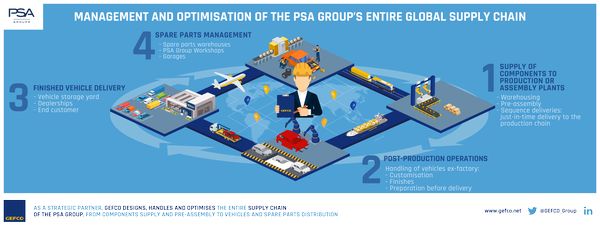
Handing over logistics operations to an external company is a difficult decision, but it is worth the profits associated with it. For example, the PSA Group, owner of brands such as Citroen, Peugeot, and the American concern General Motors, uses the comprehensive services of GEFCO 4PL. The 4PL solution gives clients access to deeper layers of the market. A company deciding on the GEFCO 4PL service gains knowledge of which 3PL operator offers the most favorable solution and the best prices immediately after signing the contract. It also receives very well-developed tools, including a ready-made process for acquiring suppliers and purchasing. In addition, there are savings, because fixed costs, which are high with in-house logistics, are shared among several companies in the case of 4PL. The benefits of 4PL also include outsourcing the management of part of the staff or sharing administrative costs among several companies.
– 4PL is a facilitation in markets where it is difficult to find specialists or when additional and expensive training is needed. Companies using 4PL also praise the outsourcing of accounting, from checking the correctness of invoices to tax matters and reporting – says Georges Gomes.
A 4PL integrator can also offer a company ready-made IT solutions that increase the efficiency of purchasing and accounting operations. According to Rafał Krajewski, companies that enter the 4PL model rarely abandon it, because returning to 3PL and their own full logistics department is increasingly losing its economic justification.
– 4PL provides savings, access to knowledge about the market and trends, and also transfers responsibility for service quality to the operator. Managing logistics on one’s own usually does not have such potential, also because a company moving around the market only knows its own flows. Thanks to cooperation with several clients, 4PL can simply have a broader recognition of the market – explains Rafał Krajewski.
Transparent selection of subcontractors
An advantage of 4PL is also the way tenders are organized on behalf of the client. Thanks to this, the client does not have to involve their employees in this or conduct tedious proceedings. The process of selecting a 3PL supplier is transparent and based only on the indicated tender criteria, because the purchasing department, after preparing the request for proposal, is separated from the operational teams. For example, GEFCO 4PL treats the GEFCO 3PL branch on an equal footing with other operators participating in the tender. The GEFCO 4PL request for proposal goes to various players on the market so that the most favorable solutions can ultimately be presented to the client. Additionally, GEFCO 4PL allows its clients to participate in the tender and provides information on the costs and scope of offers submitted by 3PL suppliers upon their request. On this basis, clients can indicate their preferred subcontractors and have an active participation in the final decision.
It happens that 3PL service providers ask why they are carrying out very few orders or have not received a new contract.
– Such a situation results solely from their insufficient competitiveness. Sometimes favorable circumstances decide the win, when, for example, the existing flows of a 3PL operator can be used to handle a new order – says Georges Gomes.
The situation may look as follows: an operator transports finished vehicles from Germany to France. When a tender for transport in the opposite direction appears, such a carrier with empty trucks or wagons can offer GEFCO 4PL a very attractive price.
– Thanks to the professionalization of the purchasing process, it is easy to audit the work of a 4PL integrator. In our case, we have developed procedures that eliminate the risk of irregularities and doing business based on connections – emphasizes Gomes.
Information protection and transparency of operations
Confidentiality in the work of a 4PL integrator primarily concerns its relationship with the client. All information about the client company’s operations and its business needs is covered by a protection clause. In turn, internal confidentiality at GEFCO applies between 3PL and 4PL structures. The organizational culture in the company and the management board are shared. However, knowledge about the client – their needs, way of functioning, and details of offers from companies competing with GEFCO 3PL remain confidential. To further increase the independence and transparency of processes, GEFCO 4PL and 3PL teams work in different buildings, and even different cities, and employees do not have access to each other’s offices.
Concerns exist, but the future belongs to 4PL
A barrier to the popularization of 4PL is the lack of market awareness about the service, and consequently, companies do not see the tangible benefits of handing over a large part of the logistics department’s duties into the hands of a 4PL integrator. Decision-making processes in international companies are also an obstacle.
– Company heads are often afraid of big changes. They prefer to have logistics in-house. Let’s remember that companies once thought the same about transport. They wanted to have their own trucks and did not trust carriers. Then 2PL appeared, and later 3PL. We are currently at the stage of popularizing 4PL services. I am convinced that companies will increasingly see 4PL operators as strategic partners, without whom it is difficult to achieve a good business result – emphasizes Rafał Krajewski.
It seems that there is no turning back from 4PL. The pace of introducing changes will, as usual, be dictated by the invisible hand of the market. Wanting to win against growing competition, more and more companies will have to focus their efforts even more on their core business and put logistics in the good hands of a 4PL integrator. The computerization of the logistics sector will only favor this.