











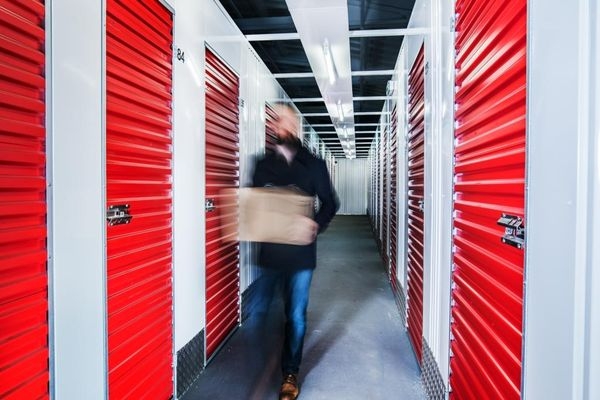
Companies involved in online retail are increasingly using self-storage facilities instead of traditional warehouses.
E-commerce is escaping from warehouses
Online retail is growing in Poland. According to a report by the Chamber of Electronic Economy, 48% of internet users already shop online. By 2020, the value of the Polish e-commerce market is expected to exceed PLN 63 billion, forecasts Sociomantic Labs. Storing goods is becoming a challenge for this growing and highly diverse market. More and more companies in the industry are looking for solutions that will allow them to avoid the need to rent a traditional warehouse. The reason? Maintaining a facility, securing it, and paying rent increases business costs and affects the price of the products sold. It is no wonder, then, that the dropshipping model, which completely eliminates the need for a warehouse, is popular among key market players today. In this model, the manufacturer sends the goods directly to the buyer. Stores that generate a high number of orders also have a way to limit warehouse involvement. They commonly use cross-docking, which involves storing goods only for the duration of transshipment.
A warehouse for a moment
Small companies have a slightly bigger problem with avoiding warehouses. Their operations often require storing at least part of their stock. This applies especially to stores selling less mass-market products. Seeking savings and alternatives, these companies are increasingly turning to self-storage facilities, i.e., storage units and boxes. Their market in Poland is developing. There are 11 such places operating in the country, with the most in the Masovian, Greater Poland, Lower Silesian, and Silesian voivodeships. However, the low supply of space does not discourage potential tenants; on the contrary.
– E-commerce companies make up an increasingly large group of business tenants in self-storage facilities. They are chosen primarily by local companies selling through auction sites or on their own platforms. These are largely stores selling electronics, cosmetics, and also car parts – says Aleksandra Suwała, a representative of the Sejfboksy storage facilities from Sosnowiec.
Where to cut costs?
For companies in this segment, often having an office at home, renting a large warehouse space is unprofitable. And this is where self-storage comes in. Firstly, they give companies the option of renting for a very short time (even for 1 month), and secondly, renting does not involve additional costs, e.g., for securing and adapting the warehouse.
– Online stores today treat self-storage as an ad-hoc additional space that they rent when needed. It is rare for a store to use it long-term. Most often, it is a monthly, quarterly, or semi-annual rental. Such a solution is more economical because it does not generate an additional, fixed cost for the company that could affect the price of the goods. This is an option, for example, for companies selling more intensively during the summer or winter season – says the Sejfboksy representative.
But companies don’t just find savings here. By choosing a self-storage facility instead of a traditional one, a store does not have to invest in securing the room or adapting it, especially if it sells goods sensitive to, for example, humidity or temperature. Self-storage facilities are already prepared for this. The halls where the storage units are located are constantly monitored, and the rooms themselves are secured with a padlock that the tenant buys themselves. Entry to the warehouse area is possible only after entering a special code. Meanwhile, constant conditions are maintained in all interior parts of the warehouse.
– In many respects, self-storage facilities are safer for goods than a traditional warehouse or an apartment, especially if the store sells luxury goods, computer equipment, software, or games – says Aleksandra Suwała.
As many meters as needed
Using a self-storage facility by a store also means a more economical approach to space – experts argue. The self-storage options available in Poland give companies several rental options – from rooms as small as 1 cubic meter, through 3 sq. m., 4 sq. m., 5 sq. m., and 7 sq. m., up to 10-meter boxes.
– The company pays only for the space it needs. It does not bear the costs of maintaining excess space. Combined with flexible rental time, this means that a store can use different storage units of different sizes throughout the year, depending, for example, on the level of sales – says the Sejfboksy representative.
Rental prices on the market are quite varied and depend on the size of the box and the rental period. In the case of Sejfboksy, they start from PLN 50 net/month. At this price, you can have a box with an area of 1 cubic meter. For PLN 80 net, you can rent 1 sq. m., and for PLN 165 net, a 2-meter warehouse. For 5 sq. m., you have to pay PLN 300 net/month, for 6 sq. m. PLN 330 net/month, for 7 sq. m. PLN 350 net/month, and for 10 sq. m. PLN 500 net/month. Monthly rental prices are lower the longer the store occupies the locker.
– If we decide to rent for longer than 1 month, we can count on discounts. By renting 10 sq. m. for a year, we will pay PLN 440 net per month instead of PLN 500 net – says the Sejfboksy representative.
Inside the warehouse
What exactly do online stores store in self-storage?
– Storage units are used primarily by small stores selling electronics, software, computer games, and consumer electronics. Secondly, these are companies trading in car accessories, as well as specialized stores for collectors, e.g., vinyl records. The warehouses are also popular with companies that trade in antiques and interior furnishings – lists Aleksandra Suwała.