











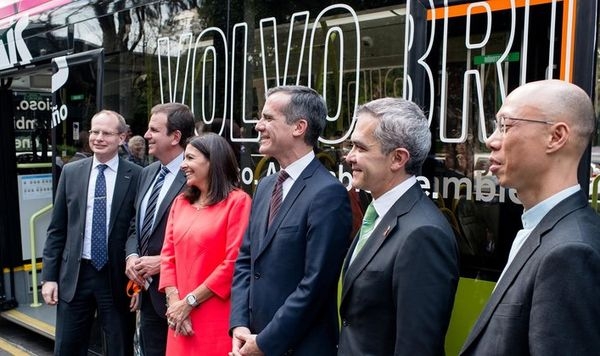
Volvo Buses highlights the benefits of electromobility and introduces the world’s largest bus in Rio. The historic C40 Mayors Summit brought together city leaders from around the world in Mexico City to discuss low-emission technologies of the future. Air pollution is now the world’s biggest killer1. It is predicted that the number of victims of air pollution will double as the urban population grows and the number of cars worldwide reaches 2 billion by 20502.
The level of air pollution has risen dramatically. In March, the World Health Organization (WHO) warned that pollution levels have risen globally by 8% over the past 5 years3. Billions of people are exposed to dangerous and polluted air, which causes more than 3 million deaths annually – more than malaria and HIV/AIDS combined4.
Following the 2015 UN Climate Change Conference in Paris (COP21), mayors from around the world have now gathered in Mexico City to discuss the growing climate change crisis. They called for immediate action on the unacceptable levels of pollution facing major urban areas. Researchers, urban planners, and a group of experts discussed energy efficiency, low-emission transport technologies, climate resilience, and other essential issues.
The number of expected bus trips in cities is set to increase by nearly 50% by 20305, which will hopefully reduce the number of passenger cars on the road. However, buses travel up to 10 times more than passenger vehicles, having an even greater impact on emissions6 – particularly those that are poorly maintained and require repairs.
Volvo has delivered 3,000 hybrids and electric buses worldwide. This number is constantly growing. Most of these vehicles are operating in cities in the UK, Colombia, Sweden, Spain, and Germany. The brand also recently unveiled the world’s largest bus at FetransRio, which has a capacity of up to 300 people. The vehicle is 30 meters long and was designed to meet the needs of Bus Rapid Transit (BRT) systems and provide more efficient transport, while additionally reducing fleet size and emissions.
Cities are being urged to adopt electromobility transport solutions, including electric and hybrid vehicles. Last year, 26 metropolises signed the C40 Clean Bus Declaration to replace parts of their fleets with eco-friendly vehicles. If 26 metropolises were to replace their entire fleets with Low Emission Vehicles (LEV), it would be possible to reduce greenhouse gas (GHG) emissions by 2.8 million tons each year – the equivalent of taking 590,000 cars off the road7.
– Cities around the world are taking positive steps, responding to global transport problems by introducing LEV systems. We believe that electric bus systems, which are both eco-friendly and comfortable, are the future of urban public transport – says Håkan Agnevall, President of Volvo Bus Corporation.
Modern electric buses are also quiet and can be equipped with various amenities, including Wi-Fi. The latest electric bus innovation also allows for groundbreaking applications for urban planners, such as bus stops inside libraries or recreation centers.
1 https://www.theguardian.com/world/2016/nov/01/madrid-poised-to-restrict-cars-in-city-centre-amid-air-pollution-fears
2 http://www.c40.org/blog_posts/cities-are-leading-an-electric-bus-revolution
3 https://www.theguardian.com/world/2016/nov/01/madrid-poised-to-restrict-cars-in-city-centre-amid-air-pollution-fears
4 https://www.theguardian.com/world/2016/nov/01/madrid-poised-to-restrict-cars-in-city-centre-amid-air-pollution-fears
5 http://www.c40.org/blog_posts/cities-are-leading-an-electric-bus-revolution
6 http://www.c40.org/blog_posts/cities-are-leading-an-electric-bus-revolution
7 http://www.c40.org/blog_posts/cities-are-leading-an-electric-bus-revolution
Further detailed information on BRT systems:
Approximately 31.7 million passengers worldwide use BRT systems every day. BRT systems combine the capacity and speed of a tram or light rail system with the lower costs and flexibility of a bus system by using dedicated lanes and high-capacity buses.
Further detailed information on electric buses:
Volvo Buses manufactures three types of electrified buses: a hybrid that uses braking to charge the battery powering the bus; an electric hybrid bus that “plugs in” to charge but also has a small diesel engine to extend range for very long routes; and a fully electric bus.
Air pollution and human health
Carbon dioxide emissions do not directly affect human health, but climate change does. Other emissions from transport, particularly particulate matter and nitrogen oxide emissions, have a negative impact on human health.
Particulate matter (PM) emissions are microscopic particles suspended in the air. Some particulate matter can enter the lungs and bloodstream due to its small size, which can cause an increased risk of heart attacks, lung cancer, and other diseases.
Nitrogen oxides (NOx), such as nitrogen dioxide and nitric oxide, can have harmful health side effects when people are exposed to high levels or long-term exposure to these particles. Nitrogen oxides are linked to an increasing number of respiratory diseases and lung function problems.
https://www.youtube.com/watch?v=OeQyW8_jHRw