











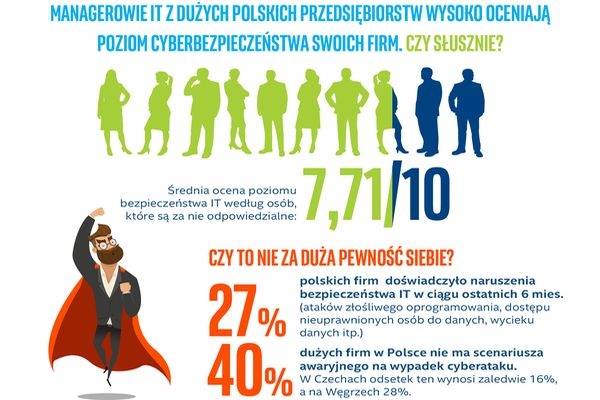
As many as 40% of large enterprises in Poland do not have a contingency plan prepared in the event of a cyberattack or similar incidents. According to a new study by Intel, conducted in Central and Eastern European countries, Polish companies are less concerned about IT security than enterprises in neighboring Czech Republic or Hungary.
Exposed to losses
The Intel study was conducted in Poland, the Czech Republic, Romania, and Hungary among 250 IT decision-makers from companies employing at least 150 people. The country where companies are best prepared for a cyberattack is the Czech Republic, where 84% of IT security decision-makers declare that their enterprise has a contingency plan ready to be implemented should an attack on the corporate network occur. In Romania, 72% of companies have such a plan, while in Poland and Hungary, the figure is 60%, meaning that 40% of enterprises react with a delay in the event of a cyberattack or similar incidents, exposing themselves to additional loss of time, money, and data.
Cyberattacks in one in four Polish companies
The low prevalence of cyberattack response plans among enterprises in Poland is surprising when compared with data on IT security breaches over the last 6 months. Incidents such as malware attacks, unauthorized access to company data, data leaks, etc., occurred in 27% of large Polish companies (in 22% 1-3 times, in 5% at least four times). Among the countries that participated in the study, companies from Romania recorded the fewest IT security breach cases in recent months (occurring in 18% of companies). In Hungary and the Czech Republic, this rate was 29% and 36%, respectively.
– Cybercriminals are using increasingly sophisticated techniques, and their attacks can have a negative impact on both the finances and the image of companies. Therefore, from an IT security perspective, it is crucial to use the latest and most secure technologies, both in terms of hardware and software – says Krzysztof Jonak, Intel Director for the Central and Eastern Europe region.
With each subsequent generation of Intel Core vPro processors, Intel improves hardware-level security, helping to protect valuable corporate data. The recently introduced Intel Authenticate technology, available on 6th generation Intel Core vPro processors, enables three-factor authentication, ensuring the maximum level of protection against identity and data theft.
– To stay ahead of the development of technological threats, one must not only focus on innovation but also remember to improve existing security measures within the company and follow best practices for application coding. This is extremely important in today’s world, which is exposed to cyberattacks. McAfee Labs researchers carefully analyze cyberspace and, in quarterly reports, warn about new threats that appear at a rate of up to 327 per minute. Among them, we discover increasingly sophisticated ones every time – as cybercriminals are constantly devising new ways to generate cleverly masked threats. To avoid them, one must focus on two elements: security and education. Company heads and manufacturers must take care of the knowledge level of their employees and customers – let us remember that it is good intuition and awareness of threats that allow us to protect ourselves against most of the most dangerous attacks – says Arkadiusz Krawczyk, Country Manager at Intel Security Poland.