








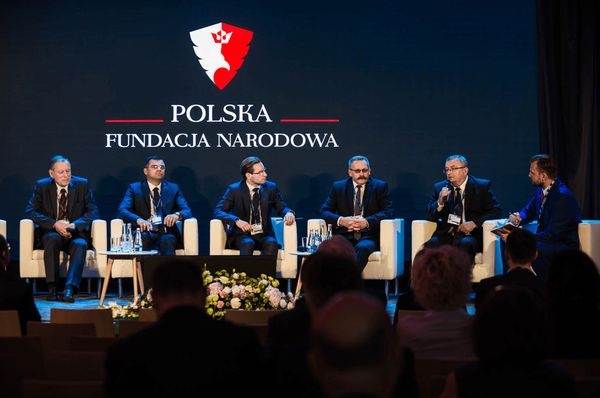
Actions aimed at increasing the competitiveness of the entire Polish railway industry and their impact on the development of the domestic industry were the leading topics of statements made by representatives of PKP Group companies at this year’s Economic Forum in Krynica. During panels and meetings, discussions included the current investment program and the main directions of change in the railway sector.
During the Infrastructure and Transport panel “Perspectives for transport development in Poland,” attended by, among others, the Minister of Infrastructure and Construction Andrzej Adamczyk, the CEO of PKP S.A. Mirosław Pawłowski emphasized that the current actions of the PKP Group fit perfectly into the new strategy and government programs. In total, investments in the railway industry from government, local government, and other development and aid funds will amount to approximately 70 billion PLN by 2023. Railway investments are intended to support long-term economic progress. Thanks to implemented projects and work on improving the quality of passenger service, in the first 6 months of this year, the PKP Group recorded an increase in the number of passengers on PKP Intercity trains – this represents over 27% more travelers than in the previous year. One of the Group’s main goals is to strive to further increase its customer base. For this to be possible, the railway must be even more user-friendly. The recipe for this is to be the introduction of a common ticket.
– We need to bring the railway closer to those who do not currently use it or are even afraid of it – said Mirosław Pawłowski. – The knowledge that a passenger needs is really just where they want to go and how much money they can spend on it. The rest should be suggested by a specially programmed system.
Work on introducing a common ticket is already underway and is being coordinated by the Ministry of Infrastructure and Construction.
Mirosław Pawłowski also listed the priorities of the PKP Group for the coming years. These include, among others, increasing the speed of rail freight transport and developing connections with Polish seaports: Szczecin – Świnoujście and Gdynia – Gdańsk.
– We want our trains from these ports, which are a window to the world, to be directed as far as possible into the heart of Europe, i.e., to the south – said the CEO of PKP S.A.
He also emphasized the importance of the east-west connection, which is almost ready. Freight trains are reaching the modern, expanded transshipment center in Małaszewicze.
The possibilities of increasing the competitiveness of rail freight transport compared to road transport were also discussed during the panel by Maciej Libiszewski, CEO of PKP CARGO. During the discussion, he emphasized that the railway needs a level playing field and that efforts should be made to increase its share in the Polish transport mix.
– The railway is the first-choice mode of transport for many groups of goods. We are a natural partner for industry: energy, coal and aggregate mining, metallurgy, and the timber industry. Without the railway, it would also be impossible to service ports, including the container ships calling at them – said the CEO of PKP CARGO. – At the same time, we are an important element of a sustainable transport system – transporting goods by train minimizes external costs. Using the railway relieves roads and slows down the wear and tear of road infrastructure. The railway can work perfectly with road transport – thanks to modern solutions, semi-trailers and swap bodies can be transported on railway platforms.
The CEO of PKP CARGO also noted that to increase the attractiveness and competitiveness of rail transport, it is necessary to continuously adapt railway services to customer needs and expectations and to create a market, e.g., by building services related to first and last-mile delivery. This is the direction in which the PKP CARGO Group is developing. Representatives of PKP Polskie Linie Kolejowe S.A. and PKP Intercity also referred to this topic. The most important signals indicating improvement are – according to the infrastructure manager – shorter travel times, better passenger service comfort at stations and stops, and an increase in the level of safety on the Polish railway. The possibilities that passengers are using in increasing numbers are the effects of a significant improvement in the state of infrastructure. The work carried out in recent years was mainly aimed at improving passenger transport. In the current perspective, the company intends to focus primarily on increasing the competitiveness of freight transport. Thanks to planned modernizations worth over 66 billion PLN, PKP Polskie Linie Kolejowe S.A. will ensure twice as fast cargo transport in a few years. Freight trains will travel more smoothly and efficiently and with larger loads, in many places on convenient routes separated from passenger traffic.
Already in 2016, greater opportunities for cargo transport by rail opened up thanks to the completed modernization of the bridge over the Martwa Wisła and the access to the Port of Gdańsk. Another positive change is, among others, the completion of the construction of the border bridge on the Lusatian Neisse on the Polish-German border. The increase in the competitiveness of the railway will be supported by the modernization of the following lines: Rail Baltica, Warsaw – Poznań, and the improvement of railway infrastructure in Silesia, at eastern border crossings, and in Baltic ports.
PKP Intercity is also thinking about improving competitiveness. In recent years, the passenger transport sector has developed in Poland. Travelers can move on planes, use buses, or travel faster by car. The railway carrier faced the challenge of creating an offer that would be competitive with other modes of transport and attract a larger number of passengers to trains. The actions taken in the field of modernizing rolling stock contributed to shortening travel times between the largest cities and enabled the effective use of newly purchased trains (Pendolino, FLIRT3, PesaDART) and locomotives. A shorter journey combined with comfortable rolling stock became the reason why passengers are returning to the railway. However, PKP Intercity does not stop investing in rolling stock, hence the announcement of allocating 2.5 billion PLN by 2020 for the modernization and purchase of locomotives and carriages, which will significantly translate into increased competitiveness and will also positively affect travel comfort and shorten travel times.
Representatives of the PKP Group emphasized a new, comprehensive way of thinking about the future of the railway in Poland. In past years, there was often a misguided focus on the short-term benefits of individual carriers, which negatively affected the way the entire railway industry was perceived by customers. The great success that was the organization of transport during World Youth Day, however, showed that the cooperation of railway companies present on the Polish market brings measurable results. That is why the actions of the PKP Group, among others in the area of investments and the implementation of modern technologies, are intended to translate into strengthening the position of the entire Polish rail transport. Thus, the Group’s companies are in line not only with the Government’s plans but also with an important global trend. More and more countries are realizing the huge role of railway development in building a modern and efficient economy.