











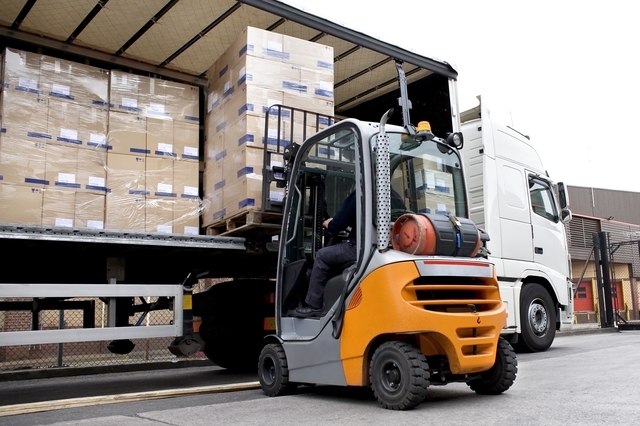
Forklifts are selected for cargo handling tasks in quantities that ensure the efficient operation of an enterprise’s logistics system. Forklifts manufactured after 2000 usually feature a modular design that allows for quick (lasting a few minutes) battery replacement, refueling, or gas cylinder exchange. Battery charging time is close to the operating time, which means that auxiliary equipment is used to replace a discharged battery with one ready for operation, with the former being immediately put on charge.
When designing or optimizing logistics systems, the appropriate number of forklifts is selected so that they are constantly utilized. This equipment is quite expensive, and it is not purchased in excess not only for economic reasons but also for technical reasons (storage, maintenance).
The lack of a functional forklift can ruin even the most secure planning of loading windows for long-distance transport, just-in-time delivery schedules, etc. Therefore, the problem of operational maintenance must be anticipated by the supply chain manager.
The role of the Office of Technical Inspection (UDT) in forklift operation
The main legal act regulating the principles of operating material handling equipment is the Regulation of the Ministers of Labor and Social Welfare and Health of March 19, 1954, on occupational health and safety in the operation of conveyors and the Regulation of the Ministers of Labor and Social Welfare and Health of March 19, 1954, on occupational health and safety in the operation of conveyors. It specifies the technical conditions for technical supervision. The body responsible for the approval and inspection of equipment subject to supervision is the Office of Technical Inspection (UDT). All equipment in the European Union is manufactured in a way that minimizes risks associated with operation, in accordance with European directives.
During the operation of a given device, it requires ongoing maintenance. Wear and tear of individual components can cause hazards: damage to the device, risks to the operator’s safety, and to people in the vicinity. The task of the UDT is inspection, which ensures the maximum level of safety for the device, as well as the risks associated with its operation.
The Office, as an independent entity in technical and financial terms, deals with the conformity assessment of technical equipment in the design, manufacturing, and operation phases, based on technical specifications and regulations.
The article contains 24,420 characters.
Source: Logistyka Magazine