











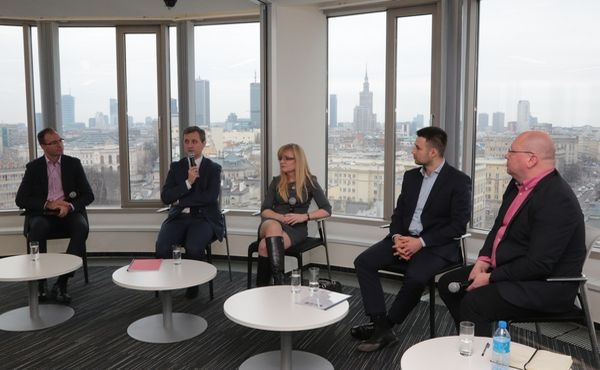
What opportunities and challenges face the Polish e-commerce industry in 2016? Will a turnover tax affect the condition of e-shops, and if so, how? How can costs be reduced and profits increased? How important are logistics and the security of e-commerce shopping platforms? During an expert debate, leading players in the Polish e-commerce market discussed the topics that will ignite the industry this year.
The meeting, held on March 10, 2016, at the Business Link headquarters in Warsaw, was attended by representatives of e-commerce companies from the B2B and B2C sectors: Ilona Weiss – CEO of ABC Data S.A., Marcin Grzymkowski – CEO of eobuwie.pl S.A., Karol Dudij – Board Member of Unified Factory S.A., and Łukasz Kiczma – Board Member and expert on national legislation at the Chamber of Electronic Economy. The role of moderator was held by Rafał Irzyński, chief analyst at the Association of Individual Investors.
Business in times of lack of time
The most important challenges facing the e-commerce industry are primarily related to process automation and quick, effective adaptation to market needs, which involves implementing new business strategies. A necessary condition for the further development of the industry, maintaining competitiveness, and increasing corporate profitability is the constant introduction of innovations, including through personalized offers or modernizing search engines. Another challenge for the industry is further automation, which, according to Karol Dudij of Unified Factory S.A., is at a high level in Poland. Adapting to the needs of modern customers is equally important for companies in the B2C sector. Marcin Grzymkowski, CEO of eobuwie.pl S.A., considers good products in the company’s portfolio, customer service quality, opening up to new markets, targeted advertising, and efficient logistics management to be the biggest challenges facing the e-commerce industry in the B2C sector. In general, the debate participants agreed that streamlining delivery and payment processes is of significant importance for the entire e-commerce industry. They consider speed of delivery to the customer and efficient, secure payments, which form the basis of e-commerce, to be the fundamental actions in this area. According to Ilona Weiss, CEO of ABC Data S.A., proper inventory management, intelligent purchasing, and the availability of high-turnover goods in the warehouse are very important in the entire process. Ilona Weiss also emphasized the importance of optimizing delivery processes. E-commerce companies are constantly working on improvements in these areas.
Does size matter?
During the debate, the issue of the security level of e-commerce companies was also raised, which is equally important in the B2B and B2C sectors. The participants unanimously agreed that customer data is one of the most valuable assets, which is why caring for security processes is a priority for them. And just as in the case of the leader in IT and electronic equipment distribution, ABC Data, or the company Eobuwie, the security standards of shopping platforms are very advanced, the level of security of suppliers and smaller companies operating on the market is not as certain. As Board Member of the Chamber of Electronic Economy, Łukasz Kiczma, said, the next educational challenge facing the Chamber is precisely raising awareness across the entire e-commerce industry regarding security and indicating a single business model at the security level in e-commerce. According to the Chamber of Electronic Economy, it is also important to systematize standards of good practice and create clear identification for product descriptions.
Turnover tax, or the one that… will turn against the Polish budget?
The discussion also included the issue of legislative changes. Participants talked about the introduction of a turnover tax for e-commerce stores. While it does not currently affect distributors, it is important for other entities that it covers all companies in the e-commerce sector without exception. On the other hand, companies providing technology for automating sales and customer service, although they do not support the introduction of the tax, see it as an opportunity to increase the number of clients in their portfolio. In general, it was agreed that the introduction of the tax is a kind of threat to the e-commerce industry, as it may cause Polish e-commerce to flee outside of Poland. The result could be the transfer of all taxes abroad, i.e., losses for the budget instead of revenue.
This was the first debate organized by the Konsorcjum inwestorzy.tv, ISBNews, the Association of Individual Investors, and Telma Communications Agency.