








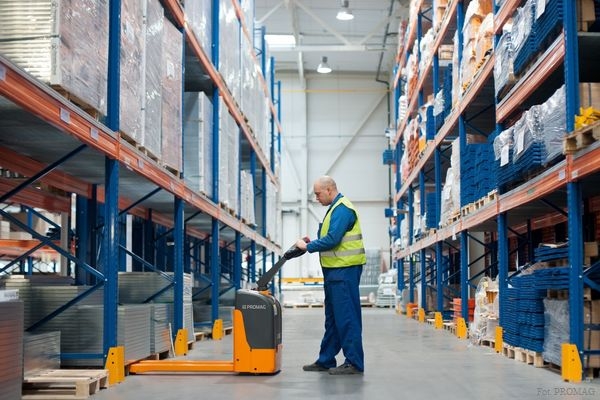
In a well-functioning warehouse, dozens of tons of goods pass through an average workstation during a single shift, and hundreds of various movements and operations are carried out every hour. Proper use and operation of racks are the fundamental factors that allow for maintaining work continuity, ensuring safety for employees, and, just as importantly, avoiding unnecessary costs associated with the need for downtime due to a potential accident or failure.
In accordance with the regulations in force in Poland, the obligation to systematically monitor the state of occupational health and safety, with particular emphasis on work organization and the technical condition of machines and other technical equipment, rests entirely with the employer. This also applies to the technical condition of rack systems and—it is worth remembering this—even in the context of potential consequences that negligence, carelessness, or lack of proper supervision may lead to.
First and foremost, the design
The first issue that cannot be overlooked in the context of safety is the design of rack systems. While the normative legal regulations existing in Poland regarding the production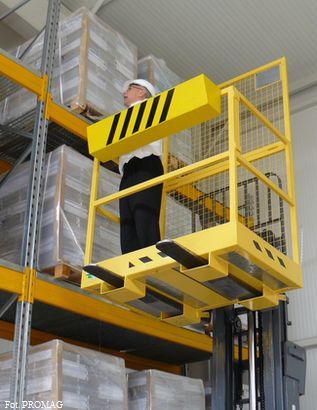 of racks are not mandatory, manufacturers, out of concern for their credibility, cite that they are manufactured in accordance with these standards (confirming this by issuing an appropriate declaration of conformity). However, this does not mean that the entire rack system, consisting of a specific number of pallet spaces with a specific load capacity located in a given warehouse, is automatically manufactured in accordance with regulations and is fully safe.
– Designers employed by companies supplying racks take into account various risk factors present in a given facility, which is why only a company that offers comprehensive service—meaning not just the finished product, but also the design—can issue a declaration of conformity for the entire rack system. And this is provided that they perform the installation themselves. However, if the client carries out this work independently or configures the racks on their own, they bear personal responsibility for their safe installation – says Marek Łabęda, Technical Director at PROMAG S.A.
Moreover, the user of the racks—without the consent of the company that designed the system—cannot make any modifications or changes to the configuration, as this risks voiding the warranty and, of course, more tangible consequences, such as the simple collapse of the structure. From the employer’s point of view, the optimal solution is therefore to choose a supplier that will provide comprehensive service including, in sequence: consulting, design, delivery, and installation, as well as subsequent maintenance.
Daily use of racks
Safe operation of racks includes: their proper use, ongoing inspections, and periodic inspections. Omitting or underestimating any of these elements can have serious consequences and lead to dangerous situations. No one will relieve the employer of responsibility if, for example, as a result of an unfortunate accident, it turns out that the rack was, for example, used contrary to its intended purpose or health and safety regulations. That is why it is so important to be familiar with the operating instructions provided by the manufacturer, along with all equipment. As practice and daily inspections in warehouse facilities show, the number of irregularities in rack operation is generally very long. The most common include, above all:
• performing inspections contrary to the manufacturer’s recommendations,
• lack of rating plates and stickers informing about the maximum permissible load capacities,
• structural damage due to collisions with internal transport vehicles, e.g., forklifts (mainly uprights and beams),
• rack anchors torn out of the floor and damage to bumpers and rack guards,
• blocked communication routes between racks.
– Many factors contribute to the weakening of the rack structure on a daily basis. These include, among others, all kinds of damage caused by accidental forklift impacts, unauthorized changes to their configuration, or the use of palletized load units with insufficient strength, quality, or inappropriate dimensions. A frequent cause of forklift impacts is not so much operator error as it is overly narrow main and working aisles in the warehouse, which hinder maneuvering. In this context, it is also important to ensure proper order in the transport space as well as lighting and heating of the storage zone – emphasizes Marek Łabęda.
 Correct storage of goods is of huge importance in the case of pallet racks. Pallet units should be stacked sequentially from the lowest level to the highest (under no circumstances should an empty rack be filled from the top), exercising caution so as to avoid potential dynamic loads (it is unacceptable and extremely dangerous to hit and slide pallets along the rack’s load-bearing structure). Furthermore, the load should be placed only and exclusively on a rack whose weight capacity we know. The technical condition of the pallets themselves and their type are also not without significance. Row pallet racks are intended for storing stock on flat wooden pallets without wings with dimensions of 800×1200 mm and 1000×1200 mm. If we wanted to use others (e.g., disposable, plastic), we should consult the rack system supplier in advance and determine a safe method for their storage.
Ongoing inspections
The consequences of all kinds of shortcomings can have very serious effects, which is why it is so important to catch and effectively eliminate them on an ongoing basis. Periodic inspections serve this purpose, among others. The obligation to perform them is regulated in detail by Polish and European standards. Despite this, many employers still forget about the need to conduct inspections, not fully realizing the scale of the risk that such negligence can entail. Inspections are crucial not only because of the possibility of preventing potential threats to employee health but also because they bring tangible financial benefits (no downtime caused by sudden failure, no expenses associated with, for example, purchasing destroyed goods, etc.).
Ongoing inspections are intended to rule out potential irregularities in the technical condition of warehouse racks and should be carried out at least once a week by their direct users, i.e., personnel designated by the employer responsible for occupational safety in a given warehouse. Any defects noticed should be recorded in the ongoing technical condition inspection card, which is an attachment to the rack operation and maintenance manual, and immediately reported to the employer in order to take preventive measures.
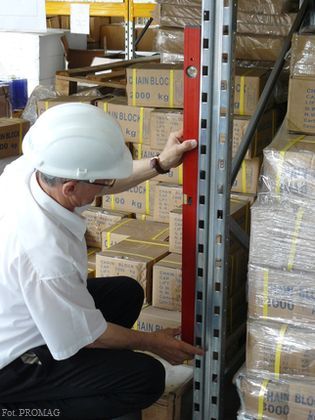
Ongoing inspections are usually performed from the floor level, where most damage simply occurs, and consist primarily of a visual check of the rack structure, and if necessary, performing simple control measurements. For example, for row pallet frame racks (i.e., those most commonly used), the inspection should include checking, among other things:
• discrepancies in the entries on rating plates with the actual state,
• potential damage or cracks in the floor, particularly in places where frames are anchored,
• all kinds of damage to frame elements such as: dents, bends, twists, tears, cracks, etc.,
• damage to load-bearing beams, connectors, and missing safety rivets protecting beam locks against accidental detachment.
Periodic inspections
Much more detailed periodic inspections should be carried out at least once a year by competent persons with appropriate knowledge, delegated by the rack supplier. They include not only a visual assessment of the technical condition and completeness of the rack installation according to the documentation provided by the user, but also:
• performing necessary measurements regarding the magnitude of deformations of rack elements under load and deviations of uprights from the vertical,
• checking the method of rack usage, and in the absence of documentation, creating drawings of the layout and configuration of the racks based on an inventory of the state,
• providing the location of elements requiring replacement, repair, and replenishment,
• checking whether the rack structure has been overloaded.
The person performing such an inspection should prepare an appropriate report containing a description of the elements that require replacement, repair, or replenishment, post-inspection recommendations, and an inspection protocol. It is worth ensuring that the report also includes drawings of the layout and configuration of the racks describing the location of elements for potential replacement or repair, as well as those that have been admitted for further operation only conditionally.
Additional equipment
There is no doubt that the human factor plays the greatest role in maintaining safety in the warehouse. Without a sense of responsibility, adherence to procedures, proper supervision and control, and attention to the appropriate level of employee knowledge, it is difficult to expect it to be a fully safe workplace. Nevertheless, many accidents and rack damage can be avoided by installing additional equipment that, for example, protects racks against forklift impacts—this is particularly important in warehouses where their traffic is intense and increased.
– Among many solutions of this type, it is worth mentioning, among others, rack bumpers, frame guards, pallet stops, forklift guides, internal warehouse mirrors, or mesh wall protection systems – lists Marek Łabęda. – Unfortunately, in practice, many companies give up on purchasing them due to the need to incur additional costs. After all, this is equipment without which the warehouse can function. On the other hand, the potential costs of rack repairs and the associated downtime in warehouse operations can be many times higher than the cost of purchasing the accessories. Something that many companies realize right after such damage occurs.
Legal standards regarding rack operation
- Safe use of warehouse equipment is regulated by:
1. Regulation of the Minister of Labor and Social Policy on general occupational health and safety regulations published in the Journal of Laws No. 03.169.1650.
2. Standard PN-EN 15635 Steel static storage systems. Application and maintenance of storage equipment.
- The obligation to perform inspections is regulated by:
1. Regulation of the Minister of Labor and Social Policy (Journal of Laws 03.169.1650).
2. Standard PN-EN 15635 Steel static storage systems. Application and maintenance of storage equipment.
3. Rack operation and maintenance manual.