








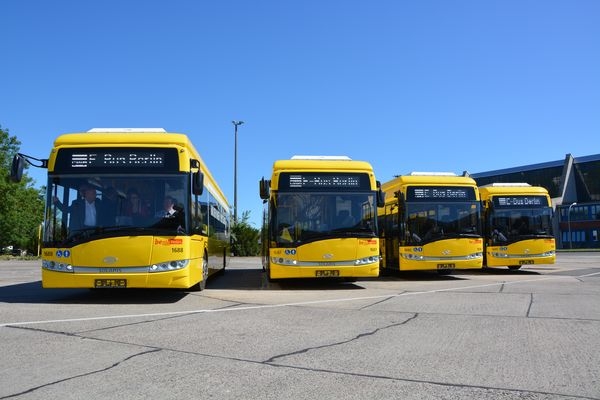
Zero-emission, quiet, and extremely smooth – this is the shortest way to describe a ride on one of the four Solaris Urbino 12 electric buses that will soon hit Berlin’s bus line 204. At the beginning of July, at the depot on Indira Gandhi Street belonging to the capital’s transport operator, Berliner Verkehrsbetriebe, the project partners presented the innovative electric vehicles.
Following the ceremonial presentation, the gathered guests, including representatives of the Federal Ministry of Transport and Digital Infrastructure, the Berlin Senate, and project partners, set off on a short demonstration ride. During the ride, the vehicle’s characteristic features were presented. The trip was preceded by a demonstration of the bus’s inductive charging process. Starting today, the buses will enter the test line 204. Meanwhile, the four Urbino 12 electric buses will begin regular passenger service from mid-summer.
The Berlin Urbino 12 electric is a completely zero-emission vehicle, meaning it does not emit exhaust fumes that are unpleasant to the nose and harmful to health. Additionally, it is characterized by an almost silent and vibration-free ride, which contributes to passenger comfort. The acoustic qualities of the Polish vehicles will certainly also be appreciated by Berliners living right next to the bus line. By choosing the solution offered by Solaris, passengers, residents, and the natural environment all benefit. Introducing four new electric Solaris buses to the line means a reduction in CO2 emissions of approximately 260 tons per year. To achieve a similar effect, one would need to electrify about 250 passenger cars moving around Berlin.
The buses will operate on the route between the Berlin University of Technology and Südkreuz Station, stopping along the way at, among others, the Zoo Station. They will therefore support very important transit hubs for the entire metropolis. The described Urbino 12 electric buses are equipped with the PRIMOVE fast inductive charging system from Bombardier. Thanks to the 200 kW power of the chargers, the vehicles will need only a few minutes to recharge their batteries. The 90 kWh capacity batteries, manufactured by Bombardier, are located on the roof. They are replenished from inductive stations located at both end points of line 204.
The electric Solaris buses delivered to Berlin are equipped with a 160 kW central asynchronous motor, which guarantees good, smooth acceleration and a maximum speed of 65 km/h. After successfully completed tests, they will appear in regular passenger service later this summer. At that time, the residents of the German capital will receive another means of electric transport, following trams, the subway, and solar-powered ferries. The “E-Bus-Berlin” project was co-financed by the Federal Ministry of Transport and Digital Infrastructure with 4.1 million euros. The project receives scientific support from the Berlin University of Technology.