








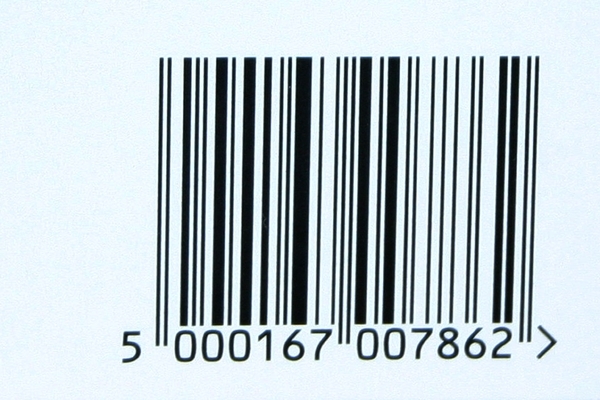
This is not just the title of a 1938 Polish film, but a name that can refer to the number found under barcodes. A 13-digit number, without which it is difficult to imagine, among other things, the functioning of today’s retail chains. A number that changed the world…
Global trade item identifiers – numbers: GTIN-8, GTIN-12, and the most common GTIN-13 (Global Trade Item Number) are 3 types of numbers most frequently used to mark trade units for the purpose of unambiguous identification of consumer goods at retail points of sale.
The beginnings of the revolution
The beginnings of the revolution can be traced back to 1879, when a device designed for recording cash transactions, authored by brothers James and John Ritty, was patented. A few years later, in 1884, John H. Patterson bought the Ritty brothers’ factory and founded a company called the National Cash Register Company. This company, whose devices are sold to this day, improved the Ritty brothers’ invention by adding a paper roll to it. This enabled a more complete recording of purchase transactions. Thus, the first mechanical cash register was produced, which significantly made life easier for owners of restaurants and small shops, among others.
This invention and the development of retail trade created new needs related to the automation of processes occurring at cash registers. When describing the beginnings of the creation of barcodes, it is impossible not to mention Samuel Nathan Friedland, who at the end of the 1920s opened a store in the United States called Reading Giant Quality Price Cutter. It was the first store of the retail chain that would later function under the name Food Fair. It was 1947 when S. N. Friedland asked for help from the Dean of the Drexel Institute of Technology in Philadelphia in developing a technical solution that would solve the problem of inventorying goods. The Dean, however, rejected the request. Fortunately, a witness to the conversation was Bernard Silver, a doctoral student at the aforementioned university, who mentioned the conversation he heard to his acquaintance, Norman J. Woodland. The then 27-year-old doctoral student and teacher at Drexel, considered today to be the father of barcodes, together with his colleague decided to start work on processing information about products.
Work on this issue resulted in a solution called the Bull’s Eye code. On October 20, 1949, both filed a patent application: “Apparatus and methods for classification,” describing their invention as the art of categorizing items using pattern identification. Their application was approved on October 7, 1952, granting the patent number 2612994.
June 26, 1974
On April 3, 1973, leaders of the food industry in the USA chose one standard for product identification, which is currently known worldwide as the GTIN number in the GS1 barcode. This decision was the beginning of the creation of a global language of business, which to this day ensures transparency in supply chains in many sectors. A year later, on June 26, 1974, at a Marsh supermarket in Troy (Ohio, USA) at 8:01 AM, the first barcode scanning took place. The first scanned product was a ten-pack of Wrigley’s fruit chewing gum, and one of the first scanners, manufactured by the National Cash Register Company, was used to scan it. About what happened in the following years, how manufacturers and representatives of retail chains in the USA and Canada, and then in Europe, reached an agreement regarding the structure of numbers used to identify trade units, we can read in a book written by the former chairman of the GS1 organization, John Berry, titled “The Secret Life of Barcodes.” It is a story about how GS1 and barcodes led the retail revolution and how they changed the world and perception in various industries, including pharmaceutical, food, timber, and metal.
The article contains 13480 characters.
Source: Logistyka Magazine