











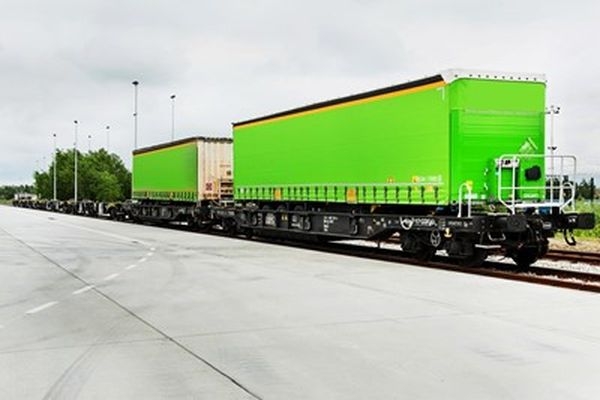
Duisburg, Hamburg, Pardubice – these are just some of the destinations to which PKP CARGO currently carries out transport using new intermodal platforms. At the end of 2013, the company ordered 330 80-foot wagons. The last of them will be delivered to the carrier in the coming weeks. Those that have already reached PKP CARGO are in constant use. The longest routes carried out using the new wagons are over a thousand kilometers long.
Intermodal transport is the carriage of goods using a single loading unit via different modes of transport. Its advantage is that there is no need to transship goods when changing modes of transport – the entire loading unit, e.g., a container, is transshipped, which streamlines and speeds up transport. Since 2004, the average annual growth in the volume of intermodal rail transport work in Poland has been almost 15 percent, and with the exception of Lithuania, it was the highest among the countries in the region. In terms of market share measured by transport work, intermodal rail transport grew from approx. 2 percent in 2004 to over 6 percent in 2013.
In the years 2009-2012, the intermodal rail market in Poland grew at a double-digit rate, slowing down in 2013. Currently, it is accelerating again. After three quarters of 2014, the transport work performed in the intermodal segment was almost 14 percent higher than in the corresponding period a year earlier.
PKP CARGO is the leader in the intermodal transport segment in Poland. After the third quarter, the company had nearly 48 percent share in intermodal rail transport in Poland in terms of mass transported and 52 percent in terms of transport work performed. PKP CARGO is constantly increasing its capabilities in the intermodal area – in addition to purchasing new container platforms, in December 2013 the company commissioned a modern intermodal terminal in Poznań-Franowo.
Thanks to its rolling stock, know-how and extensive experience, the company offers its clients comprehensive service in the field of intermodal transport. The company has its own infrastructure allowing for the storage, warehousing and transshipment of goods at container yards and terminals. In total, the storage capacity of PKP CARGO terminals is approx. 11,500 TEU, and the maximum technical transshipment capacity is nearly 890,000 TEU per year.
New PKP Cargo intermodal platforms are used to transport containers primarily from Polish ports on the Baltic Sea, where they arrive from all over the world. They are then transported in all directions. Some of them are used as part of international connections, including to the Czech Republic and Germany. The longest connection operated by PKP CARGO using the new intermodal platforms is almost 1.3 thousand kilometers.
– Intermodal transport is a huge opportunity for the railway, which is why we are investing intensively in this segment, both in rolling stock and transshipment infrastructure – says Jacek Neska, member of the PKP CARGO management board for commercial affairs. – The railway is dedicated to container transport, especially over longer distances. It is a proven, reliable and predictable means of transport. Taking into account that investments carried out on Polish railway lines will result in an increase in commercial speed in the near future, intermodal will develop dynamically, which will allow PKP CARGO to strengthen its position as the clear leader of this market.
The new platforms are 80 feet long and are the most universal container wagons. They enjoy great interest from PKP CARGO customers because they can be used to transport various types of containers in several configurations: two 40-foot, one 40-foot and two 20-foot, or four 20-foot. These types of wagons also allow for transporting a larger number of containers in one train. So far, PKP CARGO has already received 240 of the 330 ordered platforms.
In addition to PKP CARGO, the company CARGOSPED, a logistics operator from the PKP CARGO capital group, is involved in handling intermodal transport. This company offers a comprehensive door-to-door service. CARGOSPED plans and organizes the entire route of the shipment, from the sender to the recipient.