











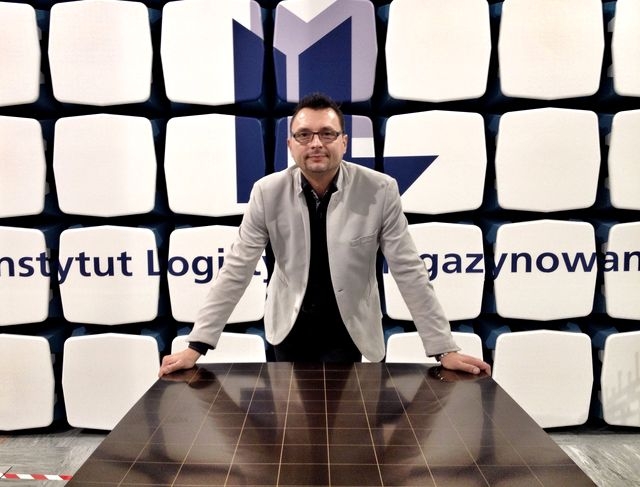
Michał Koralewski: Why do I hear buzzing in my speakers when my phone starts receiving an incoming call?
Krzysztof Sieczkarek: We know that a mobile phone is a radio station that transmits and receives. When it is in standby mode, the field intensities emitted for communication with the base station are relatively low. When an SMS arrives or a call is being established, the phone optimizes its power to maintain sufficient call quality or to receive the SMS. Such increased power causes increased emission and can cause voltages to be induced in the acoustic amplifier. Such an amplifier will also act as a radio wave receiver; demodulation occurs, and the sound, which normally appears as buzzing (digital signal), enters the amplifier, is demodulated on the acoustic circuits, and is sent to the speakers. This is, of course, a result of, among other things, poor shielding of such an amplifier.
M.K.: Buzzing in the speakers can be unpleasant to the ear, but it does not usually cause any major damage or life-threatening risks. However, there are situations where such wave interference can have much more serious consequences.
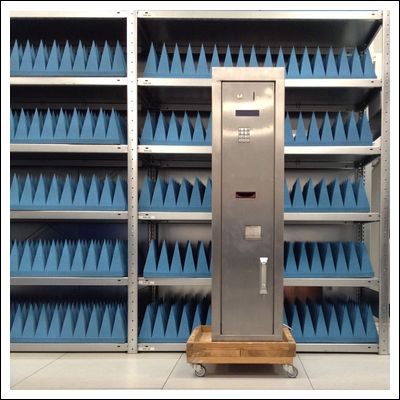
K.S.: In our field, which we call electromagnetic compatibility, we distinguish between emission originating from devices and immunity. Within the scope of this immunity, we conduct several tests, each of which reflects the real phenomena in which devices operate. For example, electromagnetic field immunity testing simulates the operation of radio stations. We check how devices behave when located near radio stations, mobile phones, walkie-talkies, CB signals, etc. We cover this entire band and check whether the device is immune to it. We also check, for example, the immunity of devices to electrostatic discharges – a person walking on a carpet in winter charges up with static electricity, touches a door handle, and a spark jumps. Such a spark jump can also occur to a device, resulting in its destruction or freezing. For example, in laboratory conditions, we tested an electronic safe that was opened using a touch panel. During the tests, it turned out that if such an electrostatic discharge spark jumped onto the safe’s keypad, the safe opened every time. So, we were dealing with a lack of electromagnetic compatibility here. We perform more such tests – a total of eight regarding electromagnetic immunity and four regarding emission. They are all intended to reflect situations that may occur in the natural environment with greater or lesser probability. The consequences of malfunction can be varied – from audible ones that cause unpleasant noise and crackling, to opening a safe, to disturbances in the readings of an electronic scale. In laboratory conditions, we checked the electromagnetic field immunity of an electronic scale that precisely showed a weight of 1 kg. When the electromagnetic field was switched on, depending on the frequency, it showed either more or less, sometimes even absurdly, e.g., several dozen kg, even though 1 kg was still on the scale. If we were to conduct transactions using such a scale, perhaps not buying apples, but selling gold, this would result in unpleasant financial consequences for the recipient.
M.K.: Do devices introduced to the market have to meet any specific requirements regarding electromagnetic compatibility, or is it a voluntary matter?
K.S.: The new approach within the regulations on the technical market in the European Union states that it is the manufacturer or their authorized representative in the EU who, when introducing a new product to the market, is responsible for meeting the directives to which the given device is subject. In the case of electronic devices, this is precisely the EMC electromagnetic compatibility directive and the low voltage directive, which is responsible for the general safety of electrical devices. In the case of electromagnetic compatibility, the directive only speaks of meeting the so-called essential requirements: immunity to external electromagnetic phenomena and a limited level of emission. That is all. The CE mark on a device is the manufacturer’s declaration that the device meets the electromagnetic compatibility requirements, but whether they have checked it – that is only their business. Market surveillance institutions exist to check such compliance with the declaration. The development of mobile telephony has taken place over the last dozen or so years, and electronic devices – over several decades. Consequently, certain types of devices that already existed and were installed – e.g., in hospitals – did not even formally have to meet compatibility requirements because they entered the market before the relevant regulations, requirements, and directives were created. Users noticed the influence of mobile phones on medical equipment, hence there is sometimes a ban on their use. We must take into account that in the case of incorrect operation of medical equipment, the consequences can be significant.
M.K.: What is the anechoic chamber built at the Institute of Logistics and Warehousing used for?
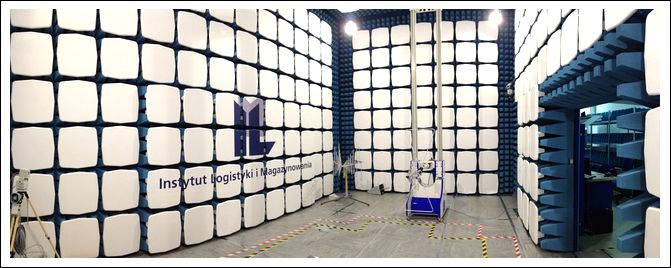
K.S.: The anechoic chamber, in standardization terms, contains two of the ten most popular electromagnetic compatibility tests, meaning it is used for radiated emission measurement tests of electronic devices, and on the other hand, it is used to test the immunity or susceptibility of electronic devices to electromagnetic fields. Thanks to it, we have expanded our scope of testing compared to what we had until November 2013 to include larger devices. Furthermore, this new chamber has a significantly larger operating frequency range of up to 40 GHz.
M.K.: So, with its help, it is possible to determine whether the emission level from a device falls within the defined permissible levels. And why is the device isolated during testing?
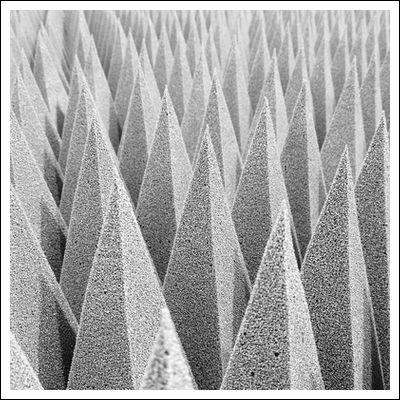
K.S.: That is true. A device installed in an office, apartment, or hospital conditions does not necessarily have to be the only one contributing to the emission present in that environment. A verdict that a given device does not meet the requirements could be unfair. You have to isolate the device, put it into a chamber where the so-called “21st-century desert” exists, i.e., complete electromagnetic silence. Additionally, lining the walls of this chamber with special materials ensures that there are no reflections of electromagnetic waves from these walls; it creates a space that is as if open to electromagnetic waves because they do not return to the object. Only in such isolated conditions can we make a verdict: if we measure the emission from a device and it is above the permissible levels – a negative result; if it is below – a positive one. That is roughly it, without going into metrological aspects.
M.K.: How long does such a test take?
K.S.: Testing a device in the chamber takes about one day. However, if the device itself operates in different modes (e.g., charging and discharging process – that is already two processes), the test time may be extended. During preliminary tests, one must choose which of these processes to select for final testing, because it is impossible to test a device in every configuration. Computers are such an example; even a simple PC would lead to an exponential increase in the number of tests. No one would be able to test all processes, either technically or financially. A decision must be made regarding the operating mode and configuration of the device being tested.
M.K.: What elements does the test consist of?
K.S.: First, the device is placed inside the chamber and turned on. An antenna is placed at one height (the antenna is adjustable from 1 to 4 m, also with an appropriate step). At this one frequency, we rotate the device around, looking to see if the rotation causes a change in emission, because the device may emit differently in different axes. We choose one position and check various types of operating modes. If it is a boiler controller, for example, we set it to a simulated temperature of 20 or 21 degrees, to a higher or lower fan speed. The goal of these trials is to find the operating mode with the highest emission. As a result of these preliminary tests, we make a decision as to which mode is the worst from the point of view of emission, i.e., one where it cannot get any worse. For this mode, we perform final tests, i.e., scanning through the entire frequency band, scanning the antenna up and down, and angular scanning around the turntable.
M.K.: The chamber is not just what we see here inside, the interior itself. It is an entire system, a multitude of devices. Can you say something more about these devices?
K.S.: When it comes to testing, we can distinguish between emission measurement and immunity testing. These are two groups of cooperating devices. They do not have a common denominator; even the cables are dedicated to one or the other test. Most important for emission measurement are calibrated antennas and a measuring receiver. We have one of the most modern products in the world, measuring up to 26 GHz, i.e., a measurement band from 20 Hz to 26 GHz. This is a tuned, specialized voltmeter that has built-in appropriate filters, bandwidths, and response to standardized signals and pulses. All of this is controlled by software that simultaneously changes the position of the turntable on which the tested device is located and causes the antenna height level to increase or decrease. Everything happens automatically; in the past, such work had to be done manually. As for immunity, we must have signal generators, electromagnetic field meters, amplifiers, and power meters that control whether the signal is maintained at a previously set level. However, the most difficult thing from the point of view of implementation is assessing whether the device is operating correctly. Each time, the criteria are selected individually, even for the previously mentioned example of the scale. A manufacturer may state that the indication tolerance is +/- x; another manufacturer may indicate otherwise. We work for the benefit of manufacturers so that they can submit a declaration of conformity, so that they have technical grounds, i.e., documents confirming that they have done everything they could and have done it in a fully professional manner. We add arguments so that they can legally draw up such a declaration of conformity. Together with the manufacturer, we establish criteria for selecting the assessment, what we should pay attention to in the case of this type of device, what is an anomaly, and how to check it. We know that no one stays in the chamber, which is why a camera system is installed. Sometimes, however, devices do not react visually. Therefore, we output signals to the outside (using media converters). These signals, if they are, for example, disturbed, change their logic states to others. Sometimes a test program runs inside the device, which automatically checks whether all components are working correctly. Each time it is an individual approach; every device is different, even the layout of the cables can be different. After performing the tests, the manufacturer receives a detailed report. If something happened to the device during exposure, whether it was electrostatic discharge or immunity to voltage dips, it is specified in the report. At the same time, the standardization organizations themselves do not necessarily say that nothing can happen to the device. Situations are given where it is permissible for something to happen to the device when an electromagnetic phenomenon exists, but the condition is, for example, that after this phenomenon ceases, the device must automatically return to normal operation, e.g., during a storm. The voltage induced as a result of an atmospheric discharge enters the device via the power cord; the device may turn off because the protection will trigger. This is permissible; the device reacted to this phenomenon but then returned to normal operation.
M.K.: In addition to EMC testing, the chamber will also be used for developing RFID.
K.S.: The scientific interests of the Institute of Logistics and Warehousing include automatic identification technologies. A center related to barcodes has been operating at the institute for a long time. The beginnings of our laboratory were also cooperation with this center, as we evaluated devices for automatic identification: scanners, barcode printers. Hence our interest in electromagnetic compatibility. The laboratory was created as support for the implementation of automatic identification technology and for the purpose of verifying electrical safety features and electromagnetic compatibility. Further consistent development followed, and responding to market requirements, we currently test a whole range of various types of devices, from furnace controllers, telecommunication exchanges, money changers, 3D printers, to pyrotechnic controllers. For several years, but not yet on a mass scale, RFID technology, i.e., identification of objects using radio waves, has been developing. Ultimately, barcodes will, of course to a limited extent, be replaced by RFID tags. To perform tests of automatic identification equipment, it is worth conducting them in electromagnetically clean conditions. If we were to give a verdict on the reading range of a given tag, we must know that there are no reflections from walls, ceilings, or floors, and this is a direct measurement at a distance. We must also be able to isolate these tags from the environment and make a decision about their better or worse use. When we did tests of tags installed on various types of surfaces, whether metal, plastic, or wood, we know that one can sometimes make a mistake resulting from the place where such tests are performed. If the room itself is full of metal reflecting elements, we can come to completely erroneous conclusions. Only in such a chamber do we have this 21st-century desert, i.e., electromagnetic silence, and the tests will be performed correctly. Another application of our anechoic chamber is taking the selective characteristic of an RFID gate, for which we have filed a patent application. To do this in the best possible way, one must separate oneself from the environment to know that the quantity we are measuring comes directly from the RFID gate and is not reflections from a wall or another device. Hence such an application of the anechoic chamber, i.e., isolating oneself from external electromagnetic phenomena, so that the measurement results refer only to the tested RFID systems, so that we arrive at correct conclusions and not erroneous ones.
M.K.: You are the main designer of the chamber…
K.S.: I was certainly the driving force; I always wanted such a chamber to be created at ILiM. Not every employee of the institute realized that such a tool was needed by us. However, this is not a one-person success. It is the merit of the entire laboratory team that cooperated in the functional design of the chamber and in creating the technical requirements document, what was to be built, as well as during the construction itself based on the executive design of the company that won the tender. It is also a success of the ILiM Management, which supported us in the process of obtaining funds for the implementation of the construction.
M.K.: Before the creation of the modern anechoic chamber, you used a smaller one, which you successfully used for 18 years. What will happen to it?
K.S.: We decided not to part with it, as it still constitutes a good tool for design, preliminary, and quick measurements. In such a chamber, one does not have to perform manual activities related to moving the antenna, as the antenna is only in one position. It is an excellent device for making design changes to a device to bring it to a state of electromagnetic compatibility. It is known that not every test will come out correctly right away, so to change something, install a filter, apply an electromagnetic gasket, or change a path, it is not necessarily required to perform tests that take all day; it is enough to put it in the GTM chamber for an hour to see if it is better or worse.
M.K.: What, besides size, distinguishes the new chamber from the old one?
K.S.: First of all, it has a significantly larger frequency range, it more accurately reflects measurement fields without reflections, where the object physically had to be at an appropriate distance from the antenna. The new chamber unambiguously reflects these standardized conditions.
M.K.: Are there other such chambers in Poland?
K.S.: Yes, there are, but ours is the newest. And the only fully automatic one. We are the only ones who have an antenna mast that tilts at an angle.
M.K.: Finally, tell us about the plans you still have for this year?
K.S.: First of all, to finish getting to know this device. Even though there was a functional design on our part, we still have to gain proficiency in using the chamber in non-standard applications. It is as if one wished for the construction of an excellent car, full of electronics, which one has to check in practice how it works. Of course, we are already performing tests; we have a number of inquiries from the market. We have clients who want our services within the framework of, for example, innovation vouchers, which support the activities of manufacturers seeking funds for research such as ours, and help introduce a product to the European Union market. We knew why we were building this chamber. We really liked the cooperation with potential suppliers. I will not hide the fact that we were a difficult partner for them, as we had a great awareness of what we wanted.
 Krzysztof Sieczkarek
Head of the Electronic Equipment Laboratory of ILiM, accredited by the Polish Centre for Accreditation. Authorization by Ministries and Notification by the European Commission in the scope of the EMC and RTTE Directives. Head of hundreds of research services regarding the CE mark of electronic devices, coordinator of national and international EMC scientific works, author of industry articles, member of the Technical Committee No. 104 for Electromagnetic Compatibility of the PKN, representative of Poland within the International Electrotechnical Committee IEC TC 77 / CISPR for Electromagnetic Compatibility, creator and coordinator of the European network of laboratories FOR-EMC.