











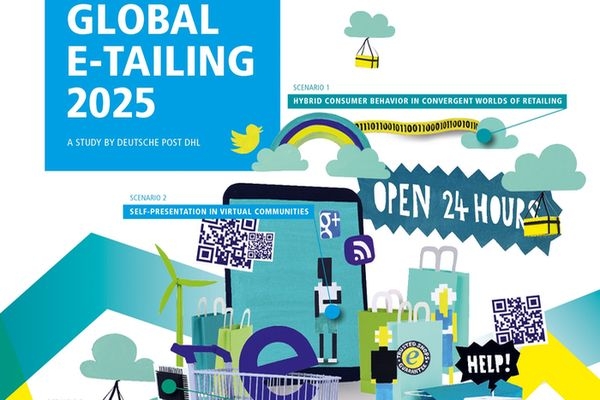
Over the next ten years, online retail will gain more importance than previously predicted – not only in developed countries but also in emerging markets. Logistics will play a key role – it will provide companies with a significant competitive advantage, for example, in the form of delivery within a few hours of ordering, flexible collection and return hours, as well as reliable logistics services and value-added concepts in emerging markets.
This is one of the main conclusions of the “Global E-Tailing 2025” study, conducted on behalf of Deutsche Post DHL with the participation of trend research institutions. It is the first global scenario analysis dedicated to cross-border online trade and its implications for the logistics industry.
Using four scenarios as an example, the study presents what online shopping worldwide might look like for customers and entrepreneurs in the near future. Individual forecasts are based on an in-depth analysis of the factors with the greatest impact – from energy and raw material prices through technological, political, and social factors, to shopping and consumer behavior patterns. The scenarios also highlight the potential effects of changes in societal value systems by 2025. The study analyzed selected developed and emerging markets from around the world. Trend scouts also examined shopping and logistics trends in 12 international metropolises – including New York, Moscow, Bangalore, Jakarta, and Lagos. This information on consumer behavior allows the scenarios to be anchored in today’s reality and increases their probability.
Currently, e-commerce already accounts for 8% of total retail turnover in Europe. Depending on the scenario, this share could increase to up to 40% in developed countries and up to 30% in current emerging markets.
– In the future, logistics will take on the role of supporting online retailers to a much greater extent than it does today. We, as a logistics company, have good knowledge of companies from various industries in almost every country in the world. That is why we are increasingly becoming an advisor and a partner in success – says Jürgen Gerdes, CEO of Post – eCommerce – Parcel at Deutsche Post DHL.
From a highly developed digital culture to DIY
The first scenario assumes that today’s emerging markets will be the driving force in 11 years. A strong global economy and a stable middle class will create a true “ubiquitous commerce.” Consumers will receive purchases faster than today, and express shipments will arrive in less than a day, with delivery times counted in minutes. In a different scenario, a highly developed digital culture will emerge, where almost all products will be sold online and consumers will be supported by their avatars. To protect manufacturers from fraud, logistics companies will offer protected supply chains.
However, the analysis does not only present positive forecasts for global e-commerce; it also contains scenarios of possible crises. The fourth scenario shows how global consumption patterns will develop after the global economy suffers another financial crisis and energy and raw material prices rise significantly. Under these circumstances, a DIY mentality and sharing models will dominate instead of an “only new” approach.
Changed consumer behaviors affect the retail sector.
The scenario analysis is complemented by numerous articles by renowned experts in the field of logistics: Prof. Dr. Dirk Moschett from the University of Fribourg in Switzerland emphasizes how important more efficient packaging of resource flows is for the entire society. Prof. Geritt Heinemann from the University of Applied Sciences Niederrhein explains in his paper “E-Pace” the importance of punctuality for the success of online trade. Prof. Shashi Matta from Ohio State University analyzes how changes in consumer behavior, e.g., trends such as sustainability or crowdshaping, affect online trade. Best practices that Deutsche Post DHL has already implemented in the field of e-commerce show a range of solutions and services in logistics.
All scenarios and scientific articles have a common denominator in the statement that competition in e-commerce, whether at a global, national, or regional level, will become more intense.
– We do not know for sure what the world will look like in 2025, but the various scenarios contained in the study show how quickly the global retail sector is changing – both online and traditional, and that logistics will be the focal point of these change processes – says Jürgen Gerdes.
The Strategy 2020 of Deutsche Post DHL, covering the pillars of Focus, Connect, and Grow, shows that the Group is in an excellent position to prepare for these changes. As part of the strategy, one of the goals is to expand the group’s leading position in the field of logistics related to e-commerce – in Germany, in Europe, and beyond. A key element of this expansion is the Post – eCommerce – Parcel division.