











A study conducted by the Polish Logistics Managers Panel shows that nearly 60 percent of companies in Poland have not even considered implementing warehouse automation. This negligible interest often stems from ignorance and a lack of awareness regarding the measurable effects of such an undertaking. So, what should one know about warehouse automation in industry?
An investment in savings and efficiency
Despite such a high percentage of entrepreneurs unaware of the benefits of implementing warehouse automation, year after year, there is a growing interest in this investment in almost every branch of the economy in Poland. It is an investment because the decision to undertake this project is dictated by the search for ways to develop the company that will guarantee safe, proven, and effective benefits directly translating into a reduction in production, storage, and shipping costs.
– Logistics specialists and manufacturers who have made the decision to implement automation in their company’s warehouse systems unanimously admit that it was dictated by a thorough analysis of the investment’s profitability. The development of the company that they have observed since taking this step results not only from the savings obtained on current operations but also from a significant improvement in the quality of the entire goods turnover chain – says Dariusz Szkiłondź from Cassioli Polska.
It is not without reason that the fastest growth in interest in warehouse automation is recorded in production, a branch of the economy that must constantly keep up with the growing consumption of almost all goods. Improving the quality of work organization for manufacturers through automated warehouses boils down to a synthesis of a number of elements responsible for efficiency. Among them, one should mention the maximum use of storage space, an increase in the ability to move products and the speed of their issuance, the minimization of the risk of mechanical damage to goods, and the almost complete elimination of errors in order picking. Warehouse automation also allows for instantaneous adaptation to changes in production and distribution of goods. A factor no less important than efficiency, which continues to win over supporters of automation among entrepreneurs, is savings on employment. Although an investment in a fully automated warehouse is not the cheapest, in practice, it means a constant reduction in costs associated with personnel employment. Automatic storage systems allow the warehouse to operate in a three-shift mode without incurring additional personnel costs and limit activities related to the organization and management of human resources.
Technology in the service of economy
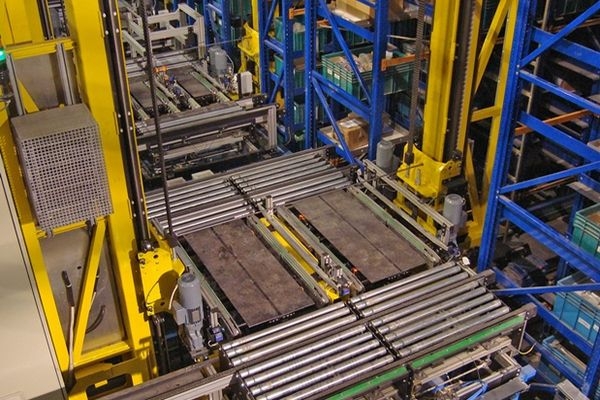
Implementing warehouse automation corresponds to introducing modern technological solutions whose task is to optimize the entire flow of goods. For example, elements such as double-deep storage racks, which allow for the storage of two pallets or other SKUs in depth on each side of the aisle, or stacker cranes with transfer platforms, which, in addition to increasing warehouse throughput, allow for an increase in the density of stored goods, are responsible for increasing storage space. Automated solutions are also the primary way to avoid investing in additional storage space, e.g., in a situation of significant growth in production or storage of goods. Compared to a traditional warehouse using forklifts, it is possible to increase the number of pallet spaces by over 100% in the same building volume. Advanced solutions in the field of mechanics and electronics, supported by the operation of control software, allow for achieving benefits resulting from the exclusion of errors during production or storage and issuance of goods. Elements such as customized picking devices, self-propelled solutions, or satellite systems limit personnel contact with goods, thereby eliminating the most common source of errors, which is the employee. Which systems will be the optimal solution for effectively increasing the company’s efficiency is analyzed in cooperation with the company providing warehouse automation technologies. In this way, the investor can check how the warehouse’s efficiency will be increased before implementation.
– Already at the design stage, the investor can see how their new automated warehouse will function. Very often, during the analysis of a computer simulation, they are convinced that they have made the right decision. The possibility of better use of available spaces and the integrity of entire production and distribution systems convince more and more new investors to take a step towards a modern warehouse – explains Dariusz Szkiłondź.
Universal solutions
Systems responsible for the automation of warehouses and production lines are also characterized by high versatility in matching optimal solutions to diverse needs. Depending on factors such as available storage space, the SKUs used, the load capacity of typical goods and their type, or needs related to automatic identification, they will require the implementation of individual systems and automatic tools that will be responsible for increasing warehouse efficiency. For example, in the case of a company that does not work with the most common SKU – the Euro-pallet, a different solution is needed. The desire to satisfy individual customer needs has forced equipment manufacturers to develop systems that also allow for operating with non-palletized products. Such solutions, designed, for example, for the needs of furniture manufacturing companies, bypass the need for palletizing materials and eliminate the circulation of empty pallets. In the case of warehouses that handle high-value goods, an important premise for automation is better care in product management and minimizing the risk of physical damage to goods. Automation, by limiting personnel contact with goods, allows for the abandonment of practices of excluding some employees from a specific warehouse zone just because valuable volume is stored there. Regardless of the modern machine park, to achieve the greatest effects and benefits of automation, it is necessary to implement an appropriate system for managing them.
– The independent application of widely available advanced solutions in the field of mechanics and mechatronics does not guarantee an increase in the capacity of goods flow. An important element of every solution is the Warehouse Management System (WMS). Its task is to coordinate and optimize all warehouse processes, from the goods entry zone to the truck loading ramps, and to find an optimal solution in the area of operational management – says engineer Dariusz Szkiłondź.
The growing popularity of warehouse automation is not a prevailing fashion for implementing modern solutions to improve image, but a carefully analyzed and calculated investment in improving the quality and efficiency of goods turnover, which brings measurable savings every day. An automated warehouse is not only an investment in development but also a method for the constantly rising costs of land and labor costs in Poland.