











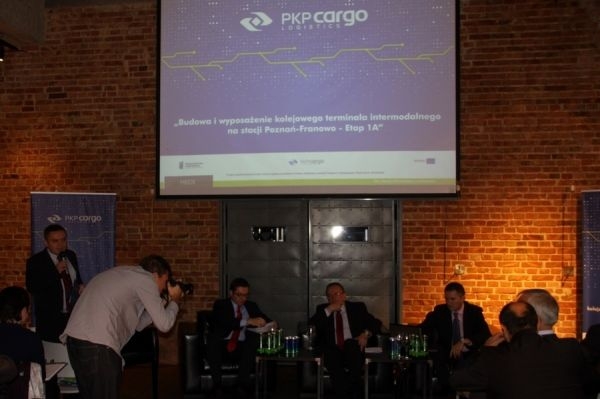
The construction of an intermodal terminal at the Poznań – Franowo station is nearing completion. The modern facility is being built with the co-financing of the European Union under the Infrastructure and Environment Operational Programme. This investment by PKP CARGO, the largest domestic rail freight carrier, is the first stage of building a Logistics Center at the Poznań – Franowo station.
The terminal will be adapted to handle containerized cargo transported via combined transport, including rail and road. It is planned to be operational by the end of 2013. It is assumed that by 2014, the terminal will be able to handle transshipments at a level of 11,000 TEU (twenty-foot equivalent units), and ultimately 26,000 TEU per year. The value of the project is estimated at 25,912,282 PLN. European Union co-financing from the Cohesion Fund under the Infrastructure and Environment Operational Programme will amount to 9,428,007 PLN.
As part of the project “Construction and equipment of a rail intermodal terminal at the Poznań – Franowo station – Stage 1A”, the following are being built: a 1,570-meter track layout with two loading and unloading tracks and a square of approximately 20,000 sqm for container storage. Other facilities to be built include an access road, energy, telecommunications, and water and sewage infrastructure, as well as a refueling station for self-propelled handling equipment.
The investment is located at the largest freight station in the Greater Poland region, where extremely important railway lines intersect, serving transport from seaports further into Poland and Southern Europe. At the same time, the terminal will be built next to line No. 352 Swarzędz – Poznań Starołęka, which constitutes a freight bypass of the Poznań Junction and is part of the E20 transport corridor. Trains from Western Europe to the center of the country and beyond the eastern border are marshaled here. From here, freight trains can also be dispatched to, among others, Wrocław, Zielona Góra, Szczecin, Bydgoszcz, Piła, Kluczbork, and Warsaw, as well as to the western border of the country, to Kunowice. Franowo is located on the outskirts of Poznań, near the Krzesiny junction on the A2 motorway, which connects Berlin via Warsaw, ultimately with our eastern neighbors.
The PKP CARGO Group has the potential to carry out freight transport based on the use of optimal logistics technologies. Depending on the defined needs of business partners, cargo delivery can be organized into any transport chain, where intermodal transport is becoming increasingly important. Choosing the location of the investment is extremely important, as it will positively influence the company’s competitiveness in terms of shortening transport times.
Along with the projected economic growth, the transport industry expects an increase in demand for intermodal transport. PKP CARGO has nearly a 65% share in intermodal rail transport by weight of goods and nearly a 72% share by transport performance (UTK data for 2012). In Poland, about 6% of the volume of rail transport is carried out by intermodal transport; for comparison, in Germany, this figure is about 30%, and in Norway, over 60%. Gaining new markets in Europe, increasing transit traffic handling, and creating new preferential rates for access to tracks in the country for container traffic will influence the growth of demand for the intermodal transport services segment. A strategic response to this challenge is the construction of the terminal at the Poznań – Franowo station.
The ecological aspect of the investment is also significant. Fewer containers will be transported by road. Repair costs for roads, which are subject to faster destruction by overloaded trucks, will also decrease. Better quality of road surfaces will consequently contribute to increasing the safety of their users.
The general contractor for construction works and railway equipment, selected through a tender, is the company SKANSKA.