











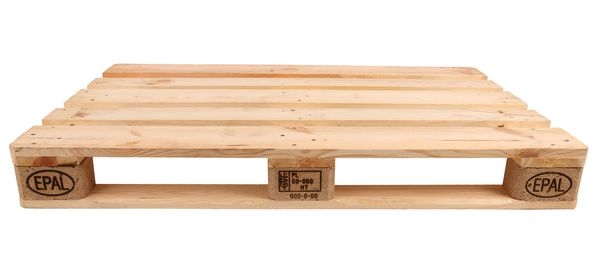
What will happen to the 450 million pallets with the EUR mark on the blocks currently in circulation after August 1st? The European Pallet Association (EPAL) is already prepared for the changes.
The termination of cooperation between the International Union of Railways (UIC) and the European Pallet Association (EPAL) has caused quite a stir across Europe. The issue of withdrawing the consent for EPAL to use the EUR in an oval mark, which belongs to the UIC, effective from August 1, 2013, even caught the attention of the German Minister of Transport. It is no wonder – the Euro-type flat pallet is currently the most popular carrier used in the transport of goods by companies, mainly retail chains. It is estimated that there are currently about 450 million such pallets in circulation, produced under an EPAL license. The foundation of the success with which it was accepted by the market is its quality and interchangeability within the so-called pallet pool.
– Standardized pallets are exchangeable packaging, which makes their circulation easier, and that is worldwide – explains Paweł Wojciechowski, Technical Director of EPAL. – If we are transporting a full truckload of juices from Poland to Spain on EPAL pallets, for example, we pick up the same number of empty pallets on-site without waiting for the goods to be unloaded. If there is an EPAL mark on the block, we are sure that it is exactly the same pallet of guaranteed quality and similar value.
The EPAL mark has so far appeared on two blocks, while the mark belonging to international railways, EUR, was branded on the others. From August 1st of this year, only the EPAL mark will appear on all blocks. Is this a cause for concern?
– Users employing used pallets according to the old labeling, where there is an EPAL mark on two blocks and the EUR mark on the other two, can continue to use them after August 1st and freely exchange them with new pallets labeled in the EPAL-EPAL system, because they are based on the same European standards for Euro pallets and are guaranteed the same quality – says Paweł Wojciechowski.
However, the issue of repairing used pallets raises more concerns. Will it be possible to repair pallets with the EUR mark currently on the market after August 1st? Paweł Wojciechowski explains that pallets produced under an EPAL license before August 1st can remain on the market as long as they can be repaired. Companies repairing pallets under an EPAL license will simply not be able to brand the right blocks with the reserved EUR mark, but rather with the EPAL mark.
Back in May of this year, when negotiations with the UIC were not yielding the expected results, there were many concerns about the future of EPAL. It was suggested that production might stop and there could be a stagnation in the supply of Euro pallets on the market, and thus a sudden increase in their price. In Poland alone, approximately 18 million new EPAL Euro pallets are produced annually, which easily find buyers in the dynamically developing international logistics of goods. Fears of paralysis in international trade were therefore completely justified.
– We reacted very quickly to the situation and sent new licensing agreements for the production of EPAL Euro pallets to our association members, which they signed – says Roman Malicki, President of the Board of PKN EPAL. – Pallet production is continuing uninterrupted, and our members are ready to introduce Euro pallets with EPAL markings on all four blocks to the market from August 1st. Their supply will be at the same level as before, because there are significant production capacity reserves in our constantly modernized plants.
The quick reaction of the Polish national committee of EPAL is welcomed primarily by logistics managers of international retail chains, which handle a volume of hundreds of thousands of pallets worldwide every month, the majority of which come from Poland.
– EPAL pallets from our country are considered a model of standard and quality – emphasizes Roman Malicki. The annual production of 18 million EPAL Euro pallets in Poland accounts for over 26% of global production and gives us the second position after Germany. In 2012, 95 entities were authorized to produce pallets in the EPAL system in Poland, while 83 companies held a license for repair.