











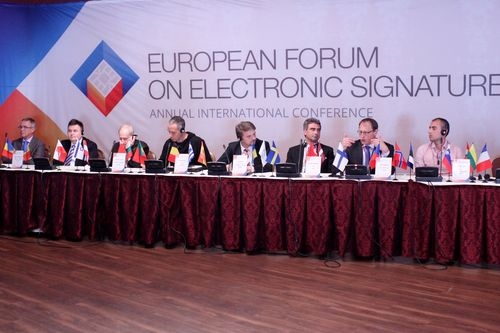
The European Forum on Electronic Signature (EFPE) 2013, the largest international conference in Europe on e-signature and e-identification issues, has come to an end. The event was attended by 130 participants from 21 countries.
The EFPE 2013 conference was held under the honorary patronage of the Minister of Economy, the Minister of Justice, the Minister of Administration and Digitization, the Sejm of the Republic of Poland, the Polish Chamber of Information Technology and Telecommunications, and the European Committee for Standardization (CEN). The organizers of EFPE 2013 were Unizeto Technologies and the West Pomeranian University of Technology in Szczecin, while the substantive partner was the European Telecommunications Standards Institute (ETSI). The conference was under the media patronage of Dziennik Gazeta Prawna, Computerworld and Manager magazines, TVP Szczecin, the Digital Poland Institute, and the websites WebSecurity.pl, e-Fakty.pl, and Logistyka.net.pl.
The theme of the 13th edition of the event, which took place on June 5-7 in Międzyzdroje, was “Trusted electronic services on the international digital market.” The conference was full of lively discussions on technological trends for e-identification and legal regulation issues.
– Currently, the digital market has reached a point where it is necessary to choose uniform and effective e-verification solutions that will allow for modern business operations on the web and trusted online contacts on an international scale. During EFPE 2013, diverse views on this topic were presented, but we all agreed that e-identification should be simple and widely accessible – says Andrzej Bendig-Wielowiejski, President of the Management Board of Unizeto Technologies – co-organizer of the EFPE 2013 conference.
Technologies
Contemporary trends in technological development have a direct impact on the electronic signature market. During EFPE 2013, examples of the use of mobile devices in this area and cloud computing were discussed extensively. Both solutions aim to enable dynamic and convenient use and verification of e-signatures. In this regard, the development of applications for smartphones and tablets, as well as applications available in the cloud, will facilitate secure e-identification. However, in terms of popularizing the electronic signature, providing the tools themselves is not enough; appropriate law is also needed to unify solutions and ensure their wide availability.
Law
EFPE 2013 was immediately followed by a three-day meeting of experts from the TC ETSI (Technical Committee of the European Telecommunications Standards Institute). As part of the committee’s discussions, the institution, which brings together over 700 member organizations from 62 countries, addressed issues related to the draft regulation governing the operation of electronic signatures for all European Union countries (eIDAS). ETSI is an official EU advisory body, and standards adopted within this institution are always taken into account in legislative work.
The topic of the eIDAS draft returned repeatedly during the EFPE 2013 conference. The initiative was also widely discussed in the context of experiences from countries outside the European Union, including Russia, Ukraine, Kazakhstan, Israel, and Japan. Comparing the solutions used allowed for the formulation of common conclusions and recommendations, which the members of the Program Committee, together with representatives of business, administration, and standardization committees, developed in a memorandum read at the end of the conference. The prepared document will be sent to institutions and entities dealing with digital services, and in particular those related to the legislation of trusted e-services in the European Union. Closing EFPE 2013, the organizers invited participants to the next, fourteenth meeting next year.