











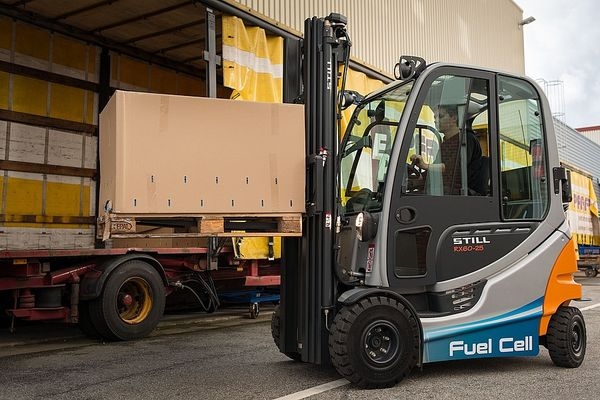
The use of fuel cells in propulsion systems is an environmentally friendly solution that also ensures high device efficiency. This technology is based primarily on oxidation, which converts the energy of the fuel’s chemical bonds into electrical energy. This is how some notebooks, phones, cars, and forklifts are powered today.
Minimizing carbon dioxide emissions, efficiency, and high energy quality are the main reasons why fuel cells may soon be used on a large scale. Hydrogen-powered devices will become a daily reality, but also the future of logistics, mainly due to new-generation forklifts.
Energy from hydrogen
The technology used in fuel cells was first presented in 1839 by British inventor William R. Grove. The device he constructed is based on the reversal of the electrolysis phenomenon. The synthesis of hydrogen with oxygen using a catalyst produces a constant electric current.
– A fuel cell uses the oxidation of fuel on electrodes connected by an electrical circuit in the presence of an ion conductor, which are formed during the reaction – explains Tobiasz Jakubczak, an expert from STILL. – The device is built from an anode, where fuel molecules are separated into cations and electrons. As a result of the reaction, the latter combine with the cations, producing direct current. To convert it into alternating current, an inverter is installed, as well as a system to level out power differences.
To trigger the reaction, hydrogen is most often used as fuel, while air can be the oxidant. The byproduct of the reaction is water, which makes this method exceptionally environmentally friendly. The advantage of this type of drive is the high quality of the energy produced, as well as the relatively simple mechanism of its generation. Fuel cells are small in size, can be mounted anywhere, and are easily expandable. The device itself regulates the amount of fuel and oxidant consumed, which makes its operation very economical. In this case, there is also no idling, and high or too low loads do not disrupt its operation. The operation of fuel cells also does not involve the generation of noise or vibrations.
Ecological initiatives
Fuel cells are increasingly used in everyday items, such as mobile phones or notebooks, but also in passenger cars and forklifts. This solution, being an alternative to traditional propulsion, allows for the complete reduction of carbon dioxide emissions into the atmosphere. Entrepreneurs and organizations are increasingly testing and implementing such solutions. One such example is the Initiative for Hydrogen and Fuel Cells in Hesse, established in Germany. Its goal is to increase the trust of local entrepreneurs in the new technology. As part of the project funded by the European HyLift initiative, local companies have the opportunity to rent an RX 60-25 forklift with fuel cells from STILL, as well as a mobile hydrogen refueling station. Entrepreneurs can test both devices for up to four weeks and see how this solution works in everyday reality.
– In 2003, we created the first prototypes of a hydrogen-powered forklift, and a year later they were already being tested in real conditions – says Tobiasz Jakubczak, an expert from STILL. – Currently, six of them work on a daily basis in companies in Belgium and Denmark. This drive is also used, among others, in luggage transport vehicles at the Hamburg airport and at the port in the HHLA Logistics company.
And in the future…
Currently, fuel cell technology is mainly being tested and verified, although commercial products have been available since the 1960s, when this solution was prepared for use during space programs. At this moment, the technology is quite expensive, which affects its popularity. However, it is predicted that it will develop rapidly over the next few years, which will contribute to cost reduction. Probably the most popular will be low-temperature cells with a membrane electrolyte. According to forecasts presented by the Częstochowa University of Technology, within the next 10 years, the costs of investment in polymer fuel cells are expected to be 150 times lower compared to the construction of a nuclear power plant, and also 150 times lower compared to a coal-fired power plant. In the case of forklifts, this technology will become increasingly popular first in plants where hydrogen is produced as a byproduct during production processes. The popularity of fuel cells will also be influenced by the ecological production of hydrogen, for example through solar technology. Taking into account the fact that fossil fuel resources are shrinking and regulations are aimed at reducing carbon dioxide emissions, they will be of great importance for the use of fuel cells.