








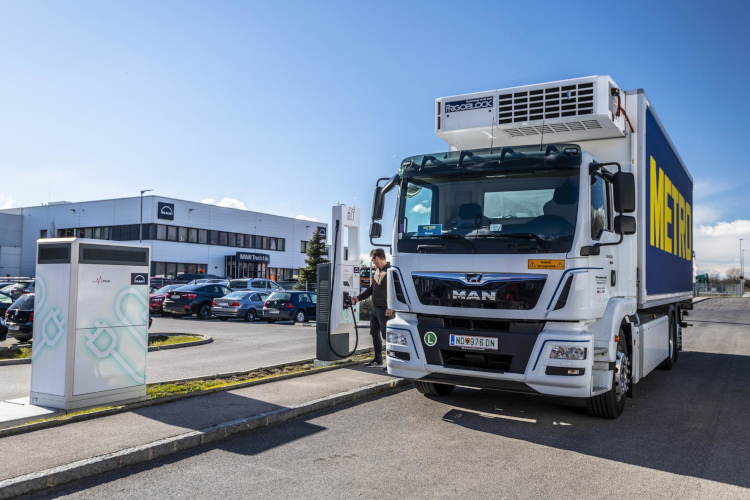
The EU is preparing to allow the sale of only zero-emission cars from 2035. This makes lawmakers dealing with internal combustion engine trucks ask themselves: Is it feasible to reach 100% sales of zero-emission trucks?
According to a new study conducted by the independent consultancy TNO, by 2035, virtually all new electric trucks – including long-haul ones – will be cheaper to operate than diesel trucks, even over the longest possible distances and with full loads. According to Transport & Environment (T&E), which commissioned the study in cooperation with Agora Verkehrswende, these findings dispel doubts about whether electric trucks can compete with diesel ones in terms of cost and performance.
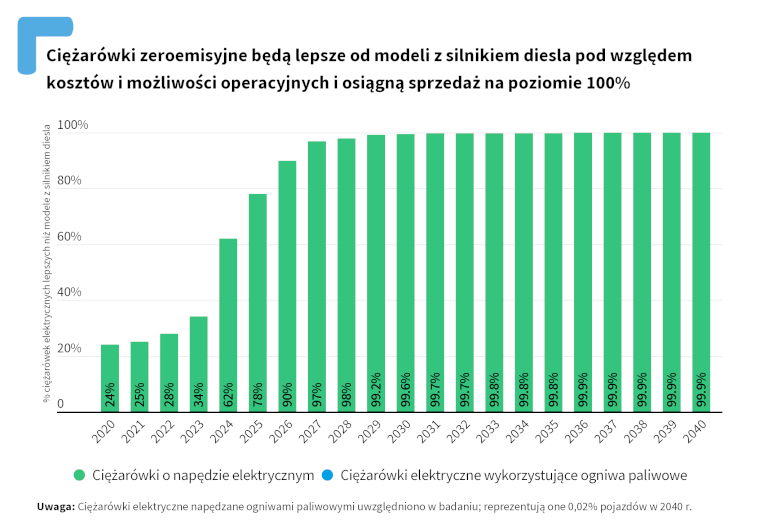
The study shows that by 2035, 99.8% of new electric trucks will be cheaper to operate than diesel trucks while transporting the same weight of goods, over a similar distance, and in the same travel time. Moreover, in most cases, the total cost of ownership of an electric truck will be more favorable compared to a diesel model even earlier. The remaining 0.2% of vehicles will easily make up for their shortcomings by making one additional charging stop beyond those required by regulations. But even with that extra stop, their purchase and operating costs will still be lower.
– They will be cheaper, more reliable, and have a longer range. The European Union can set a deadline for the total sale of zero-emission trucks for 2035, confident that electric vehicles will be better than diesel trucks in all these areas. This will reduce costs for carriers and make road freight transport more environmentally friendly, while enabling European truck manufacturers to maintain their position as a global leader – comments Rafał Bajczuk, senior specialist at the Foundation for the Promotion of Electric Vehicles.
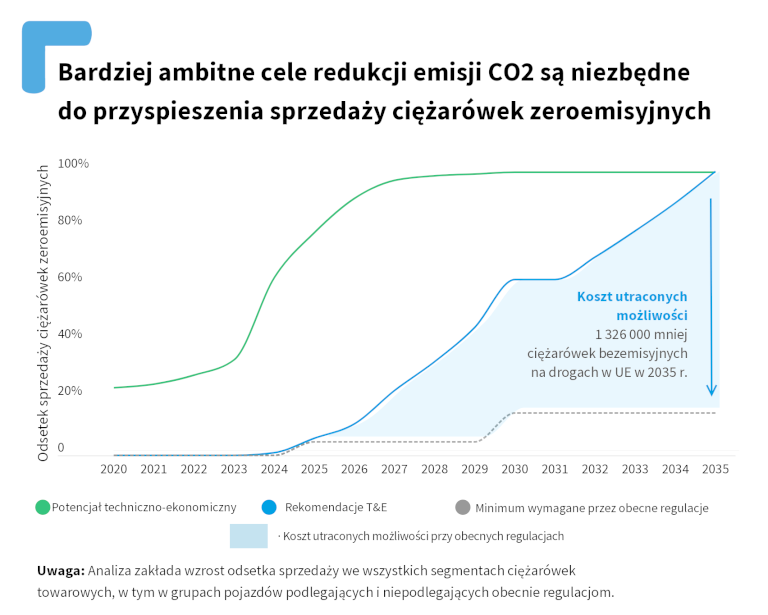
However, T&E points out that tightening the CO2 emission reduction target for truck manufacturers to -65% by 2030 is essential if zero-emission truck sales are to reach nearly 100% five years later. Leaving the EU climate targets for truck manufacturers at their current level would result in 1.3 million fewer zero-emission models on the roads in 2035. T&E adds that more ambitious EU standards early in the 2020-2030 decade would force manufacturers to meet their voluntary electrification commitments. Already today, most zero-emission trucks in the urban delivery segment are cheaper and more operationally competitive than diesel models, but low targets for truck manufacturers mean that the former are not being delivered to carriers.
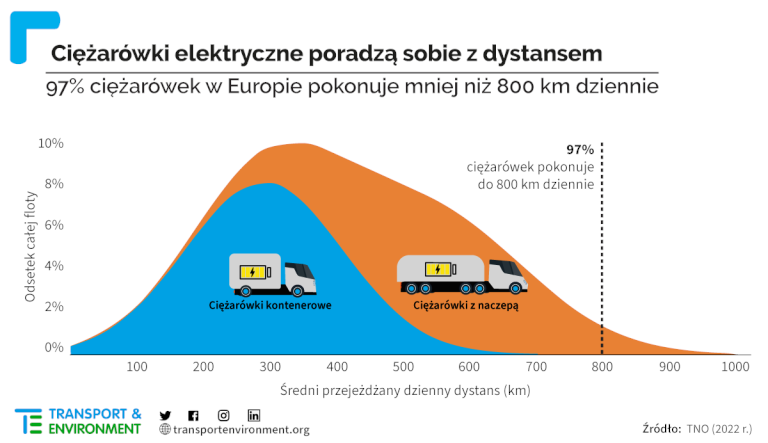
Studies also show that electric trucks will be able to cover the same distances as their diesel-based counterparts. Statistics reveal that almost all trucks in Europe travel less than 800 km per day – and such a distance is within the range of the latest electric batteries, provided they are properly charged during the driver’s legally required breaks. By 2030, even the largest electric long-haul trucks will be able to carry the same weight of cargo as diesel models, because under EU regulations, the weight of the battery is offset by the removal of the engine and an additional permitted 2 tons of weight for zero-emission vehicles.
– Progress towards climate neutrality in transport is not happening as fast as it should. It is all the more important to fully exploit the technical and economic potential of zero-emission road freight transport from the very beginning. In addition to ambitious CO2 emission standards for trucks, this also requires further implementation of other measures, such as purchase support schemes and road tolls based on CO2 emission levels – adds Wiebke Zimmer, Deputy Director of Agora Verkehrswende.
In the coming months, the European Commission will present a proposal to tighten climate targets for heavy-duty vehicles.