








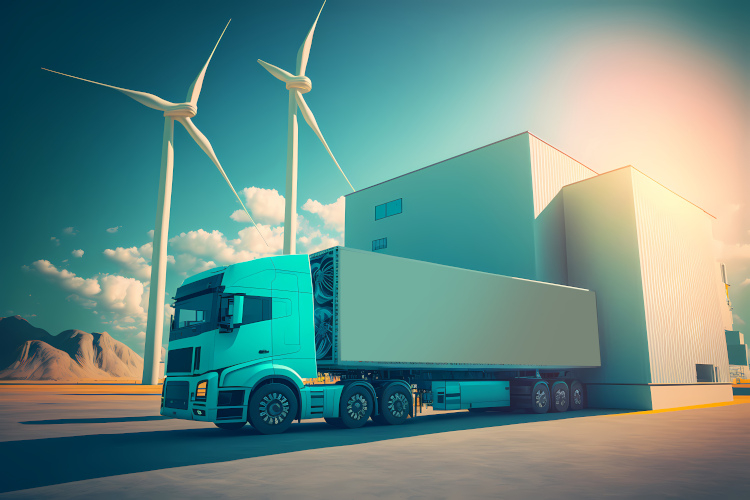
In the face of climate and social changes, companies are increasingly required to apply the principles of sustainable development, i.e., ESG (Environmental, Social and Corporate Governance). In the TSL industry, zero-emission transport is an integral part of the ESG strategy.
Sustainable and responsible development should become an indispensable element of corporate strategy. Due to the fight against climate change, the European Union is introducing new regulations and requirements. In January of this year, the new CSRD (Corporate Sustainability Reporting Directive) on sustainability reporting entered into force. It imposes an obligation on companies to submit annual reports.
- ESG covers areas related to environmental protection, social responsibility, and corporate governance;
- In January of this year, the new CSRD (Corporate Sustainability Reporting Directive) on sustainability reporting entered into force;
- The ESG strategy is a business opportunity, as the criteria for selecting subcontractors will increasingly be based on the company’s environmental responsibility as well
Transport and CO2 emissions
According to the European Environment Agency, approximately 25 percent of total CO2 emissions in the European Union come from the transport sector (2019 data), of which 71.7 percent comes from road transport. Transport is the only sector where greenhouse gas emissions have increased over the last three decades – by 33.5 percent between 1990 and 2019. The European Union emphasizes that there are two ways to reduce CO2 emissions from cars: increasing vehicle efficiency or changing the fuel used. Currently, diesel and gasoline are used in most road transport in Europe.
– Of course, organizations are taking various actions for ESG. A great example is the crossing of trucks via the Eurotunnel Le Shuttle Freight. It is one of the least emission-intensive modes of transport, especially now that the Eurotunnel has introduced electric trains with 100 percent low-emission electricity in both the UK and France – says Joanna Porath, President of the AC Porath customs agency.
Additionally, Eurotunnel has launched an online CO2 emissions calculator. It allows logistics companies to calculate the carbon dioxide emissions generated by trucks for a specific journey. Thanks to this, they have documented their commitment to climate protection.
– This means greater market competitiveness for them when applying for new contracts or renewing old ones, because the criteria for selecting subcontractors are also based on the company’s environmental responsibility – adds Joanna Porath.
Another significant example is the actions of the energy group Eni, which signed a two-year contract with the Italian company Spinelli for the supply of diesel fuel for trucks. The biofuel is produced 100 percent from renewable raw materials. These are waste raw materials, plant residues, and oils processed in Eni’s biorefineries in the Sicilian city of Gela and in Venice.
Implementing ESG is a necessity
From 2024, ESG reporting will apply to the largest enterprises and will be expanded in terms of entities each subsequent year. Directly obligated entities will report on sustainability issues across their entire supply and value chain.
– It is within the entire supply and value chain, and not just their own plant, company, or employees, that the company will have to identify ESG-related risks. Sustainable development principles will therefore apply to almost all companies, not just financial institutions or listed companies, because entities directly obligated to report on these issues will require relevant data from their contractors, clients, and portfolio companies for their own disclosures. Ignoring ESG factors may mean failing to obtain a loan, worse financing terms, or losing a contract – says Aleksandra Polak from the law firm B2RLaw Jankowski, Stroiński, Zięba i Partnerzy.
Many organizations are still unaware of how necessary it is to implement ESG principles. They often find out about it only during the tender process or while seeking debt or equity financing.
– Another difficulty is the fact that the carbon footprint is not regulated in detail in Polish law. Such a concept does not appear in either environmental protection law or building regulations – adds Aleksandra Polak from the law firm B2RLaw Jankowski, Stroiński, Zięba i Partnerzy.
From a business perspective, entrepreneurs must ensure ESG compliance if they do not want to close themselves off to broader financing opportunities. According to a PwC report, as many as 79 percent of investors believe that implementing ESG principles is a decisive factor in making investment decisions, and 49 percent of them would refrain from investing in a company that is underperforming in this area.
– The transport companies we work with are increasingly aware that if they plan development and expansion, they must think about sustainable development. Implementing ESG into a company’s strategy is a necessity – says Joanna Porath, President of the AC Porath customs agency.
Currently, the Greenhouse Gas Protocol (GHG Protocol) standards are most often used to calculate greenhouse gas emissions. The Greenhouse Gas Protocol was created as a result of the cooperation between the World Resources Institute and the World Business Council for Sustainable Development. The standard according to which organizations calculate their carbon footprint divides emissions into three scopes.
– Until now, entities reporting greenhouse gas emissions have primarily accounted for Scope 1 emissions, i.e., direct emissions from sources that are owned or controlled by the company, and Scope 2, i.e., indirect emissions resulting from the generation of purchased electricity consumed by the company. Scope 3, i.e., other indirect emissions, is not yet mandatory, but this is soon to change – explains Dorota Gajuk from the law firm B2RLaw.
Changes in Poland
Poland is a signatory to the Paris Agreement, according to which global net greenhouse gas emissions are to reach zero by 2050. Meanwhile, the European Union, as part of the European Green Deal, assumes a 55 percent reduction in greenhouse gas emissions by 2030 – this is the so-called Fit for 55 package.
How to achieve this? One of the most important solutions would be to replace combustion vehicles with vehicles powered by alternative fuels. However, current data is not optimistic, because according to the Polish Alternative Fuels Association, in 2021 there were only about 1,800 electric trucks on Polish roads. The EU wants goods to be transported across Europe using hydrogen or electric cars. To this end, Fit for 55 imposes an obligation on countries to increase the availability and interoperability of charging infrastructure for every type of transport.
– Rail transport will adapt to new EU standards faster and more easily, which, according to data from the European Environment Agency, generates about 9 times fewer greenhouse gases per tonne-kilometer compared to road transport. Hence the growing popularity of intermodal transport, i.e., using more than one mode of transport to carry cargo – explains Joanna Porath from AC Porath.
As part of the Fit for 55 package, the European Union also plans to establish a separate market for trading emission allowances (ETS). This means that owners of various means of transport will be forced to pay for the emissions they produce.
– The green transformation is becoming a fact and will force changes in the TSL industry. Therefore, necessary steps must be taken as soon as possible. ESG is often mistakenly associated only with reporting obligations, distracting from issues that are strategic for business. And it is ESG factors that are now becoming strategic for business and may decide on the loss of market position or its strengthening, at the expense of those entities that neglect ESG issues or treat them only as a burdensome regulatory obligation. ESG is not about mass-producing policies and procedures. If ESG factors are well integrated into the business model, they become an element of the company’s development strategy and help minimize internal and external risks, build lasting relationships with employees and suppliers, reduce costs, secure liquidity, increase valuation, and gain a competitive advantage – says Aleksandra Polak from the law firm B2RLaw.
Source: AC Porath