








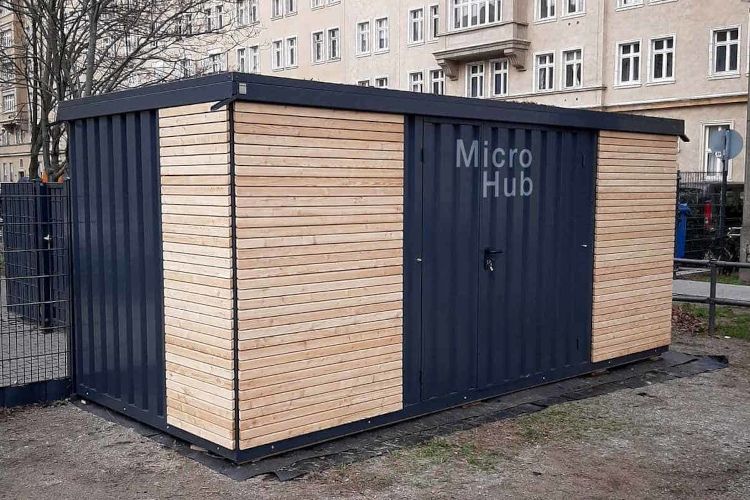
A groundbreaking project set to revolutionize last-mile transport in congested metropolises. Poznań is the first city in Poland to introduce a micro-transshipment hub. This initiative is being carried out by the Łukasiewicz – Poznań Institute of Technology and the City of Poznań, with support from GLS Poland, which will handle parcel operations from the micro-hub as part of the pilot program.
The idea behind micro-transshipment hubs is to create a transshipment point in the city center from which parcels would be delivered to recipients via courier bicycles. The first micro-hub in Poland will cover the center of Poznań, the area with the highest density of buildings and traffic.
– The goal of this project is very simple. We want to create an ecological and efficient solution that will reduce the number of delivery vans in the center of Poznań and increase the number of cargo bikes, without compromising the quality of parcel deliveries – says Marta Cudziło from the Łukasiewicz – Poznań Institute of Technology. – The creation of the micro-hub is possible thanks to the EU’s GRETA project, an essential element of which is the pilot implementation of innovative solutions supporting the path of European cities toward the use of efficient and ecological last-mile transport. In addition to Poznań, cities such as Reggio Emilia, Maribor, Verona, and Budapest are participating in the program – she adds.
How does a micro-transshipment hub work?
A micro-hub is a small parcel transshipment point located in the city center, where couriers arrive in delivery vans to unload parcels. The parcels are then transferred to courier bicycles and delivered to recipients in the city center. By definition, a micro-hub is small in size, comparable to a garage or a container. In the long term, it is also possible to expand its functionality to include a PUDO (Pick-Up Drop-Off) point, where people can personally send or collect parcels.
– Every action that supports zero-emission transport is close to our hearts. That is why participation in this project is a natural consequence of our ambitions to reduce CO2 emissions and achieve total zero-emissions by 2045. Pilots like this one in Poznań are gaining importance, especially now that the European Union is taking legislative steps to reduce CO2 by 55 percent by 2030 compared to 1990 levels – says Andrzej Wasielewski, Director of National Operations and Infrastructure at GLS. The company already has experience in transporting parcels by cargo bike in the capital of Greater Poland. For a year now, three courier bikes with the GLS logo have been operating in the Jeżyce district and the Old Town area, transporting parcels through the city’s most congested streets.
– Bicycle transport in Poznań is favored by a well-developed network of bike paths, as well as the mentality of residents who want to live ecologically and not generate noise or exhaust fumes – emphasizes Andrzej Wasielewski.
As part of the pilot, GLS will support the Łukasiewicz – Poznań Institute of Technology at the conceptual stage, as well as with the logistical handling of the entire project. It is the GLS courier cyclists who will deliver parcels picked up from the micro-hub across the center of Poznań using cargo bikes.
– Currently, together with the city and GLS, we will define the requirements for the hub and the bicycles, select a suitable location, proceed to implement the system in practice, and finally analyze all indicators to assess the effectiveness of this form of delivery – concludes Marta Cudziło.
The pilot of the first micro-transshipment hub in Poland will end in March 2026.
Source: Łukasiewicz – Poznań Institute of Technology