








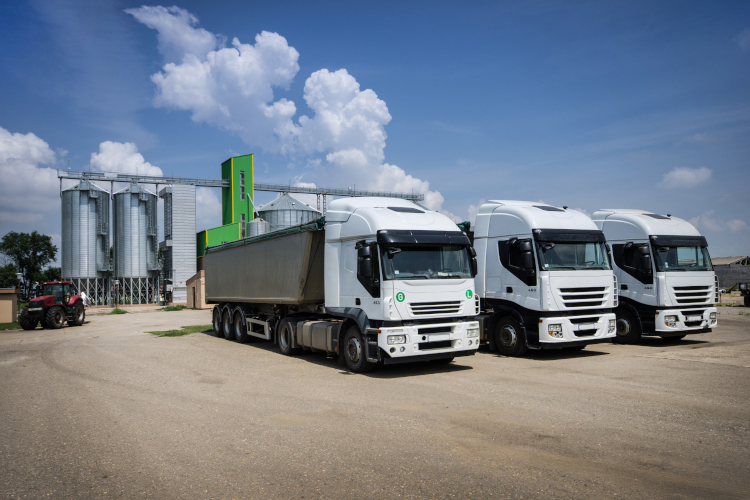
Warehouses must be emptied urgently and Ukrainian grain must be moved out of Poland – farmers appeal. According to estimates, as much as 9 million tons of grain have entered our country within a year. Most of it without control, including sanitary checks. Following farmers’ protests, the priority is to move the grain out of the country. Primarily through Baltic ports. However, it is already known that they are unable to handle such large needs in a short time. Their capacity is too small, and clearing them will take a long time. In this situation, transport companies will take on a large part of the task. There will be a lot of work, because warehouses are overflowing with grain that needs to be moved. There are also situations where Ukrainian grain goes to Germany, from where it is sent back because it does not meet standards. This generates additional traffic.
– Our conversations with transport companies show that their demand for cash is growing. It is needed to secure additional tractors and trailers for future orders. Also for contracting drivers, who are in short supply, so they do not want to wait for payment until the end of the order. Faster cash flow and current funds allow the TSL industry to prepare for an increased number of orders in the near future. Warehouses full of grain that needs to be moved can be an impulse for the development of the industry – says Wojciech Miklaszewski from Finea, a micro-factoring company serving the TSL sector.
The transport industry tries to be ready when it is needed
According to government announcements, intensifying the export of agricultural produce is now the main task, and moving Ukrainian grain out of Poland is currently the most important problem.
- Between 4 and 9 million tons of grain from Ukraine have entered Poland by train and truck. The ports are clogged, so it must now be moved out in the same way.
- Transport companies can not only profit from this but also help solve an important social problem.
- The TSL industry is also growing along with the increase in warehouse space, which was at a record high at the end of 2022 – 28.3 million sqm.
- However, the problem is the extension of payment terms for transport services. Especially by tenants from the e-commerce sector.
For the second time in 2023, the transport industry is becoming very important from a social point of view. The first time was in the autumn, when fears of a coal shortage caused a general mobilization to distribute it throughout the country. At that time, the ports were also clogged, and rail traffic was insufficient. Transport companies came to the rescue, and as a result, there was no shortage of coal anywhere. In the context of such events, the industry is gaining strategic importance. Polish companies have a strong position in the European Union – they are responsible for nearly 20% of road transport work in the EU.
Record warehouse space that needs to be serviced
Another impulse for development is the expansion of warehouse facilities. In 2022, developers completed 4.4 million sqm of warehouse space. This is the most in history. This means that 42% more such properties were built in 2022 (according to Axi Immo). Warehouse space in Poland at the end of 2022 amounted to as much as 28.3 million sqm. Demand is constantly growing, because according to Savills data, only 4% of the space is currently unleased. This is good news for the transport industry, which services warehouse parks. However, this does not happen without difficulties. Over the last few years, a large group of tenants has been the e-commerce industry. These were both large international companies and medium and small online stores.
– Large e-commerce players are tough negotiators for long payment terms for transport services. That is why TSL companies are regular clients of factoring. The online retail industry is largely made up of stable entities and solid payers, so there are no obstacles to financing invoices issued to such contractors. In practice, it looks like this: a transport company carries out an order for a large e-commerce company. It issues an invoice, but the partner expects the payment term to be two months. The carrier, whether they like it or not, agrees to such conditions. They bring such an invoice to us. After the application is accepted, they receive the money within 24 hours – says Wojciech Miklaszewski from Finea – a factor specializing in financing transport companies.
– Thanks to this, the entrepreneur immediately obtains funds for operational activities, payment of their liabilities, e.g., to ZUS or the Tax Office, and uses the cash for wages or the purchase of fuel for future orders. They can respond faster and more flexibly to unfavorable phenomena in the economy, and their company is more competitive.
The industry needs money, but has to wait the longest for it
The TSL industry is experiencing a swing of moods because strong factors stimulating business and those holding it back are acting on it simultaneously. According to faktura.pl data, the waiting time for a transfer in the TSL industry was the longest in the entire economy in 2022 and averaged almost 21 days. On average, so in many cases it was 30, or even 60 days.
– This year it is similar – an order completed in April may be paid for in the summer. Of course, fuel reserves made when it is cheaper would increase the comfort of operation and improve competitiveness, but few companies have their own funds to make such reserves. It is quite the opposite – delayed transfers are a threat to current liquidity – continues Miklaszewski.
According to Finea data, in the case of the transport industry, 45% of invoices have a payment term of a month or longer. However, it is no secret that most freight forwarders calculate the payment term not based on the date from the invoice, but from the date of receipt of the complete set of documents by the company. Thus, 7-14 days added by the freight forwarder should be added to the average waiting time. Therefore, an invoice with a payment term of 45 days is in reality about 60 days of delay. Carriers are trying to put pressure on freight forwarders to make payments faster. However, freight forwarders, especially small and medium-sized ones, have no interest in this. Their ability to agree to this is limited.
Freight forwarding companies are aware of the problems with long waiting times for payment
Freight forwarding companies are aware of the brake applied in the form of long payment terms. That is why they are increasingly offering discounts to their carriers, i.e., the possibility of earlier payment of funds from the invoice.
– Long payment terms in the transport industry are the norm. Recent years have not helped to shorten them, but on the contrary – they have encouraged discussions about extending them. Freight forwarding companies, despite everything, realize that the condition and endurance of a carrier have their limits, which is why they are increasingly coming to us for the service of financing subcontractors, i.e., drivers. This is the so-called discount. It is a win-win situation: the carrier can receive money from the invoice immediately, the forwarder can extend the payment term. And all this without involving their own capital, which today is even more valuable than a few years ago – says Wojciech Miklaszewski from Finea.