








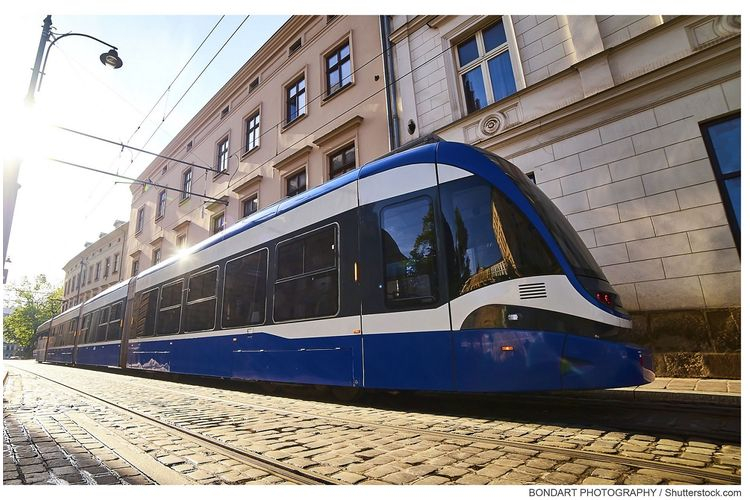
Public transport in Krakow is struggling with many problems. To improve it, the city is planning an investment in fast, collision-free rail transport. In June this year, the results of a feasibility study were presented, in which the company ILF Consulting Engineers Polska analyzed a total of over 30 route variants and 21 investment variants. A pre-metro fast tram was recommended as the optimal solution.
Krakow’s public transport
Krakow holds the position of a regional leader in modern business services, which is associated with many investments that are changing the urban fabric. Krakow’s transport needs will grow systematically over the years due to population migration and further growth in the number of residents. These factors argue for the creation of a modern and efficient transport system.
– Currently, public transport in Krakow consists of a bus and tram network, additionally supported by rail transport and private carriers. The tram network is struggling with several significant problems. The challenge is, among other things, insufficient density in the north of the city, limited capacity of the First Ring Road, or the growing number of derailed vehicles – points out Michał Bogucki, project manager, ILF Consulting Engineers Polska.
A problem with rail transport in Krakow is also the average operating speed of Krakow’s trams. In 2017, it was 14.2 km/h, while in 2003 it was 15 km/h. This applies not only to these vehicles – the average operating speed of buses was noticeably higher back in 2006 (18 km/h), while in 2017 it almost equaled the average speed of trams (15.2 km/h). The highest averages are achieved by the Krakow Fast Tram – about 20.5 km/h (this value should be above 24 km/h) – according to data provided in one of the issues of the journal “Scientific Works of the Warsaw University of Technology. Transport”.
– An important barrier to increasing the average operating speeds of trams are sections of the route in the city center area. On streets where the track is not separated from the roadway, travel time increases and delays occur. The cause is mainly tracks blocked by, among other things, illegally parked cars – points out Michał Bogucki. – Collision-free travel on the central section can bring a significant improvement in tram travel time. Our work on the “Feasibility study for the construction of fast, collision-free rail transport in Krakow” began back in 2018 – he adds.
Why pre-metro?
As part of the “Feasibility study for the construction of fast, collision-free rail transport in Krakow”, 7 route paths were developed. Each of the variants was analyzed in terms of 6-7 implementation options. Numerous simulations and analyses of the proposed possibilities were carried out in terms of social, demographic, and planned investments. The 7 best route variants were analyzed in detail in terms of 3 possible means of transport – this means that as many as 21 investment variants were studied. Each of them was verified against a number of criteria, including the projected number of passengers, average travel time, conservation conditions, transfer hubs, city-forming potential, or the approximate cost of transporting one passenger. On this basis, the 3 most convenient solutions were selected. A total of over 300 km of possible variants were verified.
In the next step, a detailed concept of 3 variants was developed – technical solutions were refined, including the location of stops, stations, and the route of the line. The power supply method for each variant, the implementation technology, and the rolling stock appropriate for the projected passenger flows were also analyzed. The work was carried out in close cooperation with specialists in the field of monument protection, experts from the Krakow University of Technology and the AGH University of Science and Technology, and the City Hall. This was the most difficult stage due to the concern for the centuries-old tradition and historical heritage of the City of Krakow, which required numerous consultations and arrangements. Within this stage alone, as many as 8 revisions of the entire design documentation were prepared. Over 1100 pages of technical analyses and over 280 design drawings regarding land development (i.e., exits, underground corridors, and stations) and 3D models were created.
Subsequently, a cost estimate, environmental analysis (assessment of the investment’s impact on the environment), institutional analysis (i.e., which entity should implement such an investment in the future), and a schedule of tenders and construction implementation were prepared. The cost analysis took into account both the investment costs associated with building a given variant and the operating costs associated with its maintenance. It was also verified whether the city would be able to bear the current expenses associated with the operation of a given variant.
– Preparing such a huge project that changes the face of the urban fabric is a great responsibility. At the end of the work – in the second quarter of 2021 – we recommended the best solution in terms of efficiency, financial profitability, safety, risk, and social and environmental factors – explains Michał Bogucki. – The optimal choice turned out to be the pre-metro fast tram variant – i.e., tram rolling stock using tunnels on the most critical sections. This variant met all the most important assumptions (e.g., collision-free passage of critical sections and higher travel speed), and at the same time is more cost-effective and possible to finance within the assumptions of the city’s financial plan – he adds.
The analyzed pre-metro shuttle variant did not find investment justification. An attractive form was the metro variant – a fast and collision-free solution, however, it did not fit into the current assumptions of the city’s financial plan.
Source: ILF Consulting Engineers Polska
Read also about urban transport:
– Solaris buses in another Spanish city
– Cargo bikes in urban logistics. Ephemera or the future?
– The first city in Poland with a hydrogen bus
– Mobility Hubs – a new era of urban mobility